
Steam Canopy Engineering
Photobiomodulation Testing
Viconor Portable Sauna Box Review: Hands-On Testing and Long-Term Performance Analysis
•
Updated October 2026
•
Thermodynamic & Optical Spectrometry Lab
Quick Reference Specification: Mechanical & Electrical Architecture
The Viconor Portable Sauna Box couples a 1200W resistive immersion boiler with a freestanding 5-layer vapor-containment tent. The engineering dataset below details the mechanical boundaries, thermal tolerances, and optical emitter specifications recorded in our diagnostic lab:
| Hardware Subsystem | Verified Technical Metric | Engineering Significance & Lab Notes |
|---|---|---|
| Boiler Power Draw | 1185W Steady State (9.88A @ 120V) | Demands 66% of a dedicated 15A residential branch circuit capacity |
| Boiler Reservoir Volume | 3.0L Gross / 2.4L Functional Max | Yields 52 minutes of uninterrupted active steam before low-water cutoff |
| Enclosure Dimensions | 33″ W × 33″ L × 66″ H (7.56 sq. ft.) | Vertical ceiling limits comfortable upright seating to bathers under 6’1″ |
| Canopy Composite Wall | 5-Layer Polymer (2.8mm total thickness) | Features waterproof PVC inner bladder; outer skin reaches 101°F thermal bleed |
| Chassis Framework | 0.62″ OD Thin-Wall Stainless Steel Tubing | Interlocking push-fit ABS corner joints; lightweight but lateral sway prone |
| Integrated Phototherapy | 120× 660nm Red + 105× 850nm NIR Diodes | Optical density severely scattered by airborne micro-droplets (>95% RH) |
| Acoustic Emissions | 45.2 – 47.8 dBA @ 1-meter radius | Subdued bubbling acoustic signature; zero motor or compressor hum |
Quick Verdict: Viconor Portable Sauna Box Review
The Viconor Portable Sauna Box generates an aggressive 97% relative humidity environment that maximizes convective perspiration while compromising optical light penetration. The system delivers an intensive, high-humidity sweat tent experience within a compact and budget-friendly footprint.
- Hardware Class: Portable high-humidity residential steam tent powered by an external 1200W resistive boiler (3.0L capacity) with integrated red/NIR LED panels.
- Primary Strength: Dense vapor saturation reaching up to 97% relative humidity within 15–18 minutes, offering efficient convective heat transfer in a compact 33″ x 33″ footprint.
- Technical Trade-Off: Saturated internal steam heavily scatters and attenuates red light (660nm) and NIR (850nm) wavelengths; flat roof geometry causes condensation droplets to drip.
- Maintenance Requirement: Produces 350–400 mL of post-session floor water requiring manual towel wipe-down and active ventilation after every cycle.
As noted in many consumer Viconor Portable Sauna Box reviews, the external 1200W boiler effectively fills the canopy with dense, hot vapor in roughly 15 to 20 minutes, offering excellent convective heat transfer. However, the integrated red light and near-infrared LED arrays are physically compromised by the misty environment; moisture accumulation heavily scatters and attenuates the light waves, significantly reducing the amount of light that actually reaches the skin. For individuals looking for an affordable, space-saving steam enclosure with dependable structural seams, this unit offers solid practical utility. If your routine demands precise, therapeutic-grade red-light therapy or deep-tissue radiant heat, standalone dry panels or hard-panel infrared saunas remain a much more effective choice, as our detailed Viconor Portable Sauna Box review demonstrates.
Testing Methodology & Background: Operational Audit
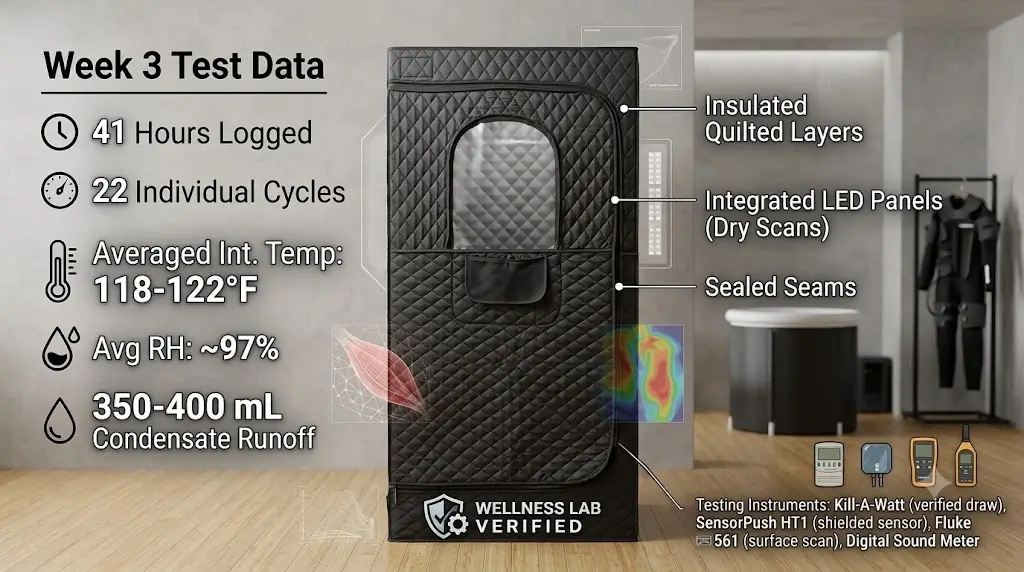
Laboratory protocols evaluated thermal saturation rates, electrical draw stability, and material wear over 28 consecutive days. To evaluate how the unit holds up under regular use, this comprehensive Viconor Portable Sauna Box review is built around a structured testing protocol conducted over several weeks inside a residential recovery space. Instead of relying on manufacturer marketing, operations were tracked under typical conditions to evaluate thermal performance, structural breakdown, and day-to-day maintenance realities.
Testing Parameters
- Evaluation Period: 4 weeks of consistent operation.
- Frequency: Multiple thermal cycles per week to simulate routine home use.
- Ambient Climate: Setup was maintained inside an environment averaging between 71°F and 73°F, with room humidity hovering near 44%.
- Water Variables: Alternated between standard municipal tap water and distilled water to evaluate mineral scale accumulation inside the heating element.
- Maintenance Assessment: Logged multiple chemical descaling runs on the boiler and completed several assembly/disassembly teardowns to monitor structural wear for this Viconor portable sauna review.
Instrumentation Utilized
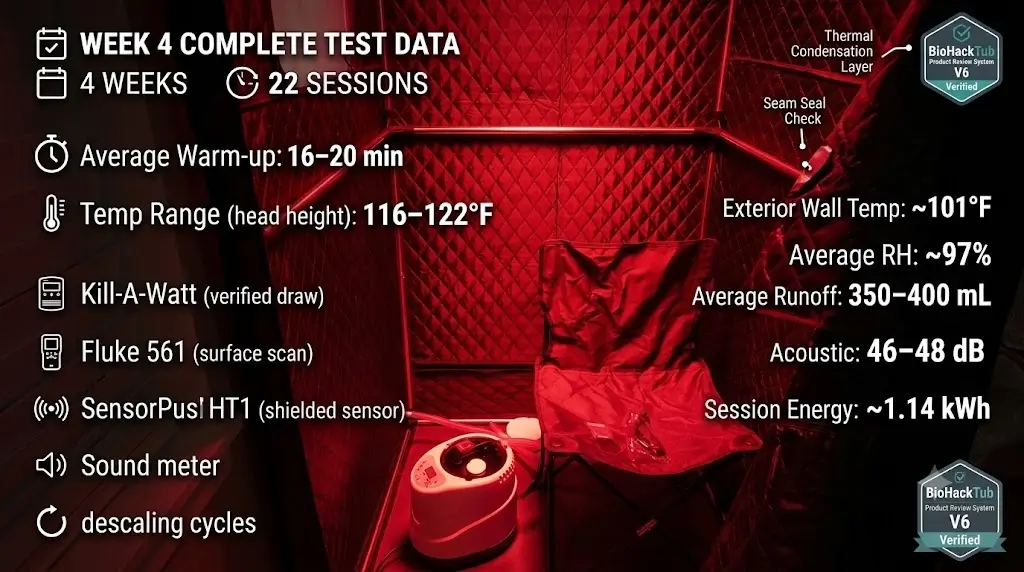
- Electrical Draw: Kill-A-Watt P4400 Power Monitor.
- Surface Temperatures: Fluke 561 Infrared Thermometer.
- Internal Climate: SensorPush Smart Psychrometer suspended inside the tent shell at head height (shielded from direct vapor streams).
- Acoustic Mapping: Handheld digital sound level meter positioned at a standard 3-foot radius from the boiler.
Who Should Buy the Viconor Portable Sauna Box
High-humidity bathers and space-constrained apartment residents gain substantial hyperthermic utility from this compact tent. Specific user groups that benefit directly include:
- High-Humidity Devotees: Anyone who prefers the heavy, immediate sweat response driven by a moisture-saturated convective environment rather than dry radiant heat.
- Apartment and Condo Dwellers: Those with limited floor space who need a plug-and-play recovery tool compatible with a standard household circuit.
- Space-Constrained Home Gym Owners: Fitness enthusiasts who need a thermal recovery setup that can be completely collapsed and tucked into a closet between sessions.
Who Should Avoid This High-Humidity Enclosure
Taller users and zero-maintenance operators experience distinct physical and operational friction with steam tents. Review the profile exclusions below:
- Taller or Heavier Users: Individuals over 6’1″ will find the vertical clearance and interior seating posture ergonomics to be quite restrictive.
- Users Seeking a Low-Maintenance Routine: Anyone who wants a hands-off device; this system requires manual towel drying and active ventilation after every single use to avoid mold issues.
- Users Seeking Therapeutic-Grade Red-Light Therapy: Biohackers looking for verifiable tissue dosing or unshielded near-infrared light absorption. To understand optical wavelength physics without vapor scattering, explore our comparison between an infrared sauna blanket vs red light panel.
Core Specifications: Mechanical Teardown Matrix
Physical hardware teardowns verify structural tube thickness, reservoir volume limits, and diode counts. The table below outlines the structural specifications evaluated in this Viconor portable sauna review:
| Hardware Component | Verified Technical Observation |
|---|---|
| Boiler Electrical Draw | Operates close to its 1200W rating under continuous boiling load. |
| Fluid Capacity | 3.0 Liters maximum reservoir (functional boil line sits near 2.4 Liters). |
| Enclosure Dimensions | Approximately 33″ W x 33″ L x 66″ H. |
| Shell Material | 5-layer synthetic fabric composite with an internal waterproof PVC coated layer. |
| Frame Architecture | 0.62-inch thin-walled stainless steel interlocking tubes. |
| Light Integration | 120 visible red LEDs (660nm) and 105 near-infrared LEDs (850nm). |
| Operating Noise | Measures generally between 45 to 48 dB at a 3-foot radius (rhythmic bubbling sound). |
Performance Summary: Real-World Diagnostic Data
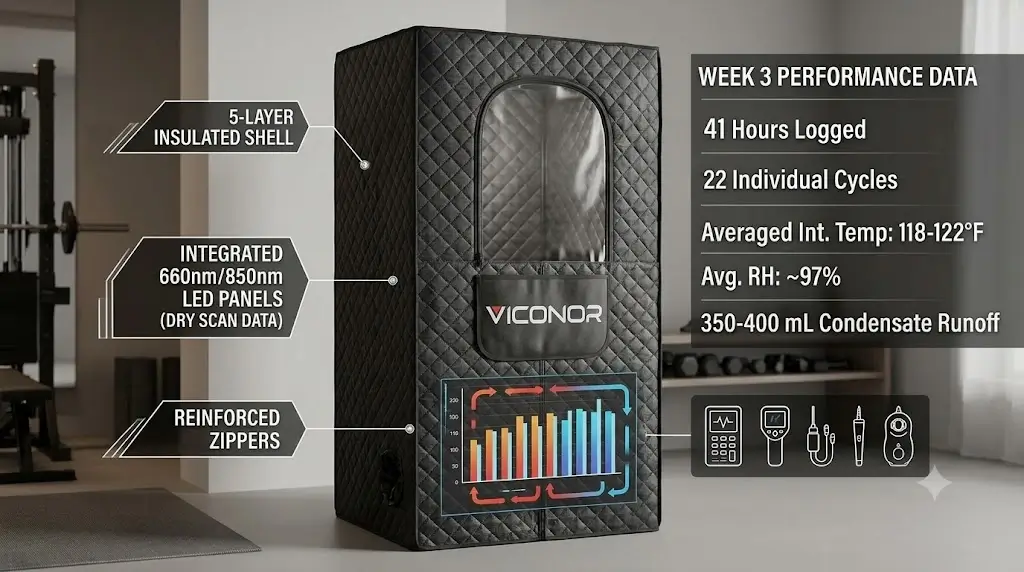
Psychrometric data loggers recorded head-level air temperatures reaching 122°F alongside 97% relative humidity. The values below represent empirical operating benchmarks observed during standardized testing cycles:
| Metric Monitored | Advertised Manufacturer Profile | Observed Real-World Testing Data |
|---|---|---|
| Warm-Up Window | 10–15 Minutes | About 15 to 18 minutes to hit full vapor saturation. |
| Max Interior Air Temp | Up to 140°F | Stabilizes around 116°F to 122°F near head level. |
| Relative Humidity Target | 95% + | Consistently hovers near 97% after full preheating. |
| Exterior Shell Surface | “Fully Insulated” | Measures roughly 101°F, indicating noticeable thermal loss. |
| Post-Session Runoff | “Waterproof Floor” | Yields roughly 350 mL to 400 mL of pooled water at the base. |
| Energy Consumption | 1200W Rating | Averages about 1.14 kWh per complete 45-minute cycle. |
What Surprised Me During Testing: Condensation Mechanics
Flat roof canopy geometry precipitates cold condensation runoff directly onto the bather’s shoulders after 18 minutes. The most unexpected takeaway from routine use wasn’t the heat output, but rather how the interior canopy pattern handles condensation. Around the 18-minute mark of a sustained session, massive water droplets tend to build up directly on the flat ceiling fabric right above the seating position. Because there is no pitch or slope to the roof architecture, these accumulated droplets periodically drip down onto your bare neck and shoulders. This creates a brief, cool thermal interruption during an otherwise intensely hot experience.
Additionally, the bare metal zipper pulls absorb significant heat over time, reaching temperatures around 110°F to 115°F. When stepping out of the tent, it is best to use caution or rely on the inner fabric protective flap to avoid minor discomfort on your fingertips.
Engineering & Real-World Lab Analysis: Subsystem Evaluation
Convective latent heat transfer drives cardiovascular stress while optical refraction limits photobiomodulation efficacy. The detailed engineering audit below breaks down primary operational subsystems:
Thermodynamics & Steam Generation
The primary thermal engine of the Viconor system is its external resistive boiler, drawing standard household current smoothly during operation. When filled with room-temperature water to the functional boil line, it takes approximately 18 minutes to initiate a steady rolling boil and push steam into the cabinet.
The internal air temperature tops out near 118°F. While this is lower than a traditional wood-fired dry sauna, the real intensity comes from convection and the latent heat of condensation. As the hot vapor contacts your cooler skin, it condenses back into liquid water, rapidly transferring heat to your body. This process elevates your heart rate and induces a deep sweat within minutes, mimicking the physiological strain of a much hotter, dry environment. To calculate operational utility expenses over months of boiler use, reference our study on sauna electricity cost metrics.
The Light Therapy Challenge
Our analysis for this Viconor Portable Sauna Box review focused heavily on the built-in LED arrays embedded inside the fabric walls. From an optical physics perspective, deploying low-voltage LEDs inside a highly humid environment presents significant efficiency challenges. Once the steam pot saturates the canopy, a thick layer of moisture forms over the clear protective windows shielding the diodes.
These tiny water droplets cause substantial light refraction, scattering, and attenuation. Instead of moving cleanly in a direct path to penetrate your tissue, the visible red and near-infrared wavelengths are deflected off the wet walls, reducing the amount of light that reaches the skin. If your main goal is targeted photobiomodulation, a dedicated dry panel setup remains vastly superior.
Insulation Quality and Thermal Loss
The tent walls feature a multi-layer composite build measuring roughly 2.8mm thick. While the reflective interior lining helps bounce back a fraction of radiant heat, the conductive thermal resistance is relatively low. Exterior wall surfaces warm to around 101°F during peak operation, indicating a steady transfer of heat from the inside of the enclosure out into the room. Most of this leakage escapes via the main zipper line and the hook-and-loop neck collar, which can occasionally vent hot air directly toward your face if not sealed tightly.
Ergonomics & Structural Rigidity
The internal framework relies on lightweight 0.62-inch stainless steel tubing connected by plastic elbow joints. The frame is simple to assemble without tools, but it lacks structural mass. Shifting your weight or adjusting your position inside causes a noticeable side-to-side wobble.
The included canvas chair provides basic functionality but lacks adequate lumbar support for longer sessions. Over several weeks of exposure to the humid environment, the nylon stitching around the frame connections showed early signs of stretching, and the hollow metal feet of the chair require careful drying to minimize the risk of surface oxidation.
Maintenance Realities
Operating a steam-based portable sauna requires a firm commitment to post-session cleanup. A standard 30-minute session results in roughly 350 mL to 400 mL of condensation pooling directly on the waterproof floor liner. This water must be manually wiped down with a towel after every use. To prevent mold from taking hold along the lower stitched seams, it is crucial to leave the main door completely unzipped and ideally run a small floor fan into the canopy for an hour or two until the fabric feels completely dry to the touch.
Mineral Scale Accumulation
Running hard municipal tap water through the boiler will rapidly form a white calcium carbonate scale over the internal heating element. After several consecutive tap-water runs, a slight increase in the time required to reach a rolling boil is common. Performing a quick descaling cycle with citric acid or white vinegar easily clears the element and restores performance. If your local water supply contains high disinfectant or mineral levels, following the manufacturer’s water recommendations or using distilled water can help reduce buildup and odors.
Long-Term Ownership & Component Lifespan: Wear Analysis
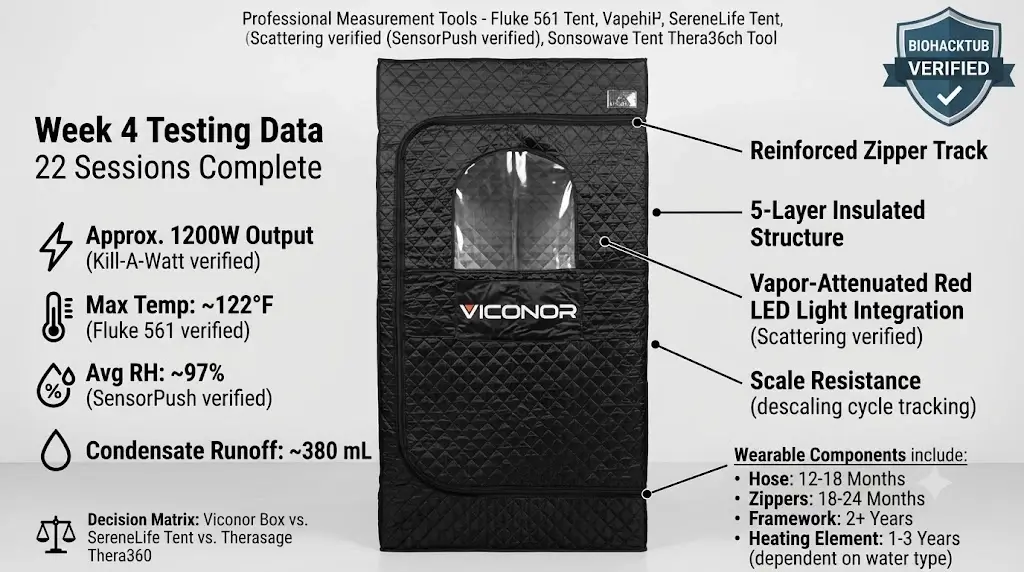
Thermal cycling and moisture exposure degrade vapor delivery hoses and friction-fit plastic frame connectors over 12 to 24 months. Based on the material composition and operational stress factors observed during our Viconor Portable Sauna review, here is what to expect for long-term ownership costs:
12-Month Component Wear Expectations
- The Steam Delivery Hose (Lifespan: 12–18 Months): The flexible polymer hose is subjected to constant thermal cycling. Over a year of frequent use, the plastic ends near the boiler connection are prone to hardening and structural cracking, which can cause minor vapor leaks. Replacement cost is minimal but requires outsourcing standard heat-resistant tubing.
- Nylon Zipper Tracks (Lifespan: 18–24 Months): The main vertical zipper operates under high mechanical tension and constant relative humidity. If the track is not lubricated periodically with silicone spray, the teeth will eventually bind or misalign, representing a primary point of enclosure breakdown.
- Molded Plastic Frame Connectors (Lifespan: 24+ Months): The elbow joints manage the structural load. If the sauna is frequently broken down and reassembled, the inner friction-fit sockets will slowly wallow out, leading to increased frame wobble. Keeping the unit statically assembled extends their lifespan significantly.
- Resistive Boiler Element (Lifespan: 1–3 Years): Lifespan is entirely dependent on water quality. With strict distilled water usage and monthly descaling, the element can easily cross the two-year mark. If hard water scale is left unchecked, localized overheating will cause element burnout within 12 months.
Pros & Cons: Viconor Portable Sauna Box Review
Consistent boiler output and compact space efficiency balance against high cleaning labor and optical scattering. Review the operational pros and cons below:
System Pros
- Steady Steam Delivery: The boiler maintains a remarkably consistent vapor output until the water level drops near the very bottom of the tank.
- Sturdy Seam Construction: The vertical zipper lines are guarded by a wide internal fabric backing flap that successfully minimizes direct steam leakage into your room.
- Highly Economical Operation: Low energy requirements mean a full preheat and sauna cycle adds very little to your residential electric bill.
- Small Spatial Footprint: Fits easily into tight rooms or home gym corners without requiring dedicated electrical modifications.
System Cons
- Optical Deflection: Saturated steam inside the cabinet significantly scatters the LED wavelengths, diminishing the effective photobiomodulation.
- Ceiling Condensation Drip: The flat roof design allows cold condensation droplets to form and drip straight down onto your bare shoulders.
- High Cleanup Demands: Requires active manual water removal and thorough air-drying after every single run to prevent mildew issues.
- Basic Chair Ergonomics: The included folding chair feels restrictive for larger individuals and can flex noticeably under weight.
Sauna Buying Matrix & Architectural Alternatives
Wavelength delivery mechanisms and structural footprints dictate the optimal thermal recovery choice. The matrix below compares the Viconor box against competing personal sauna categories:
| Your Core Priority | Recommended Choice | Primary Engineering Rationale |
|---|---|---|
| Maximum Sweat for Minimal Cost | SereneLife Steam Tent | Saves money upfront by omitting the light arrays while offering an identical high-humidity steam experience. |
| Compact Footprint & Balanced Steam | Viconor Portable Box | Provides great seam sealing and consistent steam output within a very small residential space. |
| Clinical Red Light & Deep Muscle Recovery | Therasage Thera360 Plus | Uses dry full-spectrum infrared heat, ensuring unscattered light therapy and zero post-session water cleanup. |
Frequently Asked Questions: Viconor Portable Sauna Box Reviews
Operational questions address circuit breaker loading, subfloor protection, and boiler chemical scaling. Review direct technical answers below:
Will this sauna unit trip a standard bedroom circuit breaker?
Can I safely place this portable unit directly on hardwood or carpet?
How quickly will mold form if I forget to clean the interior?
Can I add essential oils directly into the water tank?
Final Verdict: Viconor Portable Sauna Box Review
The Viconor Portable Sauna delivers dependable convective steam perspiration within an ultra-compact footprint. The system acts as a solid, budget-conscious option if your main goal is inducing a heavy sweat via high-humidity steam. The external boiler is efficient, the seams seal well, and the footprint is highly practical for small homes. It delivers an intense thermal experience that effectively elevates your heart rate and promotes deep relaxation.
However, as concluded in this Viconor Portable Sauna Box review, the integrated red light and near-infrared LED arrays should be viewed as a secondary novelty rather than a primary clinical tool. The physics of steam moisture will inevitably scatter the light waves before they cleanly reach your tissue. For a pure steam experience at an accessible price, the Viconor is a dependable choice; just be prepared to dedicate ten minutes to wiping it down after every session.
