
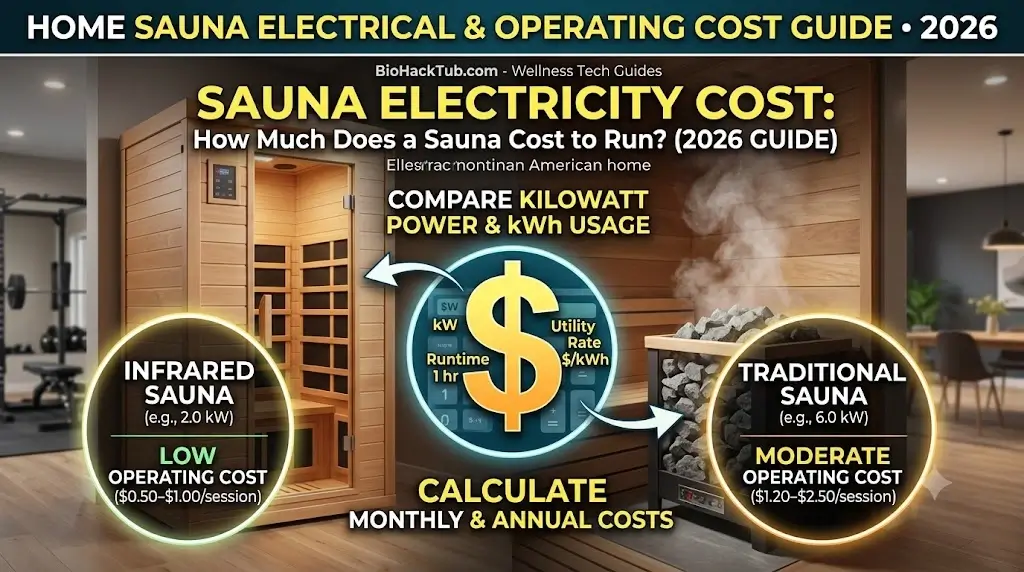
Sauna Electricity Cost: How Much Does a Sauna Cost to Run?
A home sauna does use meaningful electricity, but the actual operating cost is easier to estimate than many buyers expect. The key variables are the sauna’s heater power in kilowatts (kW), how long the heater operates, and the electricity rate charged by your utility.
For a simple estimate, a 6 kW electric sauna heater running at full rated output for one hour would consume about 6 kWh. At an electricity price of $0.20 per kWh, that represents approximately $1.20 of electricity for that hour. Real sessions can cost less because the heater does not necessarily draw its maximum rated power continuously once the sauna reaches temperature.
For many U.S. home sauna setups, a practical electricity-cost range is roughly $0.50–$2.00 per session, depending heavily on heater size, warm-up time, session length, insulation, outdoor temperature, and local electricity prices.
A small infrared sauna may use substantially less power than a traditional electric sauna with a multi-kilowatt heater. Large traditional saunas can cost more per session because their heaters commonly operate in the several-kilowatt range.
How Much Does It Cost to Run a Sauna?
The easiest way to calculate sauna electricity cost is:
Electricity Cost = Power (kW) × Runtime (hours) × Electricity Rate ($/kWh)
For example, suppose a sauna heater is rated at 6 kW, operates for 60 minutes, and your electricity rate is $0.20/kWh.
6 kW × 1 hour × $0.20 = $1.20
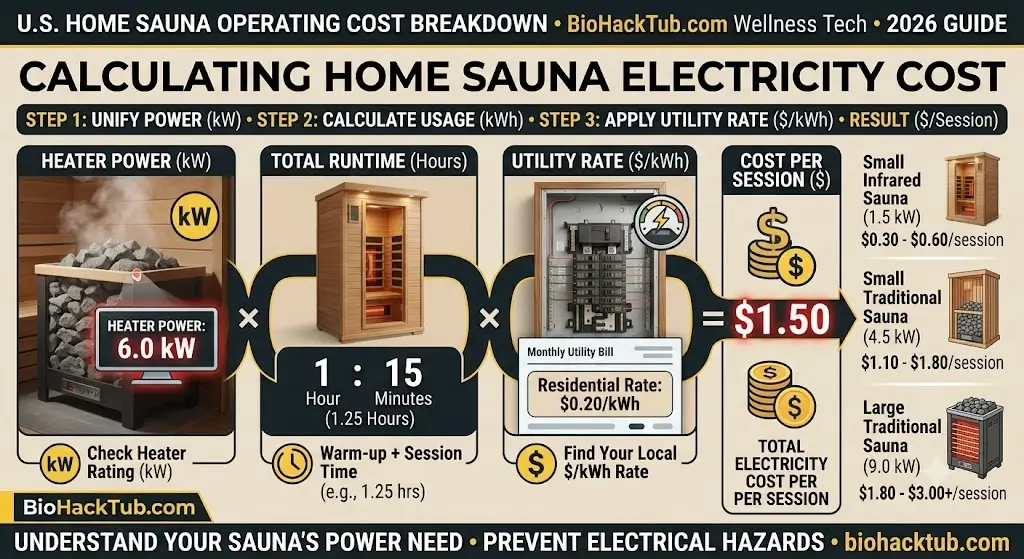
That is a full-load estimate. It should not automatically be interpreted as the exact amount appearing on your utility bill because sauna heaters cycle on and off as the thermostat regulates temperature.
Sauna Electricity Cost Calculator
Use the following examples as a planning tool. Replace the electricity rate with the rate shown on your utility bill for a more accurate estimate.
| Heater Power | Runtime | Rate | Maximum Energy Used | Estimated Cost |
|---|---|---|---|---|
| 3 kW | 1 hour | $0.15/kWh | 3 kWh | $0.45 |
| 4.5 kW | 1 hour | $0.15/kWh | 4.5 kWh | $0.68 |
| 6 kW | 1 hour | $0.15/kWh | 6 kWh | $0.90 |
| 6 kW | 1 hour | $0.20/kWh | 6 kWh | $1.20 |
| 8 kW | 1 hour | $0.20/kWh | 8 kWh | $1.60 |
| 9 kW | 1 hour | $0.20/kWh | 9 kWh | $1.80 |
These are maximum full-load calculations, not measurements of every sauna model.
Infrared Sauna vs. Traditional Sauna Electricity Cost
One of the most important distinctions when estimating operating cost is whether you are comparing an infrared sauna with a traditional electric sauna heater.
| Factor | Infrared Sauna | Traditional Electric Sauna |
|---|---|---|
| Typical electrical load | Often lower | Usually higher |
| Heating method | Infrared emitters heat occupants and surfaces directly | Heater warms air and sauna stones |
| Typical operating temperature | Lower | Much higher |
| Warm-up behavior | Often relatively quick | Usually requires heating the room and stones |
| Electrical infrastructure | Depends on model | Higher-power models commonly require dedicated high-voltage circuits |
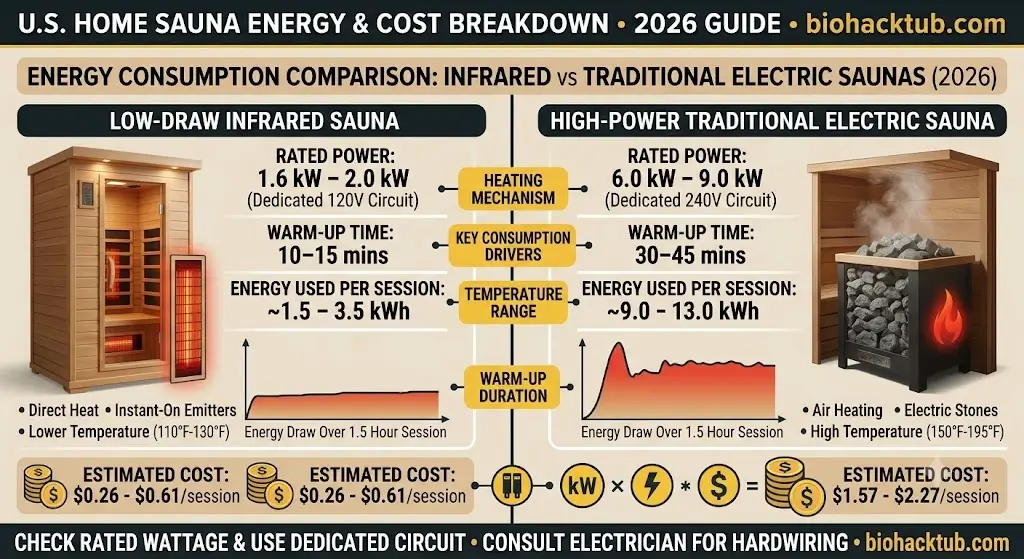
This does not mean every infrared sauna is inexpensive to operate or that every traditional sauna is expensive. The actual electricity bill depends on the rated power, runtime and utility rate.
For traditional electric heaters, manufacturer specifications are particularly important. For example, Harvia lists a 6 kW KIP heater for sauna rooms of approximately 170–300 cubic feet and specifies 240 V electrical operation for its U.S. model.
How Much Does a 6 kW Sauna Cost to Run?
A 6 kW heater is a useful reference point because several residential traditional sauna heaters fall around this power level.
| Electricity Rate | 1 Hour at 6 kW | 30 Sessions/Month |
|---|---|---|
| $0.10/kWh | $0.60 | $18.00 |
| $0.15/kWh | $0.90 | $27.00 |
| $0.20/kWh | $1.20 | $36.00 |
| $0.25/kWh | $1.50 | $45.00 |
| $0.30/kWh | $1.80 | $54.00 |
The monthly figures assume one hour of full-load operation per session and 30 sessions. Actual consumption may be lower because the heater cycles rather than drawing maximum power continuously.
How Much Electricity Does a Sauna Use Per Month?
The monthly calculation depends primarily on frequency of use.
For example, consider a 6 kW heater, a $0.20/kWh electricity rate, and three one-hour sessions per week.
6 kW × 3 hours/week × 4.33 weeks × $0.20 ≈ $15.59/month
At five sessions per week:
6 kW × 5 hours/week × 4.33 weeks × $0.20 ≈ $25.98/month
These figures represent full-load assumptions. Actual utility consumption may be lower depending on thermostat cycling and heat retention.
Does Sauna Warm-Up Time Increase Electricity Cost?
Yes. Warm-up time is one of the variables that can make a real-world electricity estimate differ from a simple “session length × heater rating” calculation.
If you spend 30 minutes inside the sauna but allow a traditional heater to operate for another 30–45 minutes before entering, the heater’s total operating time is longer than the time you actually spend bathing.
That is why a useful cost estimate should include:
- Preheating time
- Time spent using the sauna
- Post-session heater operation, if any
- Thermostat cycling
- Outdoor temperature
- Sauna insulation
- Sauna volume
- Door opening frequency
Why Rated kW Does Not Equal Real-World Electricity Consumption
A heater’s rated power describes its electrical capacity under specified operating conditions. It does not mean the heater will consume that amount continuously for every minute of operation.
Once the sauna approaches the thermostat setting, the heating elements can cycle. During those periods, energy consumption can be lower than the theoretical full-load number.
This is one reason why comparing sauna models solely by advertised wattage can be misleading.
What Makes a Sauna More Expensive to Run?
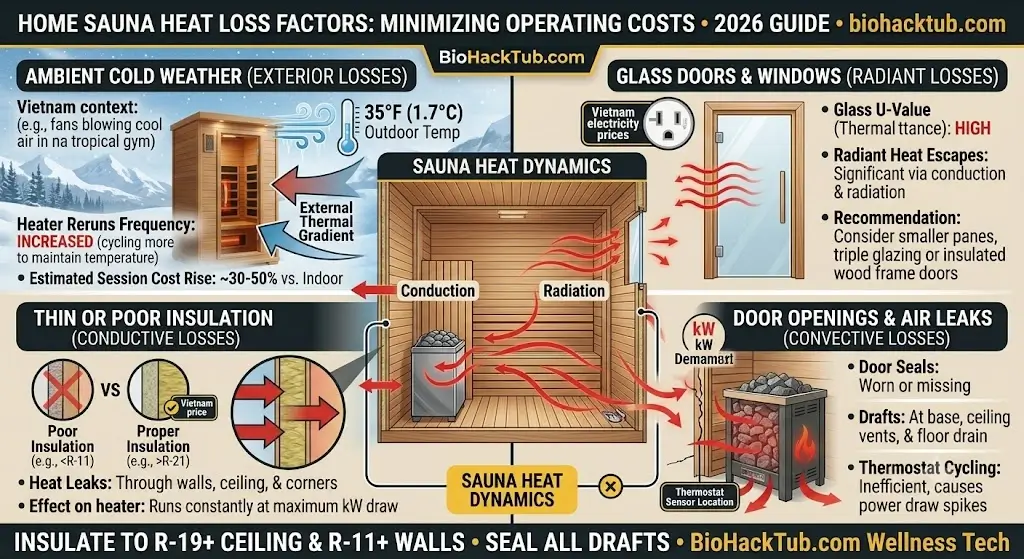
Several environmental and structural factors dictate total power draw:
1. Larger Heater
A larger heater generally has a greater maximum electrical load. However, heater sizing should follow the sauna manufacturer’s recommended room volume rather than simply choosing the lowest-power heater available.
2. Poor Insulation
A poorly insulated sauna loses heat faster. That can increase heater runtime because the system has to replace heat escaping through walls, ceiling, glass and doors.
3. Outdoor Installation
Outdoor saunas are exposed to ambient temperature, wind and seasonal weather. A sauna operated during a cold winter evening can require more heating energy than the same sauna operated indoors under similar settings.
4. Large Glass Areas
Glass can contribute to greater heat loss compared with well-insulated wall assemblies. Large windows or glass doors can therefore affect warm-up time and energy consumption.
5. Frequent Door Opening
Opening the sauna door allows heated air to escape. Repeated door opening can increase the workload required to restore the target temperature.
6. Higher Temperature Settings
A higher target temperature generally requires more heating energy, although the exact effect depends on the sauna’s construction and environmental conditions.
Does an Outdoor Sauna Cost More to Run?
It can, particularly in cold climates.
The heater has to overcome heat losses caused by the difference between the sauna’s internal temperature and outdoor air temperature. Wind exposure and insulation quality also matter.
This does not mean outdoor saunas are inherently inefficient. A well-insulated outdoor sauna with an appropriately sized heater can perform efficiently for its intended use.
The important comparison is not simply “indoor vs. outdoor.” It is heat loss versus heater output and operating time.
How Much Does Electricity Cost in the U.S.?
Electricity prices vary considerably between U.S. states, utilities and rate plans. Some households also pay different rates depending on time of day.
For an accurate sauna-cost calculation, use the actual $/kWh rate on your electric bill rather than a generic national estimate.
The U.S. residential electrical system commonly uses 120 V and 60 Hz service, while larger sauna heaters may use 240 V circuits. The voltage itself does not determine the final energy cost; the relevant quantity for the bill is energy consumed in kilowatt-hours.
Can a Sauna Increase Your Peak Electricity Demand?
Potentially.
A high-power electric sauna heater can create a substantial electrical load while operating. This matters more in homes with limited electrical service or other large appliances running simultaneously.
For example, a 6 kW heater is a much larger electrical load than a small household appliance. Harvia’s U.S. 6 kW KIP specification lists 240 V operation and a minimum 25 A fuse configuration for the cited model.
Estimated Sauna Operating Cost by Sauna Type
| Sauna Type | Relative Electrical Load | Cost Consideration |
|---|---|---|
| Small Infrared Sauna | Low to moderate | Often lower maximum power than traditional sauna heaters |
| 2-Person Infrared Sauna | Moderate | Depends on number and rating of infrared emitters |
| Small Traditional Electric Sauna | Moderate to high | Multi-kilowatt heater plus warm-up period |
| Large Traditional Sauna | High | Larger heater and greater room volume |
| Outdoor Traditional Sauna | High | Weather and insulation can increase heat demand |
How Much Does a Sauna Cost to Run Per Year?
Annual cost can be estimated with:
Annual Cost = kW × hours per session × sessions per week × 52 × electricity rate
Example:
6 kW × 1 hour × 3 sessions/week × 52 × $0.20 = $187.20/year
Again, this assumes full rated output for the entire operating period. Real consumption can be lower when thermostat cycling reduces the average power draw.
How to Reduce Sauna Electricity Costs
Choose the Correct Sauna Size
Do not automatically choose an oversized heater. Match the heater to the sauna room volume and the manufacturer’s specifications.
Improve Insulation
Good insulation reduces heat loss and can shorten the time required to maintain the target temperature.
Minimize Unnecessary Door Opening
Every time the door opens, heated air escapes. Keeping the door closed during normal operation helps retain heat.
Use a Timer or Manufacturer-Approved Controls
Automatic controls can reduce unnecessary runtime when supported by the sauna system.
Use the Sauna on the Appropriate Utility Rate
If your utility offers time-of-use pricing, operating large electrical loads during lower-cost periods may reduce the effective cost per session. Check your own electricity plan because rate structures differ.
Sauna Electricity Cost vs. Other Home Wellness Equipment
The useful question is not simply whether a sauna consumes electricity. Almost every powered recovery or wellness device has an operating cost.
| Equipment | Main Energy Driver | Cost Variable |
|---|---|---|
| Infrared Sauna | Infrared emitters | Emitter wattage × runtime |
| Traditional Electric Sauna | Heater | Heater kW × runtime |
| Cold Plunge With Chiller | Compressor + circulation system | Electrical draw × operating time |
| Portable Steam Sauna | Steam generator | Generator wattage × runtime |
For a complete home recovery setup, operating cost should therefore be evaluated alongside purchase price, installation, maintenance and expected service life.
What to Check Before Buying a Sauna for Energy Cost
- Rated heater power: Look for the actual kW rating.
- Voltage: Confirm whether the model requires 120 V or 240 V service.
- Required circuit: Follow the manufacturer’s stated electrical requirements.
- Sauna volume: Verify that the heater is appropriately sized for the room.
- Insulation: Better thermal retention can reduce unnecessary heater runtime.
- Glass area: Large glass surfaces can affect heat loss.
- Control system: Look for accurate temperature control and appropriate timers.
- Installation cost: Include electrical work when calculating total ownership cost.
Buying a Sauna on Amazon: What Matters for Electricity Cost?
If you are comparing sauna products sold through Amazon, do not select a model simply because its listing advertises a lower wattage.
A lower-power heater is not automatically better if it is undersized for the sauna enclosure. Conversely, a larger heater can be unnecessary for a small, well-insulated room.
When evaluating an Amazon listing, record these specifications before comparing models:
- Rated wattage or kW
- Voltage
- Recommended room size
- Sauna dimensions
- Heater type
- Control method
- Electrical requirements
- Warranty
- Replacement heater availability
- Installation requirements
This gives you a much better basis for estimating ownership cost than headline marketing claims.
Common Sauna Electricity-Cost Mistakes
Mistake #1: Confusing kW With kWh
kW is power. kWh is energy consumed over time. A 6 kW heater running for one hour at full load uses 6 kWh.
Mistake #2: Assuming Maximum Draw Happens Continuously
Thermostat cycling means the heater may not operate at maximum output for the entire session.
Mistake #3: Ignoring Warm-Up
If you preheat the sauna for 45 minutes before a 30-minute session, your heater has operated for substantially longer than the session itself.
Mistake #4: Ignoring Local Electricity Rates
A sauna that costs $1 per session in one location can cost substantially more where electricity rates are higher.
Mistake #5: Ignoring Installation Cost
For higher-powered traditional sauna heaters, electrical installation can be a significant part of the initial project cost.
Sauna Electricity Cost FAQ
How much does it cost to run a sauna for one hour?
It depends on heater power and your electricity rate. A 6 kW heater running at full output for one hour uses 6 kWh. At $0.20/kWh, the theoretical cost is $1.20.
Does an infrared sauna use less electricity?
Often, yes, because many residential infrared units have lower electrical power requirements than traditional multi-kilowatt sauna heaters. However, compare actual wattage, runtime and room design rather than assuming every infrared sauna is cheaper.
How much does a 6 kW sauna cost per month?
At one hour per session, 30 sessions per month and $0.20/kWh, the full-load calculation is approximately $36 per month. Actual consumption can be lower if the heater cycles.
How much does a sauna cost to run per year?
For a 6 kW heater used one hour three times per week at $0.20/kWh, the full-load estimate is about $187 per year.
Does an outdoor sauna use more electricity?
It can. Cold outdoor temperatures, wind and poor insulation increase heat loss and may increase warm-up and heating time.
Does sauna electricity cost depend on temperature?
Yes. A higher target temperature generally requires more heating energy because the sauna must reach and maintain a larger temperature difference from its surroundings.
Is a 240V sauna more expensive to run than a 120V sauna?
Not simply because it uses 240 V. Energy cost is determined primarily by power consumption in kW and runtime, not voltage alone.
Does a larger sauna always cost more to operate?
Not necessarily, but larger rooms generally require more heating capacity and can have greater heat losses. Insulation, construction, outdoor temperature and heater sizing all matter.
Can I calculate my sauna electricity cost from the Amazon listing?
Usually, you can create a useful estimate if the listing provides wattage and operating voltage. For a more realistic calculation, you also need expected runtime and your electricity price per kWh.
Should I install a sauna heater myself?
High-power sauna heaters can require dedicated electrical circuits and must comply with the manufacturer’s specifications and applicable electrical codes. Installation should be handled or verified by a qualified electrician rather than improvised from a standard household outlet.
The Bottom Line: Is a Sauna Expensive to Run?
For most homeowners, the electricity cost of sauna use is more manageable when calculated per session rather than judged from the heater’s headline wattage.
The basic calculation is straightforward:
Cost = kW × Hours × $/kWh
A 6 kW heater at $0.20/kWh has a theoretical full-load cost of $1.20 per hour. Use the same formula with your actual heater rating and utility rate to estimate your own cost.
The largest variables are heater size, preheating time, thermostat cycling, insulation, outdoor temperature, sauna volume and electricity price.
If you are deciding between an infrared sauna and a traditional electric sauna, electricity cost should be only one part of the decision. Compare purchase price, electrical requirements, room size, heating behavior, maintenance and how you actually intend to use the sauna.
Technical References
Electrical specifications should always be verified against the current manufacturer’s documentation for the exact sauna heater model. Harvia’s U.S. specifications, for example, provide room-volume recommendations, power output, voltage, fuse and cable requirements for individual heaters.
The U.S. Department of Energy explains that U.S. residential electrical service commonly uses 110–120 V at 60 Hz, while electrical equipment can have different voltage requirements.
