
Photobiomodulation vs Hyperthermia
Clinical Biohacking
Far-Infrared Sauna Blanket vs. High-Output Targeted Red Light Therapy Panel
•
Medical & Biophysics Review: Dr. Alex Mercer, CSCS
•
Updated October 2026
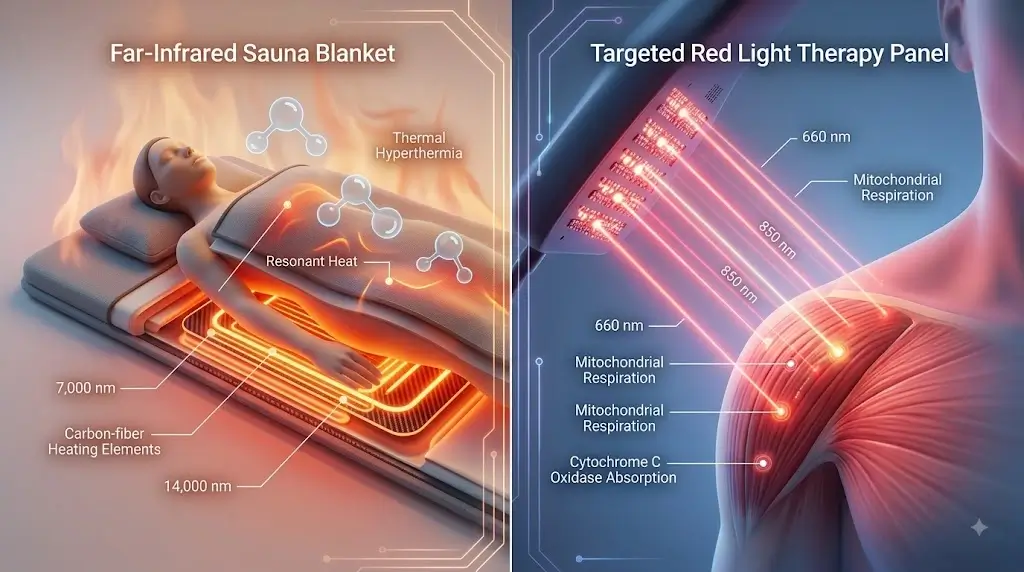
A far-infrared sauna blanket and a high-output red light therapy panel deliver light-spectrum energy via fundamentally distinct physical and biological pathways. Sauna blankets function primarily as thermal-stress devices designed to induce systemic hyperthermia and cardiovascular thermoregulation, whereas red light panels operate via non-thermal photobiomodulation (PBM), targeting mitochondrial respiratory chromophores without elevating core body temperature.
Quick Reference Specification: Far-Infrared Blanket vs. Red Light Panel
Optical physics separates radiant far-infrared wavelengths from narrow-band photon flux across biological target structures. The quantitative reference matrix below presents the foundational physical measurements, energy delivery modes, and cellular mechanisms characterizing both modalities:
| Technical Parameter | Far-Infrared Sauna Blanket | Targeted Red Light Panel (RLT/NIR) | Biophysical Mechanism |
|---|---|---|---|
| Spectral Bandwidth | 7,000 – 14,000 nm (Far-Infrared) | 660 nm (Red) & 810–850 nm (Near-Infrared) | Water cluster molecular resonance vs chromophore absorption |
| Primary Energy Mechanism | Radiant Thermal Energy (Heat Stress) | Non-Thermal Optical Photons (PBM) | Hyperthermic vascular pump vs photochemical respiratory excitation |
| Primary Target Receptor | Intracellular Water & Cutaneous Vasculature | Cytochrome c Oxidase (Mitochondrial Complex IV) | Systemic core heat load vs local ATP synthesis upregulation |
| Core Body Temp Impact | Elevates +1.0°F to +2.5°F (Hyperthermia) | 0.0°F (Athermal Operation) | Cardiovascular Zone 2 mimicry vs athermal cellular signaling |
| Dosimetry & Measurement | Temperature (°F/°C) & Time (Minutes) | Irradiance (mW/cm²) & Fluence (J/cm²) | Thermal accumulation vs biphasic optical Arndt-Schulz curve |
| Key Biomarkers Activated | HSP70, eNOS, Plasma Aldosterone | ATP, Reactive Oxygen Species (ROS), Nitric Oxide (NO) | Heat shock protein refolding vs mitochondrial respiration support |
Core Mechanistic Differences
Photobiomodulation arrays excite mitochondrial cytochrome enzymes whereas far-infrared wraps elevate core temperatures to dilate vascular beds.
Red Light Therapy (660 nm & 850 nm)
- Mechanism: Non-Thermal Photobiomodulation (PBM)
- Primary Target: Mitochondrial Chromophores (Cytochrome c Oxidase)
- Key Effect: Modulation of Cellular Respiration & ATP Support
- Systemic Impact: Localized Tissue Response & Cytokine Regulation
Far-Infrared Sauna (7,000–14,000 nm)
- Mechanism: Systemic Hyperthermic Stress
- Primary Target: Cutaneous Tissue & Peripheral Vasculature
- Key Effect: Vasodilation & Heat Shock Protein Expression
- Systemic Impact: Thermoregulatory Sweating & Increased Cardiac Workload
1. Far-Infrared Sauna Blanket: Thermal Conditioning & Vascular Response
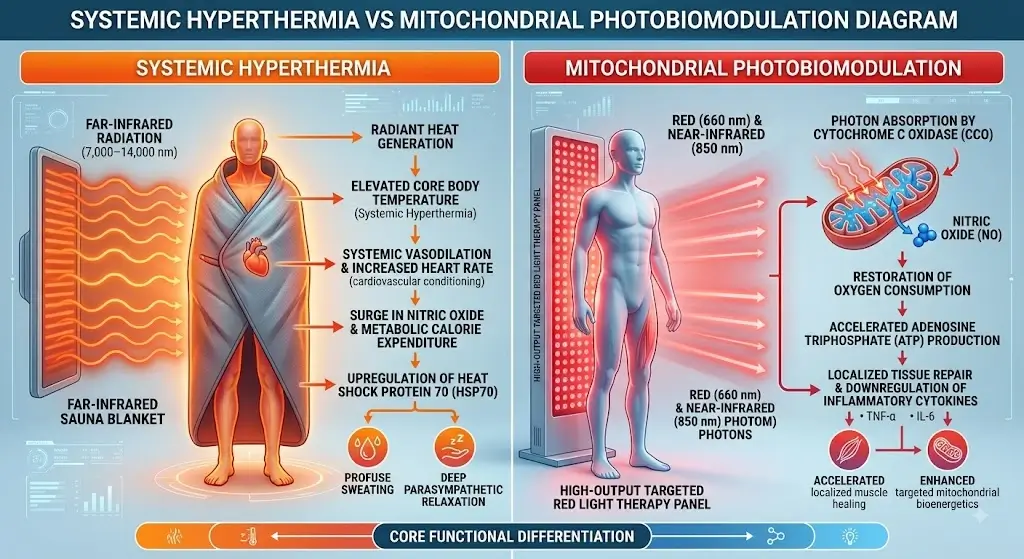
Far-Infrared (FIR) sauna blankets utilize wavelengths between 7,000 and 14,000 nanometers (nm). FIR optical energy is absorbed by superficial dermal tissue, converting into thermal energy. This continuous radiant heat elevates cutaneous and core body temperatures, triggering a systemic thermoregulatory cascade. Consumers evaluating the best infrared sauna blanket focus on low electromagnetic field (EMF) output, accurate thermal controls, and non-gassing material construction. To verify low electrical field radiation on personal recovery devices, explore our sauna EMF measurement guide.
- Physiological Cascade: The elevation of core temperature triggers systemic vasodilation, elevated heart rate, and increased cardiac stroke volume to dissipate heat. This thermoregulatory load upregulates cellular defense pathways, including Heat Shock Protein 70 (HSP70), which acts as a chaperone for protein folding.
- Primary Physiological Outcomes: Thermoregulatory sweating, increased peripheral circulation, and a subsequent autonomic shift toward parasympathetic dominance upon cooling. (Note: Primary systemic metabolic excretion remains regulated by the hepatic and renal systems, rather than sweat dissipation). If you are analyzing how thermal sweating impacts body weight and fluid distribution, review our guide on the best infrared sauna blankets for weight loss & detox.
2. Targeted Red Light Panel: Non-Thermal Photobiomodulation
Targeted Red Light Therapy (RLT) panels operate within the optical therapeutic window, utilizing 660 nm (Red) for dermal penetration and 810–850 nm (Near-Infrared / NIR) for deeper tissue penetration. High-output LED arrays deliver optical photons without inducing systemic heating.
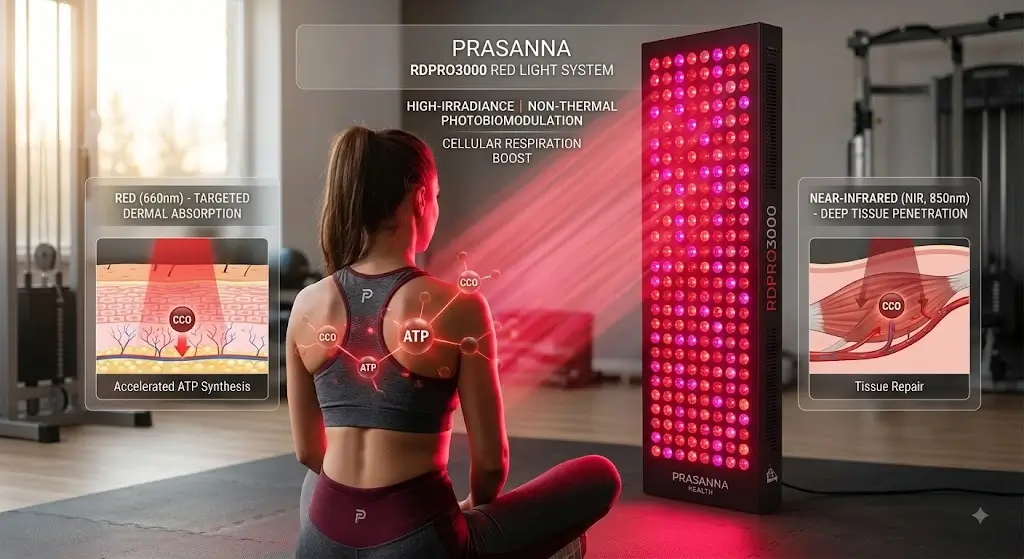
- Physiological Cascade: Photons interact with primary photoacceptors—most notably Cytochrome c Oxidase (CCO) within the mitochondrial respiratory chain. This photo-stimulation alters local nitric oxide signaling, supporting cellular oxygen consumption and local Adenosine Triphosphate (ATP) bioenergetics.
- Primary Physiological Outcomes: Targeted cellular recovery, localized anti-inflammatory signaling modulation, support for tissue repair, and mitigation of exercise-induced delayed-onset muscle soreness (DOMS).
Technical & Functional Comparison
Measurement metrics contrast radiant thermal temperatures in degrees against optical irradiance quantified in milliwatts per square centimeter. Below is our direct technical parameter breakdown:
| Specification / Parameter | Far-Infrared Sauna Blanket | Red Light Therapy Panel |
|---|---|---|
| Primary Wavelength Spectrum | 7,000 – 14,000 nm (Far-Infrared) | 660 nm (Red) & 810–850 nm (Near-Infrared) |
| Primary Energy Delivery | Radiant Thermal Energy | Non-Thermal Optical Photons |
| Primary Biological Target | Cutaneous Vasculature & Core Temperature | Mitochondrial Electron Transport Chain |
| Systemic Heat Load | High (Induces hyperthermia & sweating) | Negligible (Non-thermal PBM) |
| Exposure Metric | Temperature (°F/°C) & Time (Minutes) | Irradiance (mW/cm²) & Fluence (J/cm²) |
| Primary Application | Whole-body heat stress & relaxation | Targeted tissue repair & cellular support |
Selecting the Appropriate Modality
Individual athletic objectives determine whether recovery protocols demand whole-body hyperthermic strain or targeted mitochondrial photon delivery. Selecting between these technologies depends on the desired physiological outcome:
- Consider an Infrared Sauna Blanket when: The objective is whole-body thermal exposure, passive cardiovascular thermoregulation, sweat induction, or evening parasympathetic relaxation. For an evening wind-down routine designed to accelerate sleep latency, check our evidence-based protocol for using an infrared sauna blanket for sleep.
- Consider a Targeted Red Light Therapy Panel when: The objective is localized tissue recovery, non-thermal cellular stimulation, targeted joint/muscle management, or mitochondrial support without heat strain.
Synergistic Usage Considerations
When incorporating both modalities within a broader recovery routine, timing should align with physiological demands:
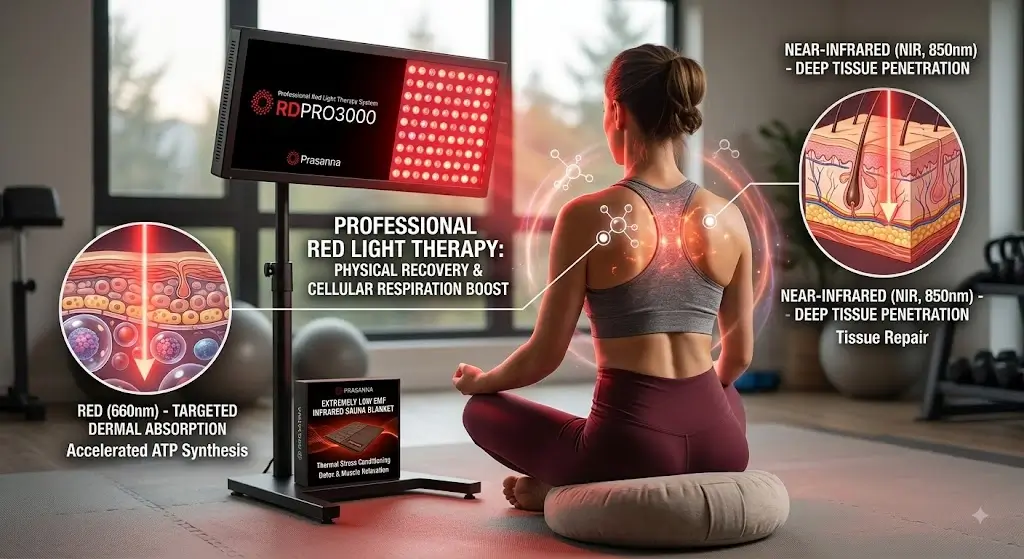
- Pre-Activity / Targeted PBM: Apply a targeted red/NIR panel session based on manufacturer-specified irradiance (mW/cm²) to support local muscle tissue prior to physical exertion.
- Post-Activity / Passive Heat: Schedule a sauna blanket session post-training or in the evening to allow core temperature elevation and subsequent cooling to facilitate restorative sleep cycles. If you also alternate sauna heat with cold water immersion, review our complete contrast therapy protocol guide for vascular flush intervals.
Safety & Operational Dosing Parameters
Adequate fluid replacement with electrolytes is necessary during sauna blanket sessions to account for thermoregulatory fluid loss. For red light therapy, treatment duration and panel distance must be calculated from verified irradiance measurements (mW/cm²) rather than arbitrary rules, preventing biphasic dose responses where excessive optical energy diminishes biological efficacy.
Frequently Asked Questions
Evidence-based answers address same-day protocol scheduling and core temperature elevation differences. Direct technical answers are outlined below:
Can you use a sauna blanket and red light panel on the same day?
Yes. Many individuals utilize targeted red light therapy prior to exercise to support local cellular energetics, followed by an evening sauna blanket session for thermal relaxation and thermoregulatory adaptation.
Does a red light therapy panel elevate core body temperature?
No. High-output red light panels operate via non-thermal photobiomodulation, delivering optical energy directly to cellular chromophores without inducing systemic hyperthermia.
