
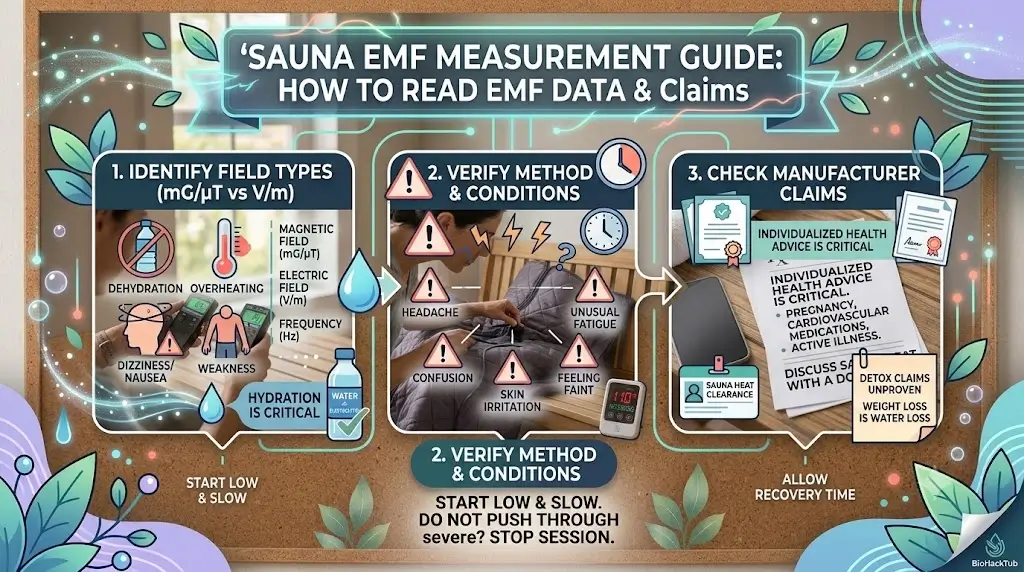
Sauna EMF Measurement Guide: How to Read EMF Data & Low-EMF Claims
Sauna EMF measurement is more complicated than looking at one number on an EMF meter. A meaningful evaluation should distinguish between magnetic fields, electric fields, frequency range, measurement uncertainty, meter capability, and the exact location represented by a reading.
This guide explains how EMF measurements are reported, what mG, µT, and V/m mean, why readings can change around electrical equipment, and how consumers can critically evaluate a sauna manufacturer’s “low EMF” claim.
Quick answer:
A credible sauna EMF measurement report should identify what field was measured, the frequency range, the units, the instrument or measurement method, and the conditions of the test. A single “low EMF” number without this information is difficult to interpret or compare.
This is an educational guide to EMF terminology, measurement science, and interpretation. It is not a personal health assessment and does not establish that a particular EMF value is medically “safe” or “unsafe.”
What Is EMF?
EMF stands for electromagnetic field.
Electricity and electromagnetic phenomena can produce electric and magnetic fields. These fields are described using different physical quantities and units depending on what is being measured.
NIST maintains measurement science programs covering electric and magnetic fields and emphasizes traceable measurement methods and standardized units.
For sauna discussions, the most important distinction is between electric-field measurements and magnetic-field measurements.
Electric Field vs Magnetic Field
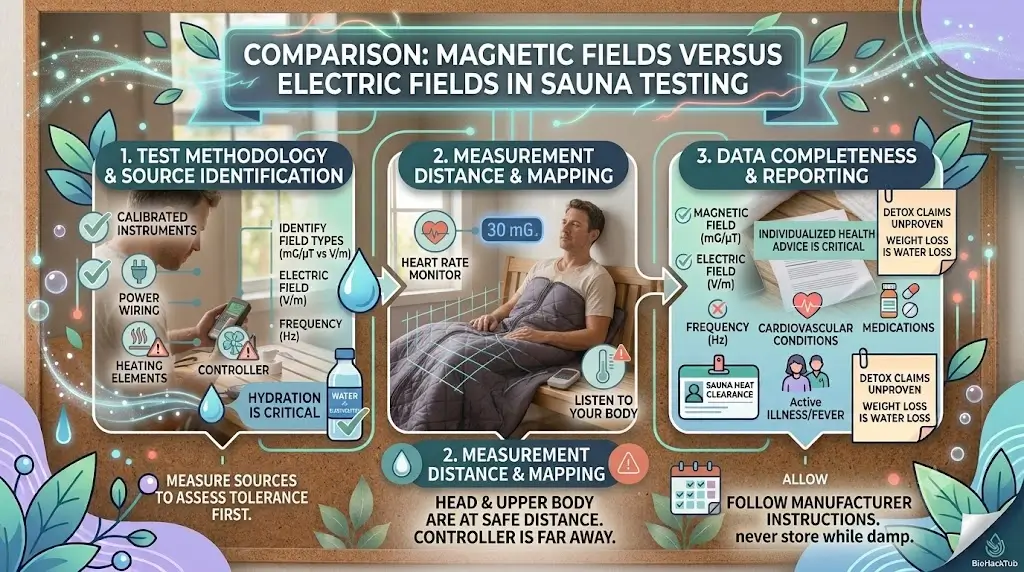
| Field | Common unit | What it describes | Typical sauna discussion |
|---|---|---|---|
| Magnetic field | mG or µT | Magnetic flux density | Often the number quoted in “low-EMF” sauna marketing |
| Electric field | V/m | Electric field strength | Less commonly highlighted in consumer sauna listings |
These are not interchangeable measurements.
A sauna can have a relatively low magnetic-field reading while having a different electric-field measurement. Therefore, saying a product has “0.5 EMF” without specifying the field type and unit is scientifically incomplete.
If a manufacturer publishes an EMF number, first ask: Is it magnetic field or electric field? Then identify the unit and frequency range before comparing it with another product.
Why Frequency Matters in Sauna EMF Measurement
Frequency describes how rapidly an electromagnetic field changes over time. It is measured in hertz (Hz).
In the United States, utility-generated electrical power operates at 60 Hz. NIST materials describe 60 Hz as the standard frequency of U.S. utility power.
That matters because a measurement instrument designed for one frequency range may not characterize another frequency range in the same way.
This is one of the biggest reasons consumers should not compare two EMF numbers without knowing what frequency range each instrument covered.
Three pieces of information should travel together
- Field type — electric or magnetic
- Frequency range — such as power-frequency measurement
- Magnitude and unit — such as mG, µT or V/m
EMF Measurement Units Explained
The unit is not just a formatting detail. It tells you what physical quantity is being reported.
Magnetic field: Gauss and Tesla
Magnetic flux density can be expressed in tesla (T) or gauss (G).
Consumer products frequently report small magnetic-field values in milligauss (mG) or microtesla (µT).
Electric field: Volts per meter
Electric-field strength is commonly expressed in volts per meter (V/m).
An electric-field reading should not be presented as though it were equivalent to a magnetic-field reading in mG.
mG vs µT: What’s the Difference?
Milligauss and microtesla are two units used to express magnetic flux density.
Conversion:
1 µT = 10 mG
Therefore:
- 1 mG = 0.1 µT
- 10 mG = 1 µT
- 100 mG = 10 µT
This conversion is useful when comparing two reports that use different units.
However, conversion alone does not make two measurements directly comparable. Frequency, measurement position, meter characteristics and test conditions still matter.
What Does V/m Mean?
V/m means volts per meter and is a unit of electric-field strength.
Electric-field measurement is a distinct area of electromagnetic metrology. NIST maintains dedicated research and calibration work for electric-field measurement.
A sauna listing that reports only a magnetic-field value in mG has not necessarily characterized its electric field.
That does not automatically make the listing inaccurate. It means the claim is narrower than a statement covering “all EMF.”
Where Can EMF Come From in a Sauna?
An electrically powered sauna contains electrical components that can contribute to electromagnetic fields.
Potential sources include:
- Power wiring
- Heating elements
- Controllers
- Transformers or power-conversion components
- Fans
- Lighting systems
- Electronic control boards
- Other powered accessories
The exact field distribution depends on the electrical design and physical arrangement of the system.
NIST research on household electrical equipment shows why magnetic fields around electrical appliances can be highly non-uniform, particularly near equipment containing electrical components such as motors, transformers and heating elements.
Why Sauna EMF Readings Change
A measurement near an electrical appliance is not necessarily a single fixed number throughout the entire space.
The reading can vary with:
- Distance from an electrical source
- Position relative to wiring
- Which components are energized
- Electrical load
- Frequency components
- Meter orientation
- Measurement bandwidth
- Nearby electrical equipment
- Background electromagnetic fields
NIST research specifically discusses measurement uncertainty and field non-uniformity near electrical appliances.
Important:
A single measurement point cannot automatically describe the electromagnetic environment everywhere inside or around a sauna.
What an EMF Meter Actually Measures
An EMF meter is not a universal “EMF detector.”
Different instruments are designed for different field types and frequency ranges.
A useful measurement specification should identify:
| Specification | Why it matters |
|---|---|
| Field type | Determines whether the instrument measures electric or magnetic fields. |
| Frequency response | Shows what frequencies the instrument can detect. |
| Measurement range | Defines the values the instrument can meaningfully report. |
| Resolution | Indicates the smallest displayed increment. |
| Accuracy | Indicates how closely the measurement represents the actual field. |
| Calibration | Provides confidence that the instrument behaves according to a known reference. |
NIST’s electromagnetic measurement programs emphasize calibration, traceability and measurement uncertainty because accurate field measurement requires more than simply displaying a number.
Consumer EMF Meter Limitations
Consumer EMF meters can be useful for exploratory measurements, but their readings should not automatically be treated as laboratory-grade measurements.
Important limitations can include:
- Limited frequency response
- Limited dynamic range
- Unknown calibration status
- Sensor orientation effects
- Environmental interference
- Limited information about measurement uncertainty
- Differences between single-axis and multi-axis sensors
NIST notes that even sophisticated commercial electric-field instruments have measurable uncertainty, reinforcing the principle that measurement accuracy must be considered alongside the displayed value.
Why Calibration Matters
Calibration connects an instrument’s displayed value to a known reference.
NIST operates measurement and calibration services covering electromagnetic measurements and field strength.
This does not mean every consumer needs a laboratory-calibrated instrument. It does mean that an unlabeled meter reading should not automatically be treated as a precision measurement.
When publishing sauna EMF test results, identify the instrument model, measurement type, frequency range, calibration information and test conditions whenever those details are available.
Why Distance Changes EMF Readings
Fields around electrical equipment are spatially distributed. A measurement taken close to a source can differ significantly from one taken farther away.
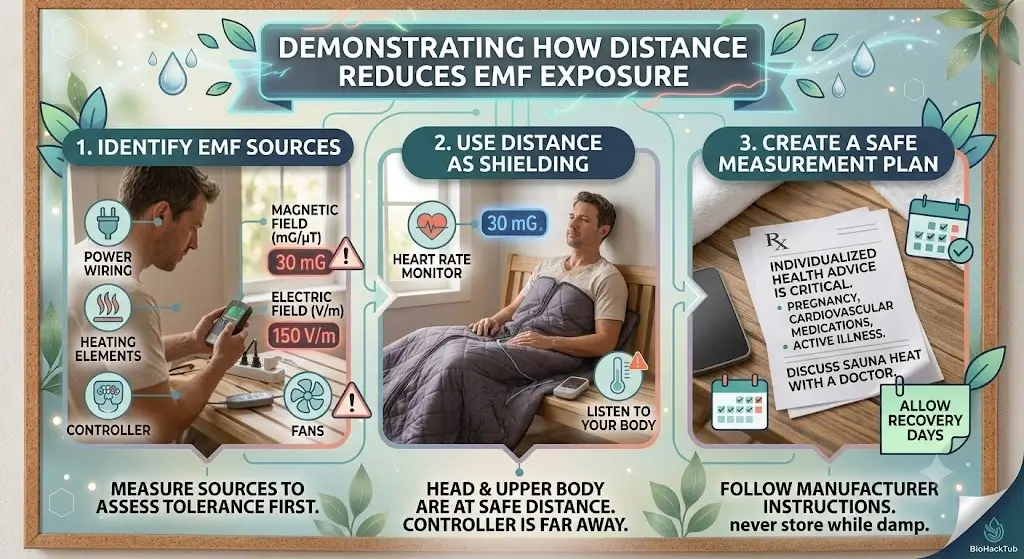
This is why two statements such as:
- “The sauna measures 1 mG.”
- “The sauna measures 8 mG.”
cannot be meaningfully compared unless the measurement conditions are known.
NIST research on appliance magnetic fields specifically considers the relationship between field measurements, probe characteristics and distance from the source.
Why One EMF Number Is Not Enough
A manufacturer’s statement such as “less than 1 mG” may sound precise, but it leaves important questions unanswered.
| Question | Why it matters |
|---|---|
| What field? | Magnetic field or electric field? |
| Which unit? | mG, µT or V/m? |
| Which frequency? | Power-frequency or another range? |
| Where was it measured? | Field strength varies spatially. |
| Which operating condition? | Electrical load can affect measurements. |
| What instrument? | Different instruments have different capabilities. |
| What uncertainty? | No measurement is perfectly exact. |
How to Evaluate Manufacturer EMF Claims
For BioHackTub’s editorial standards, a manufacturer EMF claim should be treated as a data point rather than an automatic ranking factor.
A stronger claim provides:
- Exact product or model tested
- Field type
- Measurement units
- Frequency range
- Measurement conditions
- Measurement locations
- Instrument information
- Calibration or laboratory information
- Date of testing
- Supporting documentation
Best practice:
The more complete the measurement methodology, the easier it is to determine whether two products were actually tested under comparable conditions.
How to Compare Two Sauna EMF Reports
Use a hierarchy rather than comparing the headline numbers first.
Step 1: Compare the field type
Make sure both reports measure magnetic field, or both measure electric field.
Step 2: Compare the units
Convert mG and µT where necessary.
Step 3: Compare frequency
A 60-Hz measurement and a broad RF measurement are not the same category of measurement.
Step 4: Compare measurement conditions
Look for differences in operating state, location and distance.
Step 5: Compare instrumentation
Identify whether the reports disclose the instrument and relevant specifications.
Step 6: Consider uncertainty
A difference between two small numbers may be less meaningful if the measurement uncertainty is large relative to that difference.
What Does “Low-EMF Sauna” Mean?
“Low EMF” is primarily a product-description term in the consumer sauna market. It does not by itself identify a universally standardized product category.
Therefore, BioHackTub should avoid treating “low EMF” as an independent safety certification.
A better editorial approach is to report the actual published measurement information and explain its limitations.
Weak claim
“Ultra-low EMF sauna.”
Stronger claim
“Manufacturer reports a magnetic-field measurement of X mG under the stated test conditions, using the specified instrument and measurement range.”
The second statement gives readers something they can actually evaluate.
Sauna EMF Measurement Red Flags
Watch for these common problems when reviewing sauna EMF claims:
- No unit is provided.
- The field type is not identified.
- The frequency range is omitted.
- The measurement location is missing.
- No test conditions are disclosed.
- No instrument is identified.
- A laboratory name is mentioned without an actual report.
- A tiny number is presented as proof of health benefits.
- Different products are compared using different measurement methods.
- “Low EMF” is presented as though it were a medical certification.
Marketing shortcut to avoid:
“Lower EMF” does not automatically mean “healthier.” The measurement and the health conclusion are separate questions.
Amazon Sauna Listings and EMF Claims
Amazon product pages can contain useful manufacturer specifications, but the listing itself should not be treated as independent laboratory verification.
For BioHackTub’s Amazon-only commercial content strategy, EMF claims should therefore be presented carefully.
A product comparison should distinguish:
| Evidence level | Editorial treatment |
|---|---|
| Manufacturer marketing statement only | Report as a manufacturer claim. |
| Manufacturer test data with methodology | Report the stated measurement conditions. |
| Independent laboratory report | Identify the laboratory and scope of testing. |
| Independent measurement with disclosed methodology | Explain instrument and test conditions. |
Do not convert a marketing phrase such as “low EMF” into a numerical measurement unless the underlying documentation actually provides that measurement.
EMF Measurements vs Health Claims
This distinction is essential.
Measuring an electromagnetic field is a physics question.
Determining whether a particular exposure causes a health outcome is a medical and scientific evidence question.
Those questions should not be merged into a single product score.
Mayo Clinic describes infrared sauna as a method that uses light to produce heat and notes that research into its proposed health benefits is still developing.
Consequently, a BioHackTub article should not say that a particular EMF reading proves a sauna is medically safer, healthier or more effective unless high-quality evidence directly supports that conclusion.
Editorial rule for BioHackTub:
Measure the field. Report the field. Explain the measurement. Do not manufacture a health conclusion from the number.
Sauna EMF Measurement: A Practical Interpretation Framework

| Question | Good answer | Weak answer |
|---|---|---|
| What was measured? | Magnetic field | “EMF” |
| What unit? | mG or µT | No unit |
| What frequency? | Specified | Not disclosed |
| Where? | Measurement location stated | “Inside sauna” |
| When? | Operating condition stated | Unknown |
| Instrument? | Model and relevant specifications | “Professional meter” |
| Uncertainty? | Discussed where relevant | Ignored |
| Health conclusion? | Evidence-based and limited | “Lower number = healthier” |
Sauna EMF Measurement Guide FAQ
What does EMF mean in a sauna?
EMF means electromagnetic field. In sauna discussions, the term usually refers to electric and/or magnetic fields generated by electrical components, but the exact field being discussed should always be identified.
What does mG mean in sauna EMF testing?
mG means milligauss and is a unit used to express magnetic flux density. It is not an electric-field unit.
What is µT in EMF measurement?
µT means microtesla. It is another unit for magnetic flux density. One microtesla equals 10 milligauss.
What does V/m mean?
V/m means volts per meter and describes electric-field strength.
Is a lower sauna EMF reading automatically better?
Not by itself. The reading must be interpreted in the context of field type, frequency, measurement conditions, instrument characteristics and the quality of the evidence supporting the measurement.
Why do sauna EMF readings vary?
Electrical fields can vary with distance, location, electrical load, source configuration, instrument characteristics and background fields. NIST research documents the non-uniform nature of magnetic fields around electrical appliances.
Can I compare two sauna EMF numbers directly?
Only when the measurements are sufficiently comparable. Check field type, units, frequency range, measurement location, operating condition and instrumentation before comparing headline numbers.
Are consumer EMF meters accurate?
Some can provide useful measurements, but accuracy depends on the instrument, frequency range, calibration, sensor design and measurement conditions. A displayed number should not automatically be treated as laboratory-grade data.
Does low EMF mean a sauna is healthier?
No automatic conclusion follows from the number alone. EMF measurement and health-outcome research are separate questions.
What should a good sauna EMF report include?
Ideally it should identify the field type, unit, frequency range, measurement location, operating condition, instrument, calibration information and relevant uncertainty.
Is “low EMF” a universal sauna certification?
The phrase itself should not be treated as a universal certification. Consumers should look for the underlying measurement data and methodology.
Bottom Line: How to Read Sauna EMF Measurements
The most important lesson is that an EMF number without context is incomplete.
A credible sauna EMF evaluation identifies the field being measured, the unit, frequency range, measurement conditions, instrument and relevant uncertainty.
Magnetic-field measurements are commonly expressed in mG or µT, while electric-field measurements are commonly expressed in V/m. These measurements should not be mixed together.
Distance and location also matter because electromagnetic fields around electrical equipment can be spatially non-uniform. NIST’s measurement literature demonstrates why measurement methodology and probe characteristics matter when characterizing fields near electrical appliances.
