

Can You Use an Infrared Sauna Blanket Every Day?
Can you use an infrared sauna blanket every day? There is no universal daily-use schedule that is appropriate for everyone. Infrared sauna blankets expose the body to heat, and the practical issue is not simply whether a blanket can be switched on every day, but whether your body is tolerating repeated heat exposure without dehydration, dizziness, overheating, or other adverse effects.
For healthy adults, sauna use can be part of a regular wellness routine, but more frequent use is not automatically better. Cleveland Clinic’s guidance for infrared sauna use recommends starting with lower temperatures and shorter sessions, and its medical guidance suggests limiting infrared sauna visits to roughly three to four times per week rather than assuming daily exposure is necessary.
Short answer:
Daily infrared sauna blanket use should not be treated as a default recommendation. Frequency should depend on the manufacturer’s instructions, the heat level, session length, hydration, how you feel during and after use, and individual health factors. If you are new to sauna use, starting conservatively is more sensible than immediately using a blanket every day.
Can You Use an Infrared Sauna Blanket Every Day?
For some healthy adults, frequent sauna use may be tolerated, but that does not establish that an infrared sauna blanket should be used every day.
Infrared saunas generally operate at lower temperatures than traditional saunas, but they still expose the body to heat and can cause substantial sweating. Cleveland Clinic notes that infrared sauna temperatures commonly fall around 110°F to 135°F and advises beginners to start at a lower temperature and shorter duration.
The key distinction is between tolerating heat and needing more heat. If a person feels good after a session, that does not necessarily mean increasing frequency will create additional benefits.
Important:
A sauna blanket should not be used to chase maximum sweating. Sweat primarily represents fluid loss, and excessive sweating can contribute to dehydration.
Daily Use vs. Regular Sauna Use
Searches for “can I use an infrared sauna blanket every day” often assume that frequency has a simple yes-or-no answer.
In practice, frequency is one variable in a larger heat-exposure equation:
- Temperature or heat setting
- Session duration
- Frequency
- Hydration status
- Ambient temperature
- Recent exercise
- Sleep and recovery status
- Individual health factors
- Medication use
A person using a relatively low heat setting for a short session is not receiving the same heat exposure as someone using a higher setting for a substantially longer period. That is why a responsible sauna routine should not be reduced to the statement “daily is safe” or “daily is unsafe.”

Why More Frequent Sauna Use Is Not Automatically Better
The body has to regulate its temperature during sauna exposure. Sweating is one of the mechanisms used to release heat. When sweat loss becomes substantial, however, the body also loses water and electrolytes.
Cleveland Clinic identifies dehydration as one of the primary risks associated with sauna use and recommends maintaining hydration before and after heat exposure.
More sessions ≠ automatically more benefit
Increasing frequency increases cumulative heat exposure. It does not guarantee a proportional increase in the desired outcome.
If a daily routine causes persistent fatigue, headaches, dizziness, nausea or unusual weakness, increasing frequency is moving in the wrong direction.
How Often Should You Use an Infrared Sauna Blanket?
There is no single frequency that applies to every person or every blanket.
For healthy adults considering infrared sauna use, Cleveland Clinic recommends a conservative approach: start low and slow, keep sessions short initially, and its infrared-sauna guidance suggests limiting sessions to roughly three to four times per week.
| User situation | More conservative approach | Why |
|---|---|---|
| New to infrared sauna | Start with lower heat exposure and short sessions | Allows you to assess individual heat tolerance. |
| Already accustomed to sauna | Follow the blanket’s instructions and monitor recovery | Heat tolerance varies substantially between individuals. |
| Feeling dehydrated or unwell | Do not use the blanket until the issue is resolved | Additional heat can increase fluid loss. |
| Medical condition or medication | Ask a healthcare professional first | Some conditions and medications can change heat tolerance. |
| Pregnancy or trying to conceive | Seek medical advice before sauna exposure | Heat exposure may not be appropriate in these circumstances. |
If You Are New to Infrared Sauna Blankets
A common mistake is starting at the highest setting because the user wants to “get the most out of” the blanket. A more sensible approach is to establish how your body responds to heat before increasing exposure.
Cleveland Clinic recommends starting infrared sauna use around 110°F for approximately five to 10 minutes and then assessing how you feel before progressing. It also recommends keeping experienced sessions below 30 minutes.
Do not copy another person’s sauna routine.
Two people can respond differently to the same temperature and duration because hydration, medications, fitness, heat tolerance and health conditions differ.
What Can Happen With Excessive Heat Exposure?
The main concern with excessive sauna exposure is not that infrared light itself is inherently dangerous. The immediate issue is heat stress and fluid loss.
Possible signs of excessive heat exposure include:
- Thirst
- Headache
- Dizziness
- Weakness
- Nausea
- Muscle cramps
- Unusual fatigue
- Feeling faint
Cleveland Clinic lists thirst, headache, muscle cramps, dizziness and confusion among dehydration-related symptoms and advises attention to hydration.
Do not push through warning symptoms.
If you feel dizzy, weak, nauseated, unusually short of breath or otherwise unwell during heat exposure, stop the session and cool down. Severe symptoms require prompt medical attention.
Hydration and Infrared Sauna Blanket Use
Hydration is one of the most important variables when evaluating frequent sauna use. The body loses fluid through sweat. The amount varies by temperature, session duration, individual physiology and environmental conditions.
There is no universal amount of water that every sauna user needs because fluid requirements depend on factors such as body size, activity, climate and health status.
Cleveland Clinic recommends drinking water before and after sauna exposure and notes that electrolytes may also be useful when sweating substantially.

Signs that hydration deserves attention
- Unusual thirst
- Headache after heat exposure
- Dark urine
- Dizziness
- Fatigue
- Muscle cramps
Do not use sauna sessions as a way to intentionally dehydrate yourself for a lower scale reading.
When Should You Stop an Infrared Sauna Blanket Session?
A sauna session should not be treated as a test of endurance. Stop the session if you feel unwell, particularly if you experience:
- Dizziness or lightheadedness
- Weakness
- Nausea
- Confusion
- Difficulty breathing
- Feeling faint
- Unusual or severe headache
Cleveland Clinic specifically advises leaving a sauna if you feel dizzy, weak, uncomfortable or have difficulty breathing.
Useful rule:
The correct session is the one your body tolerates without warning symptoms. “More sweat” is not a reliable measure of a better session.
Who Should Talk to a Healthcare Professional Before Using a Sauna Blanket?
Some people should obtain individualized medical advice before beginning a sauna routine rather than relying on a generic internet schedule.
Cleveland Clinic recommends discussing sauna use with a healthcare provider for people with certain cardiovascular conditions, blood-pressure problems, pregnancy, attempts to conceive, epilepsy and medication use. It also advises medical consultation for people under 16 and other specific groups.
Medical clearance may be especially important if:
- You are pregnant or trying to become pregnant.
- You have a cardiovascular condition.
- You have unusually high or low blood pressure.
- You have a neurological condition affected by heat.
- You take medication that may affect hydration, blood pressure or heat tolerance.
- You are under 16.
- You are recovering from an illness.
Can You Use a Sauna Blanket Every Day After Exercise?
Exercise already creates a heat and fluid-management demand. Adding a sauna blanket immediately afterward can increase total heat exposure and sweating. Whether that is appropriate depends on the intensity of the workout, hydration status, environmental conditions and individual tolerance.
A common mistake is stacking several heat exposures because each one is marketed as a recovery tool. For example:
- Hard workout
- Hot shower
- Sauna blanket
- Hot tub
The combined heat exposure matters more than the label attached to each activity. If you feel depleted after exercise, additional heat is not automatically the correct recovery strategy.
Does Using an Infrared Sauna Blanket Every Day Cause Weight Loss?
No. Sweating can temporarily reduce body weight because the body loses water, but that is not equivalent to losing body fat.
Cleveland Clinic specifically states that sauna use is not recommended as a weight-loss strategy because the short-term scale change is primarily water loss and is restored with rehydration.
Important distinction:
A lower scale reading immediately after a sweaty sauna session should not be interpreted as evidence that the session burned a meaningful amount of body fat.
Does Daily Sweating Detox the Body?
Sweating is a normal thermoregulatory process, but that does not mean more sweating equals more detoxification.
Cleveland Clinic notes that sweat is mostly water and that there is not enough evidence to conclude that excessive sweating through exercise or sauna use meaningfully purifies the body. The liver, kidneys, gastrointestinal tract and other physiological systems handle the body’s normal waste-processing functions.
How to Build a Conservative Infrared Sauna Routine
For an adult who has been cleared for sauna use and is following the manufacturer’s instructions, the most useful framework is to control several variables rather than obsess over a single number.
Variable 1: Heat
Start with a lower heat exposure rather than immediately selecting the highest available setting.
Variable 2: Duration
Keep early sessions short and evaluate how you feel during and afterward.
Variable 3: Frequency
Do not assume that daily use is required. A less frequent routine may provide a more practical balance between heat exposure and recovery.
Variable 4: Recovery
Pay attention to hydration, sleep, fatigue and how you feel after sessions.
Temperature and Frequency Are Connected
Frequency cannot be evaluated independently from heat intensity. A blanket used at a lower setting creates a different exposure from the same blanket used at its maximum setting.
For comprehensive guidance on dialing in your heat settings, consult our dedicated Sauna Blanket Temperature Guide.
Session Length and Frequency Are Connected
Longer sessions create more cumulative heat exposure. If frequency increases while session duration also increases, the total weekly exposure can rise substantially.
Cleveland Clinic’s infrared sauna guidance recommends keeping sessions below 30 minutes even for experienced users, while beginners should start with shorter sessions. For detailed duration recommendations, refer to our guide on How Long to Use an Infrared Sauna Blanket.
Does the Infrared Sauna Blanket Model Matter?
Yes. Different products can have different heating systems, temperature controls, materials, electrical requirements and manufacturer instructions. A product’s maximum temperature is a hardware specification, not an individualized health recommendation.
Always review your product’s technical guidelines, including safety cutoff mechanisms and manufacturer-recommended usage cycles, such as those found in our curated review of the Best Low-EMF Infrared Sauna Blankets.
10 Common Mistakes With Daily Infrared Sauna Blanket Use
- Assuming daily use is automatically better: More frequent heat exposure does not guarantee greater benefits.
- Starting at maximum temperature: A maximum setting is not a beginner setting.
- Increasing frequency and duration together: That can substantially increase total weekly heat exposure.
- Ignoring hydration: Sweating increases fluid loss.
- Treating sweat as a detox measurement: More sweat does not prove greater toxin removal.
- Using sauna sessions for rapid weight loss: Short-term scale changes from sweating are primarily water loss.
- Exercising hard and then adding excessive heat: The combined physiological load matters.
- Ignoring dizziness or nausea: Warning symptoms should be treated as a reason to stop rather than something to train through.
- Copying another person’s routine: Heat tolerance is individual.
- Treating manufacturer maximums as medical recommendations: The maximum operating specification of a device is not an individualized health prescription.
Daily Sauna Use vs. 3–4 Times Per Week
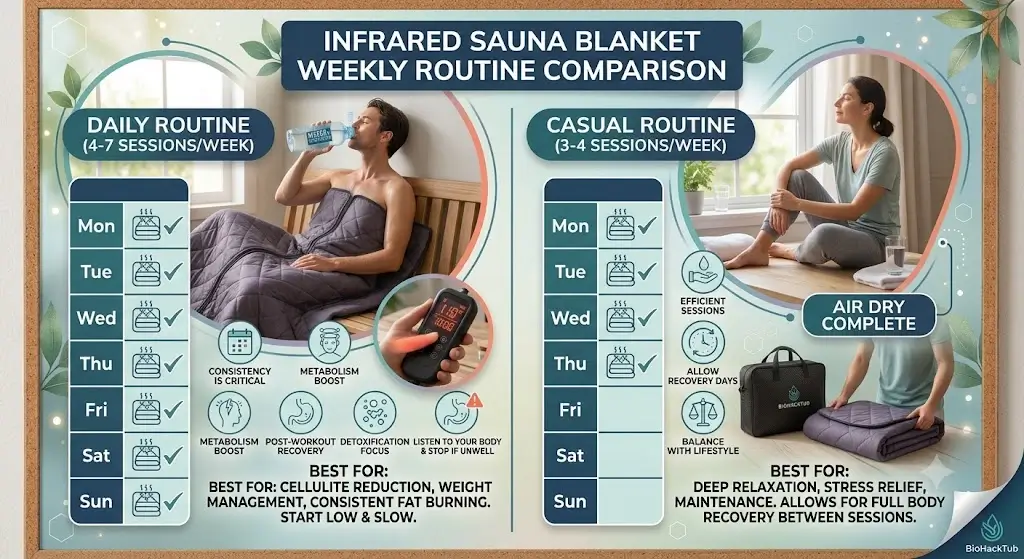
| Factor | Daily use | 3–4 Times per week |
|---|---|---|
| Total heat exposure | Higher cumulative exposure | Lower cumulative exposure |
| Recovery between sessions | Less time between exposures | More recovery days |
| Hydration demand | Repeated sweating requires strict tracking | Balanced fluid replenishment |
| Beginner suitability | Not recommended as a starting point | Ideal conservative starting structure |
| Clinical alignment | Requires careful self-monitoring | Matches conservative clinical guidance |
Can You Use an Infrared Sauna Blanket Every Day? FAQ
Can I use an infrared sauna blanket every day?
Daily use should not be assumed to be appropriate for everyone. Manufacturer instructions, heat exposure, duration, hydration and individual health factors all matter. Clinical guidance generally suggests limiting sessions to roughly three to four times per week rather than treating daily use as necessary.
Is it better to use an infrared sauna every day?
Not necessarily. More frequent heat exposure does not automatically produce more benefit, while repeated sweating increases cumulative fluid loss and heat stress.
How many times a week should I use an infrared sauna blanket?
For most healthy adults, three to four sessions per week provides a sensible balance between heat benefits and adequate recovery time.
Can I use an infrared sauna blanket twice a day?
Twice-daily use substantially elevates cumulative heat exposure and fluid loss. It is generally not recommended for routine home wellness.
Can I use an infrared sauna blanket every day for weight loss?
No. Any weight reduction immediately after a session is temporary water loss from sweating, not fat loss.
Does using a sauna blanket every day detox the body?
Sweat is primarily composed of water and minerals. Primary detoxification functions are performed internally by your liver and kidneys.
Can I use a sauna blanket every day after working out?
Post-workout heat stacking can cause sudden dehydration and fatigue. Allow your heart rate to return to baseline and rehydrate thoroughly before adding heat exposure.
What are the signs that I am using a sauna blanket too often?
Persistent headaches, lightheadedness, fatigue, muscle cramps, and dark urine are clear indicators of overexposure and dehydration.
Can I use an infrared sauna blanket when I am sick?
No. Adding external heat when your body is already fighting an illness or fever can elevate core temperature dangerously and worsen dehydration.
Final Verdict
Daily infrared sauna blanket use should not be treated as a default wellness routine. The safest approach is to balance session duration, temperature intensity, hydration, and personal recovery.
Starting with 3 to 4 moderate sessions per week allows your body to adapt safely without risking chronic dehydration or heat exhaustion.
