
Thermoregulation Benchmarks
Clinical Safety Audit
Cold Plunge Temperature Guide: What Temperature Is Safe?
•
Medical Audit: Dr. Alex Mercer, CSCS
•
Updated October 2026
Cold plunge water temperature is one of the most important variables in cold-water immersion. The difference between cool water and very cold water can substantially change how the body responds, including breathing, blood-vessel constriction, heart workload and heat loss.
There is no single temperature that is universally “best” for everyone. Research on cold-water immersion has used different temperatures, exposure durations and populations, while medical guidance emphasizes that colder water increases risk rather than automatically producing better results.
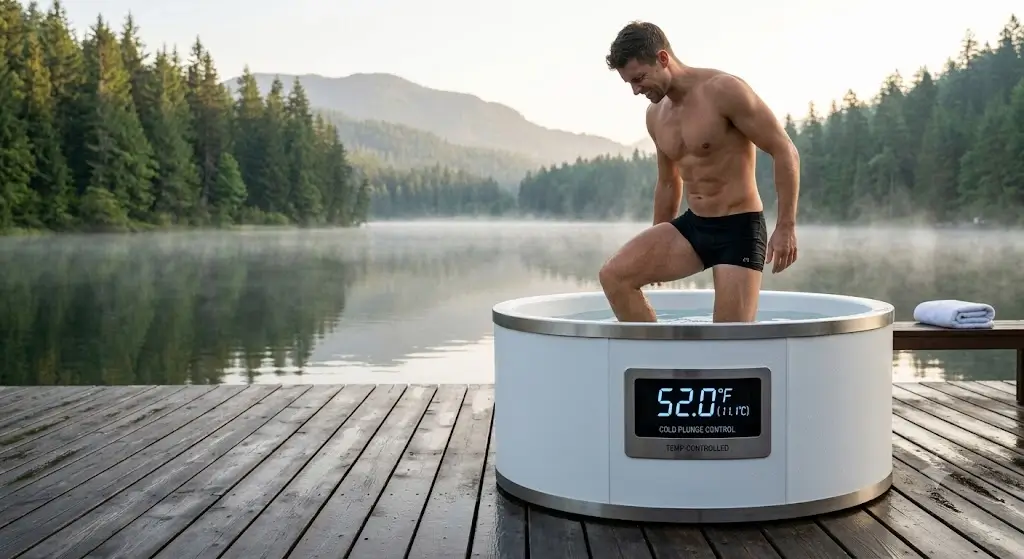
Quick Reference Specification: Cold Plunge Temperature Tiers
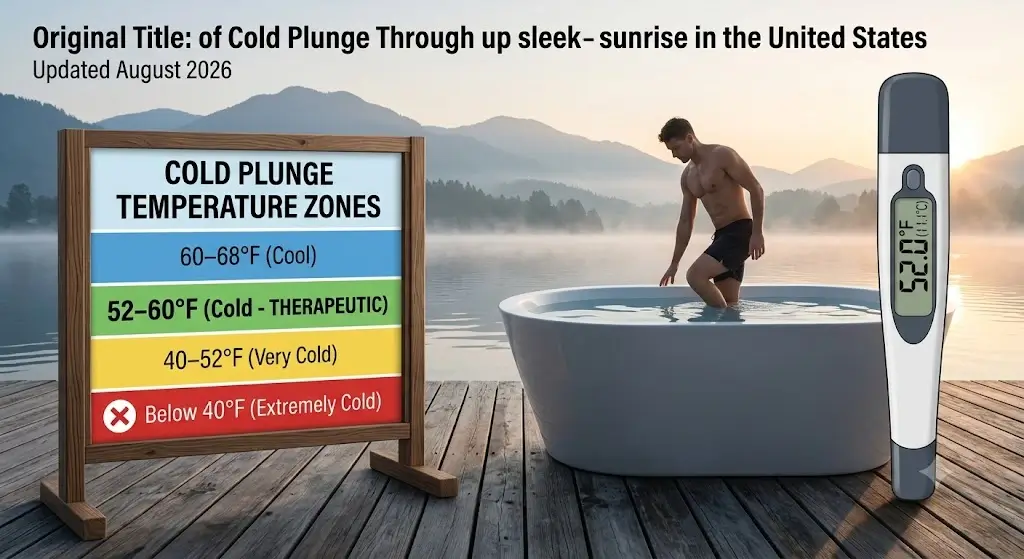
Published sports science defines 50°F to 60°F as the optimal therapeutic recovery band for cold-water immersion. The benchmark matrix below categorizes physiological stress levels, neurochemical cascades, and safety guidelines across standard temperature brackets:
| Water Temp Bracket | Thermal Category | Cardiorespiratory Load | Primary Biological Impact | Recommended Max Duration |
|---|---|---|---|---|
| 60°F – 68°F (15.5°C – 20°C) | Cool Exposure | Mild (Minimal gasp reflex) | Gradual peripheral vasoconstriction, baseline recovery | 10 – 15 Minutes |
| 50°F – 60°F (10°C – 15.5°C) | Therapeutic Cold | Moderate (Controllable hyperventilation) | Optimal vascular pumping, DOMS mitigation, norepinephrine surge | 2 – 5 Minutes |
| 40°F – 50°F (4.4°C – 10°C) | Very Cold | High (Acute tachycardia & gasping) | Intense sympathetic tone, rapid numbness, shivering thermogenesis | 1 – 2 Minutes |
| Below 40°F (< 4.4°C) | Extremely Cold (Clinical Risk) | Severe (High arrhythmia risk) | Rapid motor control loss, cutaneous pain, sudden hypothermia risk | < 60 Seconds (Not Recommended) |
Cold Plunge Temperature Chart
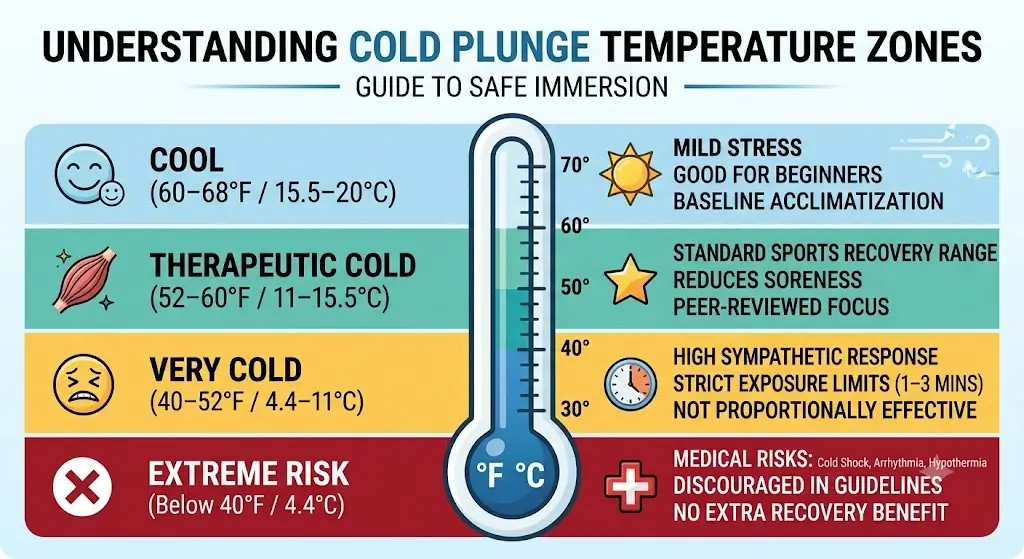
Clinical literature categorizes cold water immersion into four distinct physiological zones ranging from cool recovery to extreme hypothermic risk. Studies and commercial cold-plunge systems use different temperature ranges, so it is more useful to think in temperature bands than to treat one number as a universal prescription.
| Water temperature | Approximate category | What it means |
|---|---|---|
| 60–68°F (15.5–20°C) | Cool | Less extreme than an ice bath, but still capable of producing a noticeable cold response. |
| 52–60°F (11–15.5°C) | Cold | A range commonly represented in sports-recovery research on cold-water immersion. |
| 40–52°F (4.4–11°C) | Very cold | Physiological stress increases as temperature falls. This is not automatically more effective. |
| Below 40°F (4.4°C) | Extremely cold | A substantially more aggressive exposure. Medical guidance warns against going this cold. |
Why Cold Plunge Temperature Matters
Water conducts thermal energy away from human tissue approximately twenty-four times faster than ambient air. As water temperature falls, the temperature difference between the body and the surrounding water becomes greater, increasing the rate at which heat can be transferred away from the skin.
Cold exposure can also produce rapid peripheral vasoconstriction. Blood vessels near the skin narrow, which changes blood flow and contributes to the characteristic sensation of intense cold.
Another important response is breathing. Sudden immersion in cold water can trigger rapid, uncontrolled breathing. This is one reason cold-water immersion should not be treated as a simple wellness activity where “colder” automatically means “better.”
Cleveland Clinic notes that cold water can cause rapid breathing, cardiovascular stress, numbness and, with prolonged exposure, hypothermia.
What Does the Research Actually Say About Temperature?
Peer-reviewed exercise trials demonstrate that water temperatures between 50°F and 60°F elicit maximal anti-inflammatory benefits without clinical frostbite hazards. Cold-water immersion has been studied extensively in sports recovery, but the research does not establish one universal temperature for every person or every goal.
The American College of Sports Medicine describes cold-water immersion as one of the most studied cryotherapy approaches in athletic recovery. Its discussion cites research using approximately 50°F (10°C) and other studies using approximately 52–60°F (11–15°C).
That distinction matters because a research protocol is not the same thing as a recommendation for every person at home. To see how deliberate neurochemical priming protocols leverage this exact therapeutic window, consult our detailed analysis of the Huberman cold plunge protocol.
Does a Colder Cold Plunge Work Better?
Excessively cold water below 40°F magnifies cardiovascular and sympathetic shock without delivering proportional athletic recovery gains. Not necessarily.
Lower water temperatures increase thermal stress, but increasing physiological stress is not the same as increasing the desired recovery effect.
This distinction is often lost in cold-plunge marketing. A machine capable of producing water near freezing may have a more impressive specification sheet, but that specification does not establish that the user receives proportionally greater benefits.
For a consumer evaluating a cold-plunge system, temperature-control stability, filtration, water circulation, insulation, electrical safety and maintenance can be more useful ownership metrics than simply asking which unit reaches the lowest temperature. Keeping chiller loops clean and algae-free is essential; review our practical guidelines on cold plunge water maintenance to maintain hygienic operating conditions.
Cold Plunge Temperature vs. Recovery Goal
Athletic training targets dictate whether athletes should prioritize acute soreness reduction or delay cold application to preserve hypertrophy pathways. Different recovery goals can involve different considerations. The table below is intentionally descriptive rather than a prescription for personal cold-water exposure:
| Goal | What the evidence suggests | Important consideration |
|---|---|---|
| Post-exercise soreness | Cold-water immersion has evidence for reducing perceived muscle soreness after strenuous exercise. | The studies use different temperatures and exposure protocols. |
| Short-term recovery between events | CWI has been studied as a recovery modality for athletes competing or training repeatedly. | Individual sport, timing and training demands matter. |
| Strength and hypertrophy | Frequent immediate post-resistance-training cold exposure may interfere with some adaptation signals. | Cold exposure should not automatically be treated as a muscle-building strategy. |
| General wellness | Evidence is less definitive than the marketing surrounding many commercial cold-plunge systems. | Avoid assuming a particular temperature is medically necessary. |
Cold Plunge Temperature in Fahrenheit and Celsius
Standard unit conversions translate imperial consumer chiller metrics into metric scientific laboratory baselines. Because most US cold-plunge products display temperatures in Fahrenheit, American buyers should understand the Celsius equivalents when comparing international research:
| Fahrenheit (°F) | Celsius (°C) |
|---|---|
| 68°F | 20°C |
| 60°F | 15.6°C |
| 59°F | 15°C |
| 55°F | 12.8°C |
| 52°F | 11.1°C |
| 50°F | 10°C |
| 45°F | 7.2°C |
| 40°F | 4.4°C |
This conversion is particularly useful when reading sports-science papers because research frequently reports water temperature in Celsius.
How Accurate Does a Cold Plunge Thermometer Need to Be?
Continuous pump circulation eliminates thermal layering to ensure displayed sensor values match bulk water temperature. A displayed chiller temperature is not necessarily identical to the temperature at every point in the tub.
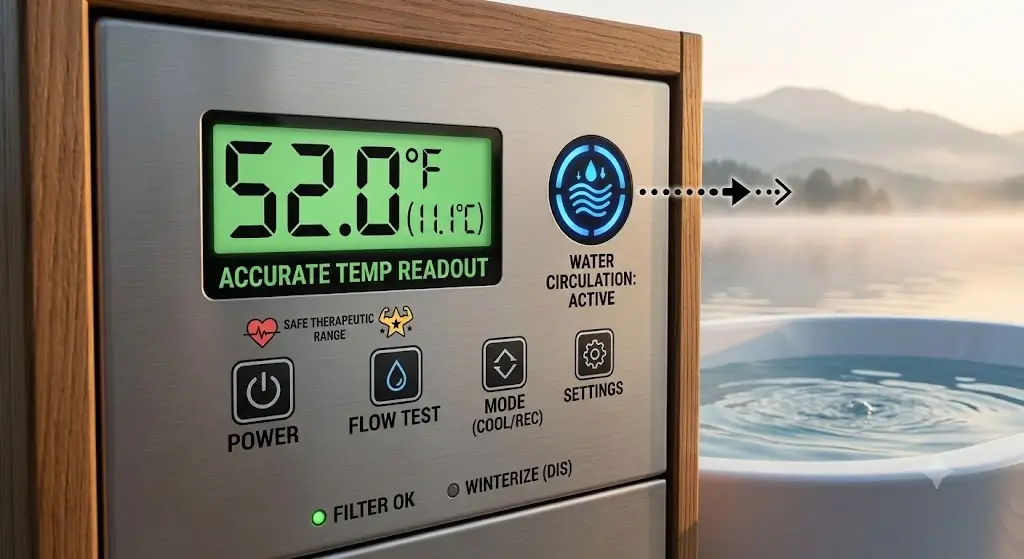
Water temperature can vary because of circulation, pump location, chiller placement, ambient air temperature, sunlight and insulation.
What matters when evaluating a cold-plunge system?
- Whether the displayed temperature is measured at the water inlet or elsewhere.
- Whether the system continuously circulates water.
- Whether the tub is insulated.
- Whether direct sunlight heats the water.
- Whether the temperature remains stable under actual operating conditions.
- Whether the thermometer has been independently checked for accuracy.
For product reviews, reporting temperature stability can provide more useful information than simply repeating the manufacturer’s minimum-temperature specification.
Cold Plunge Risks: Why Temperature Is a Safety Variable
Sudden whole-body submersion triggers the mammalian cold shock response, driving rapid hyperventilation and acute blood pressure surges. Cold-water immersion can produce significant physiological stress. It should not be treated as risk-free simply because the exposure is short:
- Rapid breathing or difficulty controlling breathing.
- Increased cardiovascular workload.
- Blood-pressure changes.
- Numbness and reduced motor control.
- Loss of coordination.
- Hypothermia with excessive exposure.
- Potential cold-related skin or nerve injury.
Cleveland Clinic specifically identifies breathing difficulties, cardiovascular stress, numbness, hypothermia and other cold-related risks associated with cold plunges.
Who Should Get Medical Advice Before Cold-Water Immersion?
Clinical contraindications prohibit unmonitored cold immersion for individuals diagnosed with cardiovascular disease, Raynaud’s phenomenon, or pregnancy. Cold exposure is not appropriate for everyone. Cleveland Clinic recommends discussing cold plunging with a healthcare professional for people with certain cardiovascular and circulation-related conditions and during pregnancy.
Examples identified by Cleveland Clinic include heart disease, high blood pressure, diabetes, pregnancy, peripheral neuropathy, poor circulation, venous stasis and cold agglutinin disease.
If there is any uncertainty about whether cold-water immersion is appropriate, the right question is not “What temperature should I use?” but “Is this activity appropriate for me at all?”
Cold Plunge and Exercise Recovery
Cryotherapy attenuates acute delayed-onset muscle soreness by constricting peripheral vascular beds and reducing localized tissue edema. Cold-water immersion has a legitimate place in sports-recovery research, particularly for reducing perceived muscle soreness and helping athletes manage recovery between demanding events.
However, recovery is not synonymous with adaptation.
The American College of Sports Medicine notes that cold-water immersion can improve aspects of short-term recovery, while also discussing concerns about interference with the biological processes associated with strength and hypertrophy.
That means a cold plunge should not automatically be positioned as an essential part of every workout routine.
Recovery versus training adaptation
| Question | Better way to evaluate it |
|---|---|
| Does it reduce soreness? | Look at evidence for delayed-onset muscle soreness and perceived recovery. |
| Does it improve performance? | Separate short-term recovery from long-term training adaptation. |
| Does colder equal better? | No. Temperature must be evaluated alongside exposure and risk. |
| Should everyone use it? | No. Individual health and training goals matter. |
Cold Plunge Temperature: What to Look for When Buying a Tub
Compressor cooling capacity and thermal wall insulation determine whether home plunge tubs maintain consistent target temperatures during hot summer months. For US consumers shopping for a home cold-plunge system, the minimum temperature specification should not be the only purchasing criterion.
1. Temperature control
Look for stable temperature control rather than an impressive minimum number that the system rarely maintains under real-world conditions.
2. Filtration
A cold-plunge system used repeatedly needs an effective approach to removing particles and managing water quality.
3. Sanitation
Evaluate the manufacturer’s sanitation system separately from filtration. Filtration removes particles; sanitation addresses microorganisms through whatever technology the manufacturer uses.
4. Insulation
Better insulation reduces heat transfer from the surrounding environment and can reduce the workload on the cooling system. If you are setting up a budget-friendly home routine without a fixed plumbed unit, explore our tested roundup of the best portable cold plunge on Amazon to see how multi-layered inflatable models perform against thermal drift.
5. Electrical requirements
Chillers and pumps can have meaningful electrical loads. US buyers should verify voltage, amperage and circuit requirements rather than assuming every cold plunge can use any household outlet.
6. Serviceability
A cold plunge is a water-and-electronics system. Filter access, drain design, replacement parts, winterization requirements and service support can matter more over several years than the initial temperature specification.
Cold Plunge Temperature: The Most Important Takeaway
Therapeutic outcomes depend on safe duration and temperature consistency rather than pursuing dangerously low chiller setpoints. The most useful cold-plunge temperature guide is not a race toward the coldest possible water. It is an explanation of how temperature changes physiological stress and how that variable fits into the larger picture of cold-water immersion.
Research commonly uses temperatures around 50–60°F, but studies vary and these numbers should not be interpreted as universal instructions. ACSM’s review identifies both approximately 50°F and approximately 52–60°F protocols in the recovery literature.
Medical guidance is more conservative about extreme cold. Cleveland Clinic specifically advises avoiding water below 40°F and emphasizes gradual exposure, short exposure and individual medical considerations.
Cold Plunge Temperature FAQ
Clinical consensus provides clear guidelines on safe temperature ranges, muscle hypertrophy trade-offs, and medical contraindications. Technical answers to common user questions are outlined below:
What temperature is a cold plunge?
There is no single official temperature definition. Cold-water immersion research commonly examines water temperatures from roughly the low 50s to around 60°F, although studies use different protocols.
Is 50°F cold enough for a cold plunge?
50°F (10°C) is within the temperature range used in published cold-water immersion research. However, research conditions should not automatically be treated as a personal-use prescription.
Is 40°F too cold for a cold plunge?
It represents a much more aggressive cold exposure. Cleveland Clinic advises avoiding water below 40°F because colder temperatures increase the risks associated with cold-water immersion.
Does colder water provide better recovery?
Not necessarily. Lower temperatures increase cold stress, but that does not establish a proportional increase in recovery benefits.
What temperature does research use for muscle recovery?
ACSM’s review describes research using approximately 50°F (10°C) and other studies using approximately 52–60°F (11–15°C).
Can a cold plunge interfere with muscle growth?
Some evidence and expert discussion suggest that frequent immediate cold exposure following resistance training may interfere with aspects of muscle adaptation. Timing and training goals therefore matter.
Is cold plunging safe for everyone?
No. Cold-water immersion can create cardiovascular, respiratory and temperature-regulation stress. People with certain health conditions should obtain medical advice before considering it.
What is the safest way to choose a cold-plunge temperature?
Do not choose a temperature simply because a commercial chiller can reach it. Consider the evidence, the physiological stress associated with colder water and whether cold-water immersion is appropriate for the individual.
Editorial Methodology
BiohackTub prioritizes empirical peer-reviewed recovery data over exaggerated manufacturer chiller specifications. A product’s advertised minimum temperature is treated as a technical specification, not proof of superior health or recovery outcomes.
For future cold-plunge product reviews, BioHackTub evaluates temperature control, insulation, circulation, filtration, sanitation, electrical requirements, maintenance and real-world ownership rather than ranking products solely by minimum temperature.
Medical and scientific information should not replace individualized medical advice. Cold-water immersion can carry meaningful risks, particularly at lower temperatures.
