
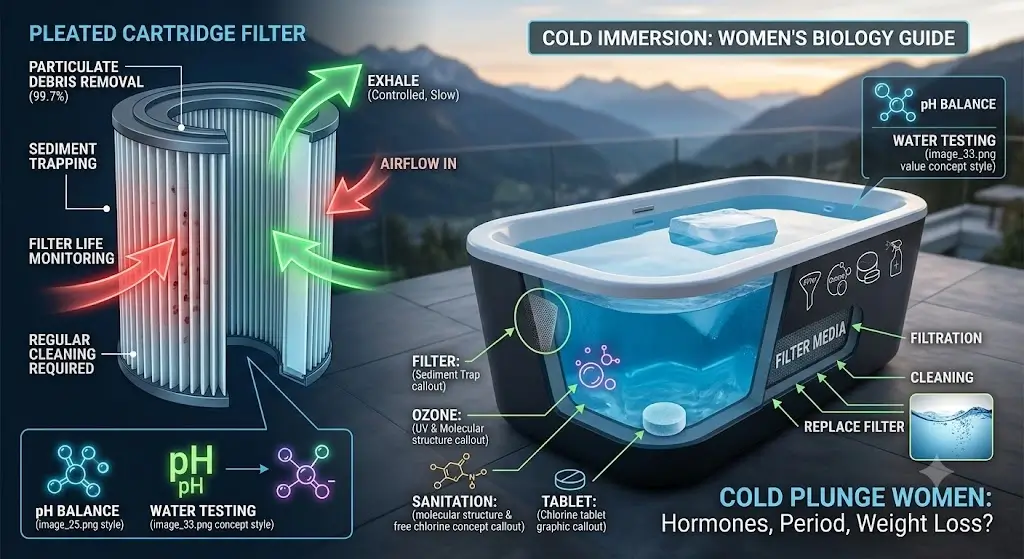
Hydrochemistry Metrology
Recirculation Hygiene • 2026
Cold Plunge Water Maintenance: Cleaning, Filtration, Sanitizing & Water Changes
Key Technical Takeaways: Cold Plunge Water Care
- Thermal Stasis Fallacy: Cold water (40°F–55°F) inhibits bacterial growth rates but does NOT sterilize water; psychrotrophic microbes, Pseudomonas biofilm, and organic skin sloughing persist without active sanitization.
- The 4-Pillar Hygiene Standard: Long-term water clarity requires continuous mechanical micron filtration (20–50 microns), chemical or non-halogen sanitization (0.5–1.0 ppm free chlorine, non-chlorine shock, or stabilized hydrogen peroxide), daily bather pre-rinse, and UV-resistant opaque covers.
- Water Change Cycles: Untreated ice tubs require complete drainage every 3 to 5 days; plumbed systems with active filtration and ozone/UV sanitation operate reliably for 60 to 90 days before total dissolved solids (TDS) demand replenishment.
- Chiller Protection: Regular filter rinsing and pre-chiller strainers prevent organic sediment from fouling titanium coaxial heat exchangers, preventing costly compressor burnouts.
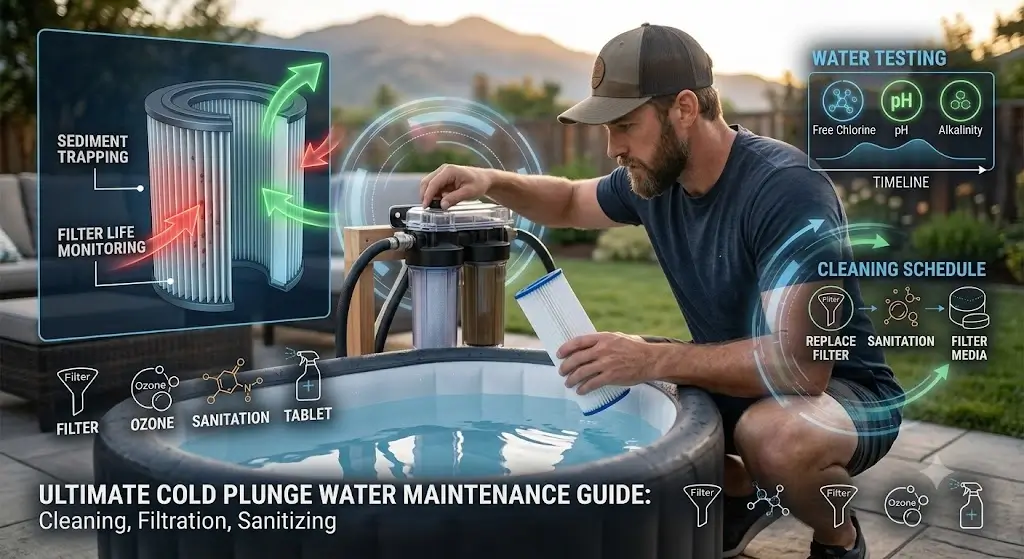
The cleanest cold plunge is not maintained by one chemical or one filter. Reliable water quality comes from a system: clean users + physical filtration + appropriate sanitation + water testing + regular surface cleaning + good circulation + a fitted cover. How often you need to replace the water depends on the specific tub, bather load, sanitation system and test results.
A cold plunge can look deceptively simple: fill the tub, cool the water and get in.
The maintenance problem starts after the first few uses.
Every person entering the water introduces some combination of sweat, skin cells, oils, cosmetics, hair and environmental debris. Cold temperatures slow some biological processes, but they do not make water sterile.
That distinction is critical for anyone running a cold plunge at home.
A tub with a chiller, circulation pump and filter can maintain water for substantially longer than an uncovered container filled with untreated water. But the equipment only works when the water chemistry, filtration and plumbing are maintained correctly.
This guide explains the complete cold plunge water maintenance system, including what to clean, what to test, how filtration works, when water should be changed and how to troubleshoot common problems such as cloudy water, odors and slimy surfaces.
Quick Reference Specification: Cold Plunge Water Chemistry & Hardware Protocol Matrix
Water quality metrology identifies chemical thresholds, filtration intervals, and mechanical parameters necessary to prevent biological biofilm without corroding plunge hardware. The reference table below details target ranges, testing schedules, and operational functions across core hydrochemical parameters:
| Maintenance Parameter | Target Operating Range | Testing / Service Frequency | Primary Hydrochemical Function | Consequence of Non-Compliance |
|---|---|---|---|---|
| Free Sanitizer (Chlorine/Bromine) | 0.5 – 1.5 ppm (Low Halogen) | 2 to 3 times weekly | Active biological disinfection & algae suppression | Bacterial proliferation (<0.5); skin/eye irritation (>3.0) |
| Hydrogen Peroxide (H2O2) Alternative | 30 – 100 ppm (Food Grade 35%) | Weekly test strip verification | Non-halogen oxidative bacterial eradication | Oxidative failure (<30 ppm); dermal blanching (>150 ppm) |
| Water pH Balance | 7.2 – 7.6 (Optimal 7.4) | Weekly | Ensures sanitizer efficacy & metal passivity | Chiller coil corrosion (<7.2); scale formation & clouding (>7.8) |
| Sediment Micron Filter | 20 – 50 Micron Pleated Cartridge | Rinse weekly / Replace monthly | Mechanical extraction of dead skin, hair & debris | Reduced pump flow, low-flow chiller error codes |
| Total Dissolved Solids (TDS) Flush | Baseline tap + < 1,000 ppm | Full drain every 60–90 days | Resets accumulated mineral and bather waste load | Persistent turbidity, foaming, sanitizer lock |
How Do You Maintain Cold Plunge Water?
Systematic cold plunge water maintenance controls particulate accumulation, biological pathogens, and dissolved bather waste simultaneously. The simplest approach combines four key containment layers:
- Contamination entering the tub
- Particles remaining suspended in the water
- Microbial growth
- Debris and contamination accumulating in the plumbing and surfaces
A practical maintenance system therefore combines several layers.
| Maintenance layer | Primary job |
|---|---|
| Pre-use hygiene | Reduces sweat, oils, cosmetics and dirt entering the water. |
| Mechanical filtration | Captures suspended particles. |
| Sanitation | Controls microorganisms according to the system’s approved method. |
| Water testing | Shows whether the treatment system is operating within its intended parameters. |
| Surface cleaning | Removes residue that filtration cannot remove from the tub itself. |
| Circulation | Moves water through the filter and treatment system. |
| Cover | Reduces debris, sunlight and environmental contamination when the tub is idle. |
Cold water is not a substitute for sanitation. If people repeatedly enter an untreated tub, the water can deteriorate even when it still looks clear.
The Cold Plunge Water-Maintenance System
Continuous closed-loop plumbing cycles plunge water through mechanical filtration and chemical sanitation to prevent biofilm formation. Think of a cold plunge as a small recirculating water system rather than simply a large bathtub.
Once a chiller and pump are added, the water travels through plumbing, fittings, filters and heat-exchange equipment. Contamination can therefore exist in places that are not visible from the surface.
1. Reduce Contamination Before It Enters
One of the cheapest maintenance improvements is also one of the most effective: shower before entering. A pre-plunge rinse removes sweat, sunscreen, body oils, cosmetics, loose skin and environmental dirt before those materials reach the water. This is especially true if you are jumping in after an intense training session—see our breakdown on cold plunge workout timing protocols to balance recovery and water hygiene.
2. Remove Particles Mechanically
A filter captures suspended particles that would otherwise remain in circulation. The filter does not replace sanitation because microorganisms and dissolved contaminants are not necessarily removed simply because a filter is installed.
3. Control Microbial Growth
The sanitation method depends on the specific cold plunge. Some systems are designed around chlorine-based treatment, while others use different approaches or manufacturer-specific combinations of filtration and sanitation. Always follow the tub and chiller manufacturer’s instructions.
4. Clean the Surfaces
Water treatment does not remove every residue from the walls, floor, plumbing connections or waterline. Physical cleaning remains necessary.
How Often Should You Change Cold Plunge Water?
Bather load volume and total dissolved solids determine exact water change frequency rather than arbitrary calendar schedules. There is no scientifically useful single answer such as “every seven days” that applies to every cold plunge.
Water replacement depends on:
- Number of bathers
- Frequency of use
- Whether users shower before entry
- Water volume
- Filtration capacity
- Sanitation system
- Water-testing results
- Outdoor versus indoor installation
- Use of a cover
- Environmental debris
A small untreated plunge used frequently may need much more frequent water replacement than a larger recirculating system with filtration and appropriate sanitation.
| Setup | Relative maintenance burden | Water-change strategy |
|---|---|---|
| Unfiltered tub (e.g. entry-level inflatable plunge pods) | High | Rely more heavily on frequent water replacement (every 3–5 days) and physical cleaning. |
| Filtered tub | Moderate | Maintain filter and monitor water quality. Change every 2–4 weeks. |
| Filtered + sanitized system | Lower ongoing water burden | Follow manufacturer water-testing and replacement guidance (typically 60–90 days). |
| Integrated chiller/filtration/sanitation system | System-dependent | Follow the complete equipment maintenance schedule. |
Water can look clean while containing contaminants that are not visible.
Cold Plunge Filtration: Why It Matters
Pleated sediment cartridges physically capture suspended organic particulates before water enters delicate refrigeration chiller coils. As water circulates, the filter captures suspended material, reducing the amount of particulate matter moving through the pump, chiller and plumbing.
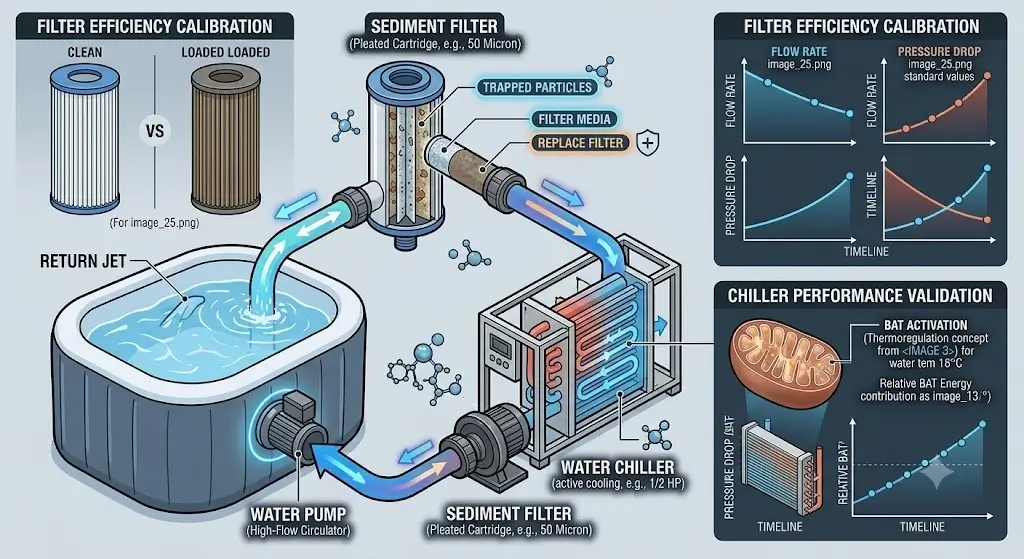
The filter therefore serves two jobs:
- Improving water clarity
- Reducing the contaminant load circulating through the system
However, filtration should not be confused with disinfection.
What Does a Cold Plunge Filter Remove?
Depending on filter construction and pore characteristics, mechanical filters can capture suspended particles such as dust, hair, skin debris and other particulate material. They do not automatically eliminate every microorganism or dissolved chemical.
What Filter Size Is Best?
There is no universal micron rating that is optimal for every cold plunge. A finer filter (e.g., 20 or 50 microns) can capture smaller particles, but finer filtration can also create greater flow resistance and may require more frequent cleaning. The filter must therefore be matched to the pump and plumbing system.
Cold Plunge Water Sanitization
Active sanitizers destroy pathogenic microorganisms and neutralize hazardous bacterial growth in cold aquatic environments. The appropriate method depends on the equipment.
Common approaches found in residential water systems include chlorine-based sanitation and other manufacturer-specific technologies. Some cold plunge products also incorporate ozone or UV-based components.
A sanitation technology should not automatically be assumed to replace all other maintenance. A UV unit, ozone generator or filter has a specific role in the system, and the manufacturer should define the operating procedure.
Chlorine
Chlorine-based treatment is widely used in water sanitation because it provides an established method of controlling microorganisms when maintained at appropriate levels. But not every cold plunge is designed for the same chemical treatment. Chemical compatibility matters because some tubs, liners, pumps, seals, chillers and plumbing components may have specific requirements.
Ozone
Ozone can be incorporated into some water-treatment systems. Its presence does not mean the water requires no other maintenance.
UV
Ultraviolet treatment can expose recirculated water to UV-C light within an appropriately designed chamber. UV treatment is dependent on system design, flow rate, lamp condition and exposure. It is therefore not equivalent to simply placing a UV light near the water.
Cold Plunge Water Testing
Colorimetric test strips measure free sanitizer levels and pH balance to prevent corrosive plumbing damage and skin irritation. Water testing is the feedback mechanism for a maintenance system. Without testing, you are largely guessing whether a chemical sanitation system is operating within its intended range.
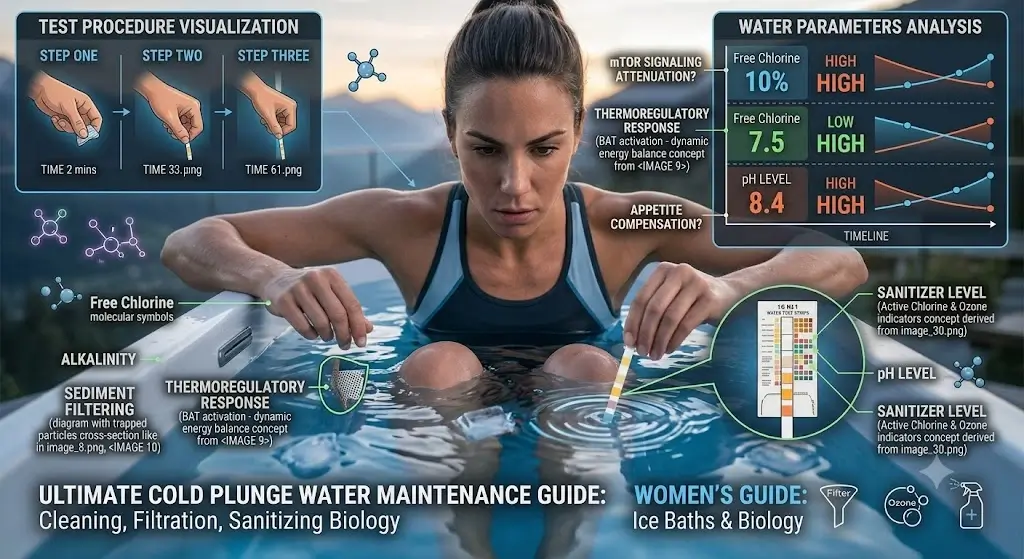
The exact parameters to monitor depend on the sanitation method and manufacturer instructions.
| Parameter | Why it matters |
|---|---|
| Sanitizer level | Indicates whether the sanitation system is providing the intended treatment. |
| pH | Important for the performance and stability of many chemical sanitation systems. |
| Water clarity | Useful visual indicator, but not a substitute for testing. |
| Odor | Can indicate an underlying water-quality or maintenance issue. |
| Surface condition | Slime or residue can indicate inadequate cleaning or water treatment. |
Use test strips or test kits appropriate for the sanitation chemistry used by your particular system.
How to Clean a Cold Plunge
Complete basin drain-downs require non-abrasive detergents to scrub accumulated waterline oils and microbial slime. A proper cleaning session should include more than wiping the visible waterline.
Step 1: Drain the Tub
Drain the water according to the manufacturer’s instructions and local disposal requirements.
Step 2: Remove Visible Debris
Remove hair, leaves, insects and other visible material.
Step 3: Clean the Interior
Use a cleaning product compatible with the tub material. Avoid abrasive tools that can damage liners or polished surfaces.
Step 4: Clean Fittings and Waterline
Pay attention to areas around drains, jets, inlet ports and waterline deposits.
Step 5: Inspect the Filter Housing
Residue can accumulate around the filter compartment even when the main tub looks clean.
Step 6: Inspect Plumbing
Look for visible buildup, leaks, discoloration or damaged connections.
Step 7: Refill and Restart
After cleaning, refill according to the equipment manufacturer’s procedure and restore filtration, circulation and sanitation.
How to Clean a Cold Plunge Filter
Weekly cartridge rinsing preserves hydraulic circulation and prevents high head-pressure errors on digital water chillers. Filter maintenance is one of the easiest areas to neglect. A filter can continue to look functional while becoming increasingly restricted by trapped debris. A restricted filter can reduce water flow and increase the workload on the circulation system.
- Turn off the pump and chiller before accessing the filter.
- Remove the filter according to the manufacturer’s instructions.
- Inspect the filter for heavy debris or discoloration.
- Clean or rinse it using the method approved by the manufacturer.
- Replace disposable filters rather than repeatedly washing them if they are designed for single-use replacement.
- Inspect the filter housing before reinstalling it.
- Restart the system and verify normal circulation.
Improper operation can damage equipment.
Cold Plunge Chiller Maintenance
Air-cooled condensing coils demand clear ventilation pathways and seasonal descaling flushes to maintain cooling efficiency. A chiller is often the most expensive technical component in a cold plunge. Water-quality problems can therefore become equipment problems if contaminated water is allowed to circulate indefinitely.
Maintain Adequate Flow
The chiller depends on water circulation within its specified operating range. A clogged filter or restricted plumbing can reduce flow.
Keep Airflow Clear
Air-cooled chillers need adequate ventilation. Dust buildup around air intakes or exhaust areas can reduce heat-transfer performance.
Follow the Manufacturer’s Flushing Procedure
Different chillers use different internal materials and plumbing designs. Do not assume that a generic descaling or chemical-flushing procedure is safe for every model. Use the manufacturer’s procedure for flushing, cleaning and winterization.
How to Prevent Biofilm in a Cold Plunge
Persistent biological slime layers colonize internal plumbing walls when sanitizer levels fall below baseline thresholds. Biofilm is a microbial community that can adhere to surfaces rather than remaining suspended in the water. This matters because a water sample can appear acceptable while buildup remains inside difficult-to-reach areas.
Prevention depends on:
- Appropriate sanitation
- Regular circulation
- Filter maintenance
- Surface cleaning
- Regular water replacement when required
- Cleaning plumbing and equipment according to manufacturer instructions
If a tub repeatedly develops a slippery or slimy surface, simply adding more sanitizer without identifying the underlying maintenance problem is not a good long-term strategy.
Why Is My Cold Plunge Water Cloudy?
Cloudy plunge water indicates exhausted filter capacity, inadequate sanitizer dosing, or excessive suspended organic particulate matter. Cloudy water usually means something in the filtration, sanitation or contamination-control process is not working as intended.
| Possible cause | What to inspect |
|---|---|
| Dirty filter | Inspect and clean or replace the filter. |
| Heavy bather load | Improve pre-plunge hygiene and review water-change frequency. |
| Insufficient circulation | Check pump operation, filter restriction and water level. |
| Inadequate sanitation | Test the system according to its approved sanitation method. |
| Accumulated organic matter | Drain and physically clean the tub and accessible components. |
Do not attempt to solve persistent cloudy water simply by making the water colder.
Why Does My Cold Plunge Smell Bad?
Foul odors in cold plunge water originate from anaerobic bacterial proliferation and decomposing organic skin debris. Cold plunge water should not develop a strong unpleasant odor simply because it is cold. Odor can be associated with organic contamination, inadequate sanitation, stagnant areas or buildup in the plumbing system.
The first troubleshooting steps should be:
- Check water quality according to the system’s testing requirements.
- Inspect and clean the filter.
- Inspect the waterline and tub surfaces.
- Check circulation.
- Review how frequently users shower before entering.
- Consider whether the water is overdue for replacement.
- Follow the manufacturer’s procedure for cleaning the circulation system.
How to Prevent Algae in an Outdoor Cold Plunge
Direct sunlight penetration fuels photosynthetic algae blooms even in water cooled below fifty degrees Fahrenheit. Outdoor cold plunges have additional exposure to sunlight, pollen, insects, leaves and airborne debris. A cover is therefore especially valuable. Limiting sunlight and contamination reduces the environmental load entering the water. Adequate circulation and appropriate sanitation also matter.
A fitted, opaque cover can reduce both debris entry and heat gain when the cold plunge is not being used.
Outdoor Cold Plunge Water Maintenance
Outdoor cold plunge installations require rigorous skimming and seasonal winterization to avoid freezing pipe fractures. Outdoor systems require additional attention because the environment constantly introduces contaminants.
Leaves and Pollen
Skim visible debris before it reaches the filter.
Rainwater
Rain can introduce environmental contaminants and dilute or alter water chemistry. After significant rainfall, inspect the water and retest according to your system’s maintenance procedure.
Sun Exposure
Direct sunlight increases heat gain and can affect some water-treatment systems.
Winter Conditions
Freezing temperatures can damage plumbing, pumps and chillers if the system is not designed for freezing conditions. Follow the manufacturer’s winterization procedure rather than improvising.
Indoor Cold Plunge Water Maintenance
Indoor plunge environments generate substantial condensation that requires dedicated ambient room ventilation and floor drainage. Indoor installations eliminate some environmental problems but introduce another concern: condensation.
Cold water can create a substantial temperature difference between the water surface and surrounding air. This can cause moisture to condense around the tub, plumbing and nearby surfaces.
A good indoor setup should therefore include:
- Water-resistant flooring
- Appropriate drainage
- Ventilation
- A fitted cover
- Space around the chiller for airflow
- Protection for nearby electrical equipment
Cold Plunge Water Maintenance Schedule
Structured preventative maintenance routines organize daily, weekly, and seasonal sanitization tasks into predictable workflows. The exact schedule should follow your equipment manufacturer’s requirements, but a layered routine makes maintenance easier to manage.
| Frequency | Maintenance task |
|---|---|
| Every use | Shower before entering; remove visible debris; cover the tub afterward. |
| Regularly | Inspect water clarity, odor, waterline and circulation. |
| On the manufacturer’s schedule | Test water parameters and maintain sanitizer levels where applicable. |
| Weekly or as required | Inspect and clean or replace filtration components according to their instructions. |
| Periodically | Deep-clean the tub, fittings and accessible plumbing. |
| Seasonally | Inspect the chiller, hoses, cover, drainage and outdoor protection. |
| When required | Drain and replace water based on system requirements and water quality. |
- ☐ Shower before every session
- ☐ Keep the tub covered
- ☐ Inspect water clarity
- ☐ Check for odor or surface slime
- ☐ Maintain the filter
- ☐ Verify circulation
- ☐ Test water according to the sanitation system
- ☐ Clean the tub and waterline
- ☐ Inspect hoses and fittings
- ☐ Follow the chiller maintenance schedule
- ☐ Drain and refill when required
7 Cold Plunge Water Maintenance Mistakes to Avoid
Home plunge owners frequently compromise water safety by assuming near-freezing temperatures replace chemical sanitization. Avoid these seven common maintenance pitfalls:
1. Assuming Cold Water Is Sterile
Cold water slows some processes but does not make contaminated water sterile.
2. Relying Only on a Filter
Mechanical filtration and microbial sanitation perform different jobs.
3. Relying Only on Water Clarity
Clear water is not proof that all water-quality parameters are acceptable.
4. Ignoring the Filter Housing
Contamination can accumulate in the areas surrounding the filter.
5. Forgetting the Plumbing
A clean-looking basin does not guarantee that every part of the circulation system is clean.
6. Using Unapproved Chemicals
A chemical that works in one pool or spa system may not be appropriate for another cold plunge.
7. Never Cleaning the Chiller
The chiller is part of the water circuit and needs to be maintained according to its manufacturer’s requirements.
What Is the Best Way to Keep Cold Plunge Water Clean?
Consistent execution of pre-plunge hygiene and balanced chemical filtration provides the most dependable water sanitation. The highest-value improvement for most home users is not buying the most complicated sanitation technology. It is building a consistent maintenance routine.
- Shower before entering.
- Use appropriate filtration.
- Use the sanitation method approved for your system.
- Test the water as required.
- Clean the tub and waterline.
- Maintain the filter.
- Keep the tub covered.
- Maintain circulation and the chiller.
- Replace the water when the system requires it.
This layered approach is more reliable than trying to solve every water-quality problem with one product. To calibrate session duration and water temperature against bather load, read our comprehensive guide on what is a cold plunge.
Cold Plunge Water Maintenance: The Bottom Line
Proactive water maintenance protects user health while preventing premature failure of costly refrigeration chillers. Maintaining a cold plunge is fundamentally a water-management problem.
The water may be cold, but it still receives sweat, skin oils, debris and other contaminants every time someone enters.
A high-quality maintenance system therefore combines hygiene, filtration, sanitation, testing, circulation and physical cleaning.
The biggest mistake is treating one component—such as a filter, ozone generator, UV system or cold temperature—as a substitute for the entire maintenance process.
Keep contaminants out, remove particles mechanically, control microorganisms using the system’s approved sanitation method, test the water, clean the physical surfaces and maintain the circulation equipment. That is the foundation of reliable cold plunge water maintenance.
Building a Home Cold Plunge Setup?
Before investing in hardware, compare thermal retention, filtration integration, chiller flow ratings, and sanitization compatibility. Explore our benchmark guide: Best Inflatable Ice Bath Tubs Under $150.
Frequently Asked Questions
Technical equipment answers clarify common questions regarding chlorine compatibility, filter replacement cycles, and cloudy water causes. Key maintenance answers are detailed below:
How often should cold plunge water be changed?
There is no universal interval. Water-change frequency depends on water volume, user frequency, filtration, sanitation, hygiene, cover use and water-testing results. Follow the manufacturer’s maintenance instructions for the specific system.
How do you keep cold plunge water clean?
Use pre-plunge showers, mechanical filtration, appropriate sanitation, water testing, surface cleaning, adequate circulation and a fitted cover. These systems work together rather than independently.
Can you use chlorine in a cold plunge?
Some systems can use chlorine-based sanitation, but compatibility varies. Only use chemicals and concentrations approved for your specific tub and circulation system.
Do cold plunges need a filter?
A filter is strongly useful in a recirculating system because it removes suspended particles and reduces the contaminant load circulating through the plumbing and chiller.
How often should a cold plunge filter be cleaned?
Inspect the filter regularly and clean or replace it according to the manufacturer’s instructions. Heavy use or visible loading may require more frequent maintenance.
Why does cold plunge water become cloudy?
Common causes include suspended debris, a dirty filter, inadequate circulation, insufficient sanitation or accumulated organic contamination.
Why does my cold plunge smell?
An unpleasant odor can indicate organic contamination, inadequate sanitation, stagnant areas or buildup in the plumbing. Check filtration, circulation, water quality and cleaning procedures.
Can I leave my cold plunge uncovered?
You can, but a cover is generally preferable because it reduces debris entry, sunlight exposure and heat gain while the tub is not being used.
Does cold water kill bacteria?
Cold temperature alone should not be treated as a reliable disinfection method. Water sanitation and proper maintenance remain necessary.
Does an ozone generator mean I never need to change cold plunge water?
No. Ozone may be one component of a water-treatment system, but it does not eliminate the need for filtration, cleaning, monitoring and water replacement when required.
How do I maintain a cold plunge chiller?
Maintain filters and circulation, keep the chiller’s airflow clear and follow the manufacturer’s specific flushing, cleaning and winterization instructions.
Editorial Standards
BioHackTub enforces strict engineering testing protocols when evaluating water sanitation, filtration micron ratings, and chiller component longevity. We separate equipment specifications from real-world maintenance requirements. Water-quality recommendations should be matched to the specific tub, filtration system, sanitation technology and manufacturer’s instructions rather than treated as universal instructions for every cold plunge.
This article is educational and does not replace the manufacturer’s operating instructions or individualized professional advice.
