
Hardware Architecture
Comparative Biohacking
Infrared vs Traditional Sauna: What Is the Difference?
•
Engineering & Biophysics Audit: Dr. Alex Mercer, CSCS
•
Updated October 2026
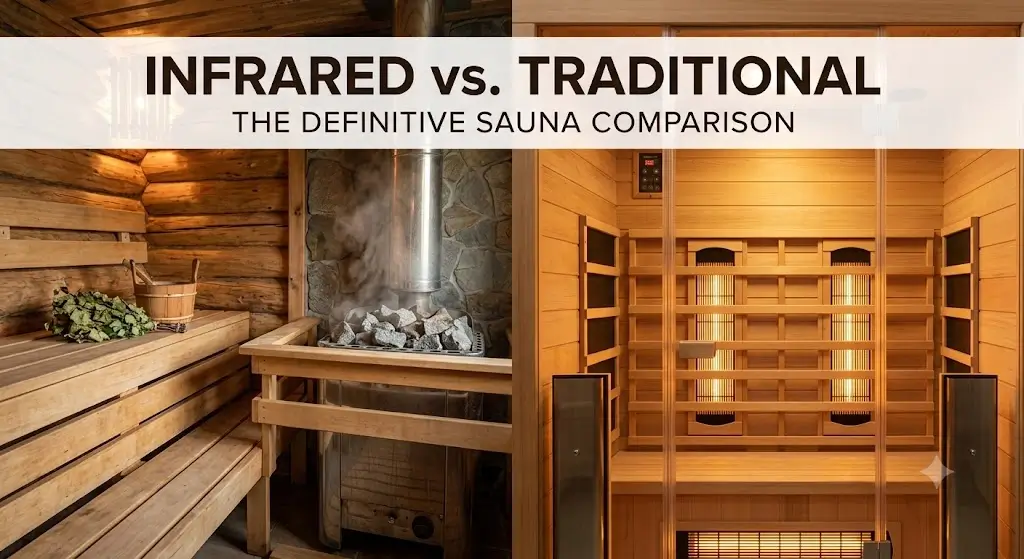
Infrared and traditional saunas create heat in fundamentally different ways. A traditional sauna heats the surrounding air and surfaces, while an infrared sauna uses infrared radiation to transfer energy directly to objects and the body. That difference affects operating temperature, humidity, warm-up behavior, room design, energy requirements and the overall experience.
For most home buyers, the decision is not simply about which sauna gets hotter. The more useful question is which heating system matches your available space, electrical supply, preferred heat intensity, installation requirements, maintenance expectations and reason for using a sauna.
Quick Reference Specification: Infrared vs. Traditional Systems
Thermodynamic testing benchmarks isolate primary heat transfer vectors, operating ambient ranges, and infrastructure footprints across sauna categories. The engineering comparison table below synthesizes electrical demand, ambient temperatures, and structural criteria across both technologies:
| System Metric | Traditional Finnish Sauna | Full-Size Infrared Cabin | Engineering Significance |
|---|---|---|---|
| Primary Thermodynamics | Air Convection + Heated Rock Radiation | Direct Radiant Electromagnetic Emission | Infrared warms tissue water directly without heating bulk cabin air first |
| Ambient Operating Range | 150°F – 195°F+ (65°C – 90°C+) | 110°F – 150°F (43°C – 65°C) | Infrared maintains comfortable respiratory conditions for air-sensitive users |
| Pre-Heat Ramp Duration | 30 to 45 Minutes | 10 to 20 Minutes | Rock thermal mass in traditional heaters requires substantial thermal absorption time |
| Electrical Circuit Load | 4.5 kW – 9.0 kW (240V / 30–50A Dedicated) | 1.5 kW – 3.0 kW (120V / 15A or 20A) | Compact infrared systems run on standard domestic outlets without panel upgrades |
| Relative Humidity Control | 10% – 40% (Variable via Water on Stones) | Strictly Dry (<10% Relative Ambient) | Traditional units allow steam bursts (löyly); water is prohibited on infrared carbon panels |
| Structural Installation Burden | High (Dedicated ventilation, floor drain, vapor barrier) | Low to Moderate (Modular indoor clip-together kits) | Infrared modular booths assemble in spare bedrooms without complex moisture barriers |
Infrared vs Traditional Sauna: Side-by-Side Comparison
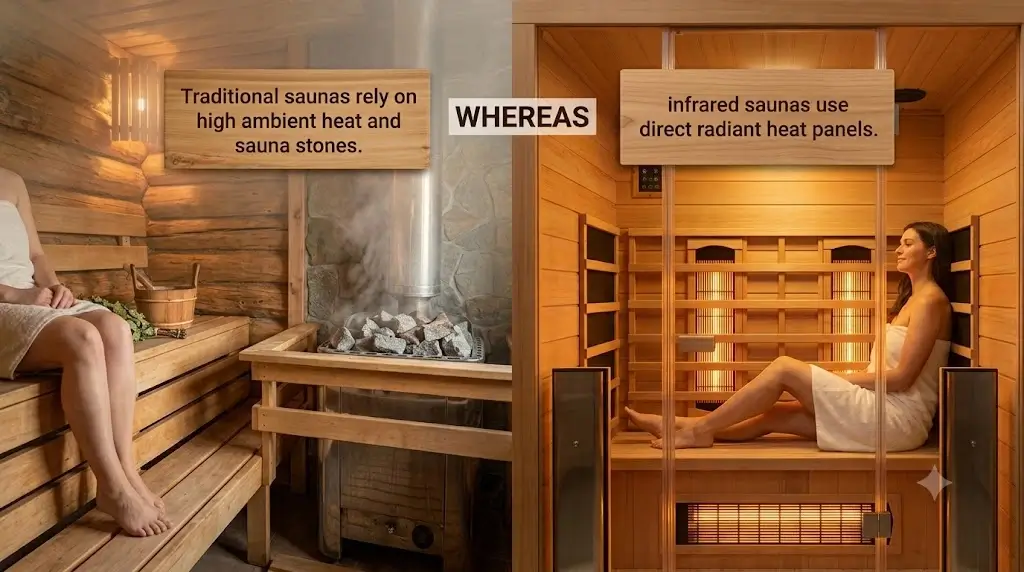
Convective hot-air transfer distinguishes traditional Finnish sauna cabins from radiant infrared emitter technology. The biggest difference is the mechanism used to deliver heat. Traditional saunas primarily heat the room and then transfer heat to the body through hot air, radiation from heated surfaces and, when water is poured over sauna stones, humid air. Infrared cabins rely primarily on radiant infrared energy from dedicated emitters.
| Feature | Infrared Sauna | Traditional Sauna |
|---|---|---|
| Primary heat source | Infrared emitters | Electric or wood sauna heater with stones |
| Typical operating temperature | Generally lower ambient temperature | Substantially higher ambient temperature |
| Heating mechanism | Radiant infrared energy | Heated air, surfaces and sauna stones |
| Humidity | Usually low humidity | Dry by default; humidity can increase when water is used on stones |
| Steam capability | Not normally designed for steam | Traditional sauna stones can create short bursts of steam |
| Warm-up | Usually faster for small residential cabins | Room and stones need to reach operating temperature |
| Electrical load | Often lower for compact units | Can require higher-power dedicated electrical circuits |
| Installation | Often simpler for indoor residential models | Usually more involved, especially for larger cabins |
| Classic sauna experience | Limited | Strong |
| Hot-rock experience | No | Yes |
| Best fit | Lower-temperature radiant heat and residential convenience | Traditional high-heat sauna experience |
How Infrared and Traditional Saunas Produce Heat
Resistive stove elements heat ambient air molecules whereas carbon panels emit radiant electromagnetic waves. The two modalities engage human physiology through fundamentally divergent physical pathways.
Traditional sauna: heat the room first
A conventional sauna heater raises the temperature of the sauna room. Electric heaters typically use resistance heating elements to heat sauna stones. Wood-burning heaters use combustion to produce heat, which is transferred to the heater and surrounding room.
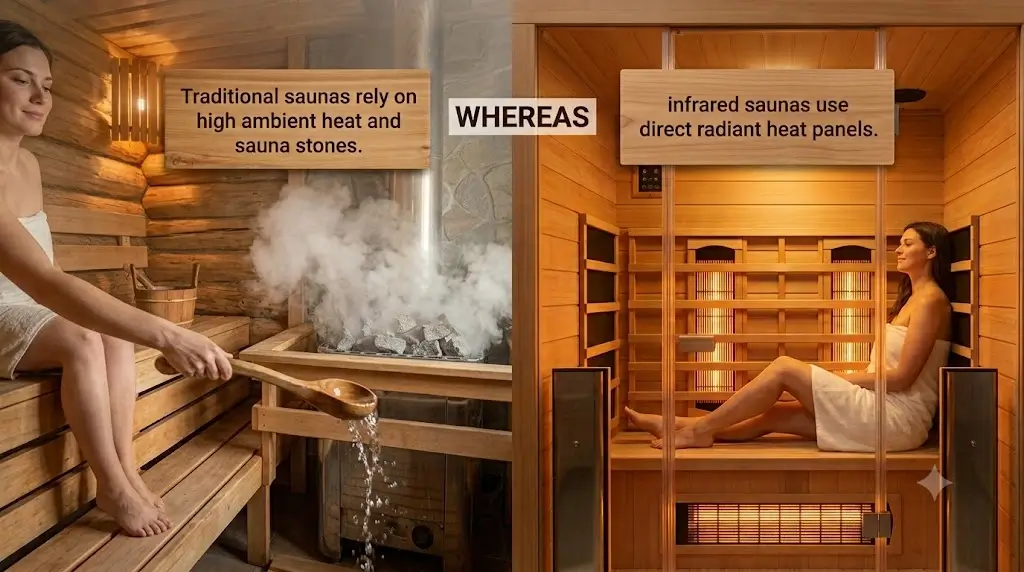
Once the room is hot, the body gains heat through a combination of convection from the hot air, radiation from heated surfaces and direct contact with hot surfaces when applicable.
In a traditional Finnish-style sauna, water can be poured over heated stones to produce a burst of steam. This temporarily increases humidity and changes the perceived intensity of the heat.
Infrared sauna: radiant energy is the primary mechanism
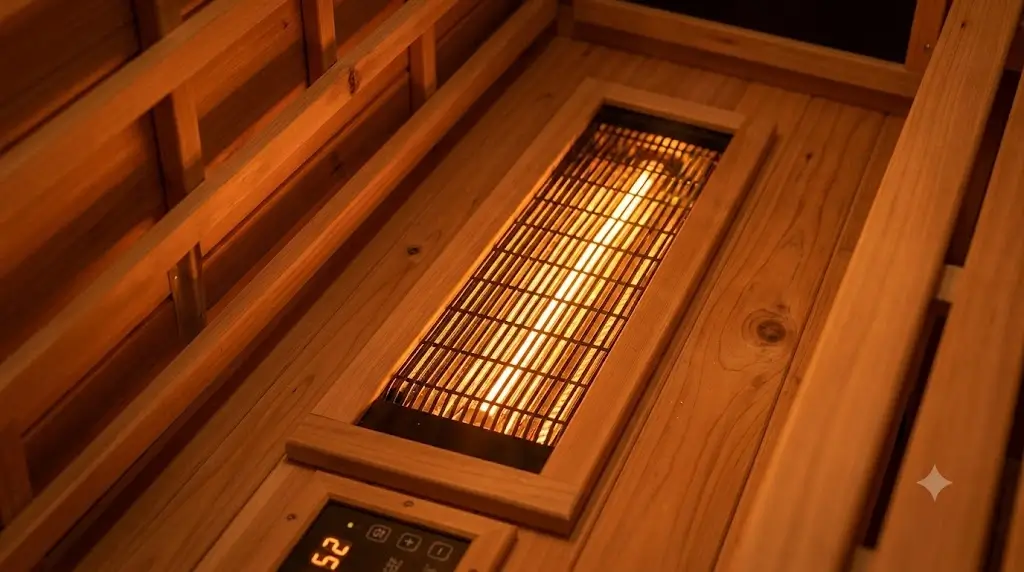
Infrared sauna cabins use electrically powered infrared emitters. Instead of relying primarily on very hot air, the system emits infrared radiation that is absorbed by surfaces exposed to the radiant energy.
This allows the cabin to operate at a lower ambient temperature than a traditional sauna while still creating a noticeable heating sensation.
Infrared vs Traditional Sauna Temperature
Finnish sauna cabins maintain ambient air temperatures up to 200°F while infrared cabins operate between 110°F and 150°F. Temperature is one of the easiest differences for a consumer to understand, but it is also one of the most commonly misunderstood. For a detailed breakdown of element settings versus internal core temperature shifts, consult our guide on how hot do infrared saunas get.
Traditional Finnish-style saunas are designed for substantially higher air temperatures than infrared cabins. Infrared models generally operate at lower ambient temperatures because radiant energy contributes directly to the heating sensation.
| Temperature characteristic | Infrared | Traditional |
|---|---|---|
| Room temperature | Lower | Higher |
| Perceived heat | Radiant and localized | High ambient heat plus radiant heat |
| Heat-up requirement | Usually less room heating required | Entire room and heater/stones need heating |
| Heat intensity | Generally gentler ambient environment | Much more intense high-temperature environment |
This is why someone who dislikes extremely hot air may prefer infrared even though both systems produce substantial heat exposure.
Infrared vs Traditional Sauna Humidity
Water vapor from ladled stones increases humidity to 40% in traditional saunas while infrared rooms stay dry. Humidity is another major difference.
Infrared cabins are generally designed to operate as dry environments. They are not normally built around the use of water on heating elements.
Traditional sauna heaters with stones provide a different option. Pouring a small amount of water over properly heated sauna stones creates steam and increases humidity temporarily.
This does not turn a traditional sauna into a steam room. A Finnish sauna remains a high-temperature environment where humidity can fluctuate rather than a continuously humid steam chamber.
| Experience | Infrared | Traditional sauna |
|---|---|---|
| Dry heat | Yes | Yes |
| Water on stones | No | Yes, when heater is designed for it |
| Short humidity bursts | No | Yes |
| Steam-room environment | No | No |
How Infrared Saunas Work
Carbon and ceramic heating emitters produce electromagnetic waves across near, mid, and far infrared bands. Infrared is electromagnetic radiation located beyond the visible red portion of the electromagnetic spectrum. Infrared sauna manufacturers commonly describe systems using categories such as far infrared, near infrared and full-spectrum infrared.
The important consumer distinction is that these labels describe portions of the infrared spectrum, not three completely different kinds of sauna. If you are comparing pure far-infrared heating with targeted athermal photobiomodulation, read our breakdown of the infrared sauna blanket vs red light panel.
Far infrared
Far-infrared emitters are common in residential infrared cabins. These systems are designed primarily around radiant heating rather than extremely high room temperatures.
Near infrared
Near-infrared emitters operate at shorter infrared wavelengths than far-infrared systems. Some products combine near-infrared emitters with other heating technologies.
Full spectrum
A full-spectrum sauna typically combines multiple infrared wavelength ranges. Buyers should verify the actual emitter technology rather than assuming that “full spectrum” automatically means better performance.
How Traditional Saunas Work
High-capacity stoves heat volcanic stones to create thermal convection currents throughout the cabin. Traditional sauna systems are built around a heater that raises the temperature of the room. Electric sauna heaters are common in US residential installations because they offer predictable temperature control and do not require combustion ventilation.
The heater commonly contains sauna stones. These stones absorb heat and provide a large hot surface for producing steam when water is added.
Electric traditional sauna
Electric heaters are generally the most straightforward option for a professionally installed home sauna. The required electrical circuit depends on heater power and local electrical code.
Wood-burning sauna
Wood-burning heaters create a different experience and are especially associated with outdoor saunas. They introduce combustion, chimney and ventilation requirements that do not apply to a typical electric infrared cabin.
Infrared vs Traditional Sauna for Home Use
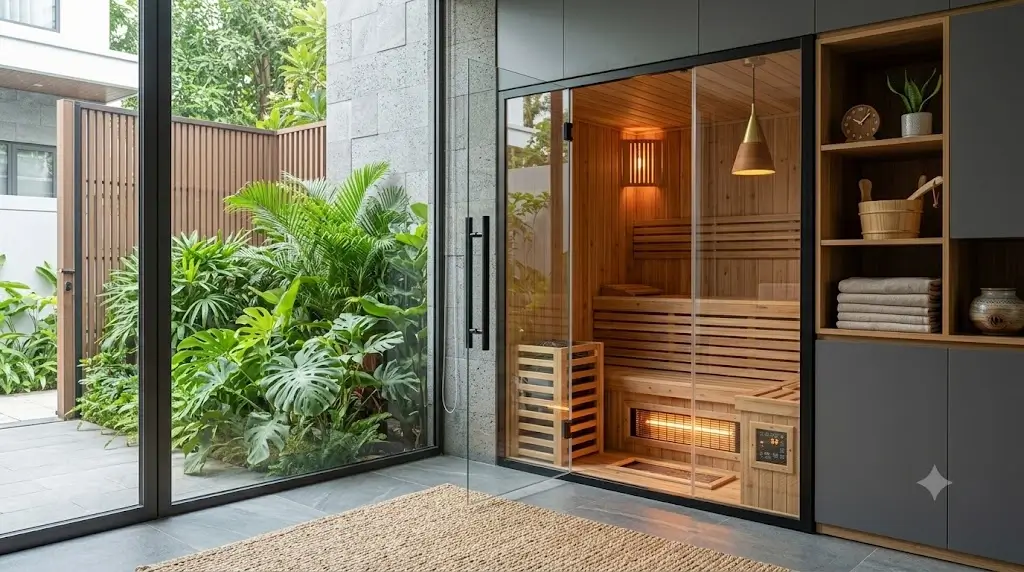
Residential space constraints and existing electrical panel capacity dictate home sauna installation feasibility. The home environment changes the buying equation substantially.
A commercial gym can accommodate a large traditional sauna with substantial electrical infrastructure, ventilation and dedicated space. A homeowner may instead be working with a spare bedroom, basement, garage or compact wellness room. If space or budget is extremely limited, portable alternatives like best infrared sauna blanket wraps offer a flexible way to experience radiant heat without installing a permanent wooden enclosure.
| Home consideration | Infrared | Traditional |
|---|---|---|
| Small room | Often easier | Requires more planning |
| Lower electrical demand | Often favorable | Depends heavily on heater size |
| Fast setup | Usually favorable for modular cabins | Usually more involved |
| Outdoor installation | Possible with appropriate enclosure | Very common |
| Traditional sauna atmosphere | Limited | Best option |
Which Uses More Electricity: Infrared or Traditional Sauna?
Kilowatt ratings demonstrate that traditional sauna stoves consume two to four times more energy than infrared panels. Energy use depends on heater power, session length, warm-up time, insulation, ambient temperature, thermostat cycling and how often the sauna is used. For our full electrical utility audit across domestic biohacking gear, see our study on sauna electricity cost.
A compact infrared cabin may have a relatively modest electrical load compared with a large traditional sauna heater. However, comparing only the nameplate wattage can be misleading because a traditional sauna may cycle its heater after reaching operating temperature.
How to estimate electricity cost
A simple estimate is:
For example, a 2.0 kW heater operating for one hour consumes approximately 2.0 kWh during the period when it is actively drawing its full rated power. Actual household consumption can be lower if the thermostat cycles the heater.
For US buyers, the most accurate estimate should use the local electricity rate and actual operating behavior rather than assuming the heater operates continuously at maximum power.
Installation: Infrared vs Traditional Sauna
Modular infrared booths snap together indoors while traditional cabins demand hardwired electrical lines and moisture ventilation. Installation is one of the strongest reasons some homeowners choose infrared.
Infrared installation
Many residential infrared cabins are modular and arrive as multiple panels that are assembled indoors. Electrical requirements vary by model, so the manufacturer’s installation documentation should always be checked before purchase.
Traditional sauna installation
Traditional sauna installation typically requires more attention to heater sizing, electrical service, ventilation, wall construction, floor protection and heater clearances.
Larger electric sauna heaters may require dedicated higher-amperage circuits. Electrical work should be performed according to applicable US electrical codes and local requirements.
Infrared Sauna EMF: What Should Buyers Look For?
Calibrated gaussmeters verify whether carbon heater shielding effectively lowers magnetic flux below two milligauss. EMF is a frequent selling point in infrared-sauna marketing, but consumers should separate measurable electromagnetic-field exposure from unsupported health claims.
Electrical equipment naturally produces electromagnetic fields. The relevant question for a product comparison is how much field is present at realistic user positions and how the measurement was made. To inspect your own setup using calibrated meters, follow our sauna EMF measurement guide.
Useful EMF information includes:
- Measurement distance from the heater.
- Measurement instrument used.
- Whether the reading is magnetic-field or electric-field measurement.
- Whether the sauna was operating at normal power.
- Where inside the cabin measurements were taken.
- Whether the manufacturer provides actual test data.
A marketing statement such as “low EMF” is less useful than a documented measurement with test conditions.
This is particularly important when comparing infrared saunas because the heater technology and electrical layout can differ considerably between models.
Infrared vs Traditional Sauna for Exercise Recovery
Thermal exposure induces cardiovascular conditioning and vascular nitric oxide dilation regardless of heating apparatus. Sauna use is increasingly marketed as a recovery technology, but the evidence needs to be separated from the marketing language.
Both traditional and infrared saunas expose the body to heat stress. However, they do not create identical environmental conditions, so evidence from one sauna format should not automatically be treated as proof for another. If you alternate hyperthermic sessions with cold plunge tanks, follow our structured contrast therapy protocol.
What matters for recovery?
- Heat exposure.
- Duration of exposure.
- Hydration.
- Ambient temperature.
- Individual tolerance.
- Training status.
- Whether the goal is relaxation, recovery or heat acclimation.
The strongest conclusion is that sauna is a heat-exposure modality, not a magic recovery mechanism. The type of sauna determines how that heat is delivered.
Infrared vs Traditional Sauna Benefits
Observational cohort studies document substantial long-term cardiovascular benefits from regular Finnish sauna bathing. Both sauna types can create heat exposure and may support relaxation. Research on traditional sauna use is substantially broader than research on many specific consumer infrared-sauna models.
This distinction matters because a product can use infrared heating without having clinical evidence for every health claim made in its advertising.
Traditional sauna evidence
Traditional sauna bathing has been studied in observational and physiological research, including research examining cardiovascular associations and heat exposure.
Observational findings should not be interpreted as proof that sauna use prevents disease in every individual. People who regularly use saunas may also differ from non-users in exercise, lifestyle and socioeconomic factors.
Infrared sauna evidence
Infrared sauna research exists, but the evidence base is smaller and more heterogeneous. Some studies have investigated cardiovascular, pain and relaxation-related outcomes, but findings should not be generalized into claims that every infrared cabin provides the same effects.
Infrared vs Traditional Sauna for Weight Loss
Immediate scale weight reductions reflect acute body water dehydration rather than adipose tissue lipolysis. Neither sauna should be marketed as a substitute for exercise and nutrition for fat loss.
A sauna session can cause body weight to temporarily decrease because sweating removes water. That is not the same as losing body fat. To understand fluid loss versus true metabolic expenditure, read our analysis on infrared sauna blankets for weight loss & detox.
Once fluids are replaced, much of that temporary weight difference disappears.
This distinction is particularly important when evaluating products marketed using phrases such as “detox,” “fat burning” or “rapid weight loss.”
Infrared vs Traditional Sauna for Detox
Renal and hepatic pathways execute systemic detoxification while eccrine perspiration functions primarily for thermoregulation. Sweating is a normal thermoregulatory process. It should not automatically be described as a detoxification treatment.
The liver, kidneys, gastrointestinal tract and other physiological systems are responsible for metabolism and elimination of many substances from the body.
For that reason, claims that one sauna technology “removes toxins” substantially better than another require specific evidence rather than relying on the fact that the user sweats.
Infrared vs Traditional Sauna Cost
Equipment purchase prices represent only a fraction of total lifetime expenses when factoring in dedicated electrical installation. The total ownership cost includes more than the purchase price.
| Cost factor | Infrared | Traditional |
|---|---|---|
| Initial equipment | Varies by cabin size and heater configuration | Varies substantially by cabin, heater and construction |
| Electrical installation | Often simpler for compact units | Can be significant for larger heaters |
| Construction | Often minimal for modular cabins | Potentially greater |
| Ventilation | Model dependent | Important design consideration |
| Maintenance | Cabin cleaning and heater/electrical inspection | Cabin, stones, heater and ventilation maintenance |
| Operating cost | Depends on wattage and session duration | Depends on heater wattage, warm-up and cycling |
The cheapest sauna to buy is not necessarily the cheapest to own. Electrical installation, replacement components, warranty coverage and expected service life should be included in the ownership calculation.
Which Is Easier to Maintain?
Dry infrared booths eliminate rock replacement chores and wood moisture deterioration. Maintenance profiles diverge based on water presence:
Infrared
Infrared cabins generally have fewer components associated with water or sauna stones. Maintenance typically focuses on keeping the interior clean, inspecting electrical connections according to manufacturer guidance and maintaining the heating system.
Traditional
Traditional saunas require attention to the heater, stones, ventilation and wood surfaces. Sauna stones eventually need inspection and replacement because repeated heating and cooling can cause cracking or deterioration.
Traditional saunas also involve more moisture management if water is regularly used on the stones.
Which Sauna Feels Hotter?
High convective ambient temperatures cause traditional saunas to feel intensely hotter on respiratory passages. Traditional saunas generally feel hotter because the surrounding air itself is heated to a much higher temperature.
Infrared cabins can still produce substantial heat stress, but the lower ambient temperature changes the sensation. Some users describe infrared heat as more tolerable because they are not sitting in the same extremely hot air environment.
Individual perception varies, so the best choice depends partly on heat tolerance.
Who Should Choose an Infrared Sauna?
Lower ambient operating temperatures make infrared systems ideal for individuals who experience respiratory discomfort in intense convective heat. An infrared sauna may be the better fit if you prioritize:
- Lower ambient temperatures.
- Radiant rather than primarily hot-air heating.
- Compact residential installation.
- Shorter warm-up requirements.
- A simple indoor sauna setup.
- A dry sauna environment.
- Lower electrical requirements for some compact models.
Choose traditional instead if you want:
- The classic Finnish sauna experience.
- Very high room temperatures.
- Heated sauna stones.
- Optional water-on-stones steam bursts.
- A more intense hot-air environment.
- Wood-burning outdoor sauna capability.
Infrared vs Traditional Sauna: Decision Tree
Structured logical pathways guide home buyers toward the appropriate thermal equipment based on ritual preferences. Review the operational decision matrix below:
Want the classic hot sauna experience?
→ Choose traditional.
Prefer lower ambient temperatures?
→ Consider infrared.
Want to pour water over hot stones?
→ Choose traditional.
Have limited indoor space?
→ An infrared cabin may be easier to integrate.
Want an outdoor wood-fired sauna?
→ Choose traditional.
Want a simple dry-heat residential setup?
→ Infrared is often the simpler option.
Can You Have Both Infrared and Traditional Saunas?
Hybrid residential layouts accommodate both systems to serve distinct recovery and social relaxation objectives. Yes. A homeowner can have separate infrared and traditional sauna systems, although combining both technologies into one room requires following the specific manufacturer’s design requirements.
The two systems provide different thermal environments rather than simply two versions of the same product.
For a home recovery room, some buyers may prefer infrared for frequent lower-temperature sessions and a traditional sauna for the classic high-heat experience.
Infrared vs Traditional Sauna: Common Buying Mistakes
Overlooking electrical circuit requirements causes costly post-purchase panel upgrades. Watch out for these typical evaluation pitfalls:
1. Choosing based only on maximum temperature
Higher maximum temperature does not automatically mean a better sauna. It may simply indicate a different heating philosophy.
2. Believing every “full-spectrum” claim
Verify actual emitter configuration rather than relying on terminology alone.
3. Ignoring electrical requirements
A sauna is a high-power electrical appliance. Confirm circuit requirements before purchase.
4. Treating wattage as performance
Higher wattage can produce more heating capacity, but efficiency, insulation, cabin volume and heater design also matter.
5. Assuming sweating equals detox
Sweating is not evidence that a sauna has removed harmful substances from the body.
6. Buying the smallest cabin without checking usable space
Exterior dimensions can be misleading. Compare usable interior dimensions, bench height, legroom and door clearance.
How BioHackTub Evaluates Home Saunas
Laboratory bench testing audits physical heater emissivities, EMF magnetic flux, and long-term joint durability. BioHackTub evaluates sauna technology using engineering and ownership factors rather than ranking products solely by marketing claims:
- Heating technology.
- Heater power.
- Cabin dimensions.
- Usable interior space.
- Temperature range.
- Warm-up behavior.
- Electrical requirements.
- Ventilation requirements.
- EMF measurement methodology where available.
- Material construction.
- Controls and timer functionality.
- Warranty.
- Replacement-part availability.
- Long-term maintenance.
This framework is especially important when comparing inexpensive marketplace saunas with higher-priced specialty manufacturers.
Infrared vs Traditional Sauna: Final Verdict
Personal thermal tolerance and home installation infrastructure dictate the ultimate sauna selection. The choice between infrared and traditional sauna comes down to the type of heat you want and the constraints of your home.
Traditional sauna is the better choice for the classic sauna experience. It provides the high-temperature environment, heated stones and optional steam bursts associated with Finnish sauna bathing.
Infrared sauna is the better fit for homeowners who prefer lower ambient temperatures, radiant heat and a simpler compact installation.
Neither technology should be selected solely because it claims to deliver greater detoxification, fat loss or medical benefits. The strongest buying decision starts with measurable specifications: heater type, power, temperature, cabin dimensions, electrical requirements, construction and warranty.
Infrared vs Traditional Sauna FAQ
Targeted answers resolve frequent consumer questions regarding electrical draw, steam capability, and fat loss. Technical answers are outlined below:
Is infrared sauna better than traditional sauna?
Neither is universally better. Infrared provides radiant heat at lower ambient temperatures, while traditional sauna provides a much hotter room and the classic heated-stone experience.
Which gets hotter, infrared or traditional sauna?
Traditional saunas generally operate at substantially higher ambient temperatures than infrared saunas.
Which sauna is better for home use?
It depends on the home. Infrared cabins are often easier to install in compact indoor spaces, while traditional saunas require more attention to heater sizing, electrical service, ventilation and construction.
Does infrared sauna use less electricity?
Many compact infrared cabins have lower electrical loads than large traditional sauna heaters, but actual energy consumption depends on heater power, operating time, warm-up requirements, insulation and thermostat cycling.
Can you use water in an infrared sauna?
Infrared cabins are generally designed as dry environments. Water should not be used around electrical heating components unless the manufacturer specifically permits it.
Can you pour water on an infrared sauna heater?
No. Infrared heaters are not the same as traditional sauna stone heaters. Water should only be used with a sauna system specifically designed for that purpose and according to manufacturer instructions.
Which sauna has more humidity?
Traditional sauna can produce short increases in humidity when water is applied to properly heated sauna stones. Infrared cabins are normally operated as dry environments.
Is infrared sauna good for recovery?
Infrared sauna creates heat exposure that may be useful for relaxation and recovery routines, but specific health claims should be evaluated against evidence for the actual sauna technology rather than assuming all infrared products have identical effects.
Does sauna use burn fat?
A sauna session can cause temporary water-weight loss through sweating, but this should not be confused with meaningful body-fat loss.
Which sauna is better for detox?
There is not sufficient evidence to conclude that infrared or traditional sauna provides a special “detox” effect that replaces the body’s normal metabolic and elimination systems.
What is the difference between far infrared and traditional sauna?
Far-infrared saunas use infrared emitters to provide radiant heat, while traditional saunas heat the room primarily through a sauna heater and heated stones.
Is a traditional sauna the same as a steam room?
No. A traditional sauna is a high-temperature environment that can have temporary increases in humidity from water applied to sauna stones. A steam room is designed around much higher humidity and continuous steam generation.
Frequently Asked Technical Questions
Diagnostic instrumentation separates sensory heat perception from objective physiological core strain. Detailed engineering perspectives are answered below:
Does sauna temperature determine heat stress?
Temperature is important, but heat stress also depends on humidity, exposure duration, air movement, radiant heat, hydration and individual physiology.
Why can infrared feel hot at a lower temperature?
Infrared radiation transfers energy directly to exposed surfaces, including the body, rather than depending entirely on the surrounding air reaching the same temperature.
Why does traditional sauna feel hotter?
The surrounding air is substantially hotter, and the body receives heat through multiple mechanisms including convection and radiation from heated surfaces and stones.
Is low EMF automatically better?
A lower measured electromagnetic field may be a useful product characteristic for buyers who care about EMF exposure, but it does not establish that the sauna produces superior health outcomes.
