
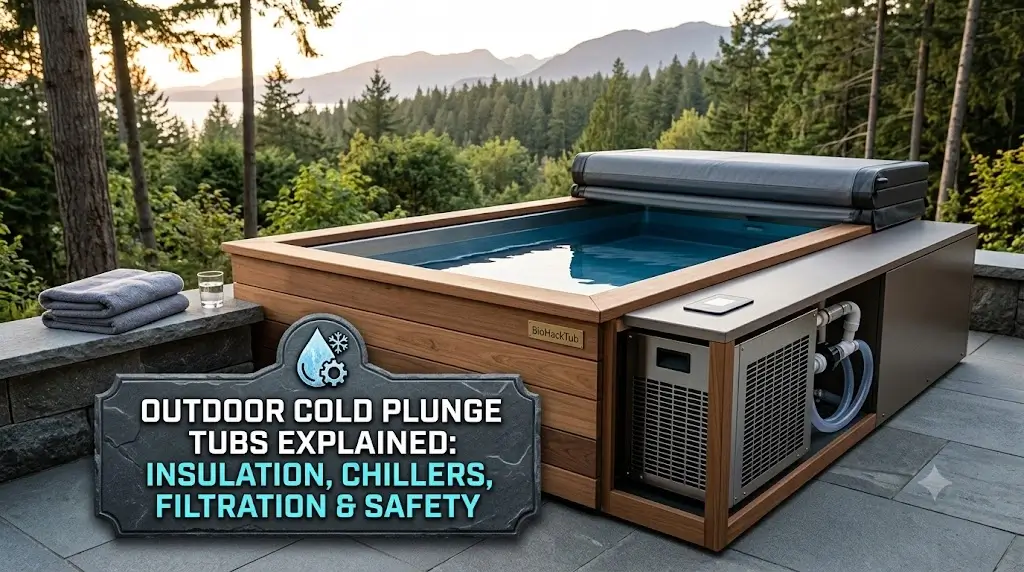
Outdoor Cold Plunge Tubs
Chiller & Water Systems
Outdoor Cold Plunge Tubs Explained: Insulation, Chillers, Filtration & Safety
•
Technical Review: Dr. Alex Mercer, CSCS
•
Updated October 2026
An outdoor cold plunge has a different engineering problem from an indoor tub. The water is exposed to changing air temperature, sunlight, wind, rain, debris and, in colder parts of the United States, freezing conditions. The tub itself therefore matters, but insulation, circulation, water treatment, electrical protection and drainage can have just as much influence on ownership.
This guide explains how outdoor cold plunge systems are constructed, how they manage water temperature, what insulation actually does, when a chiller is useful, how filtration works, and what homeowners should consider before installing a cold-water immersion system outside.
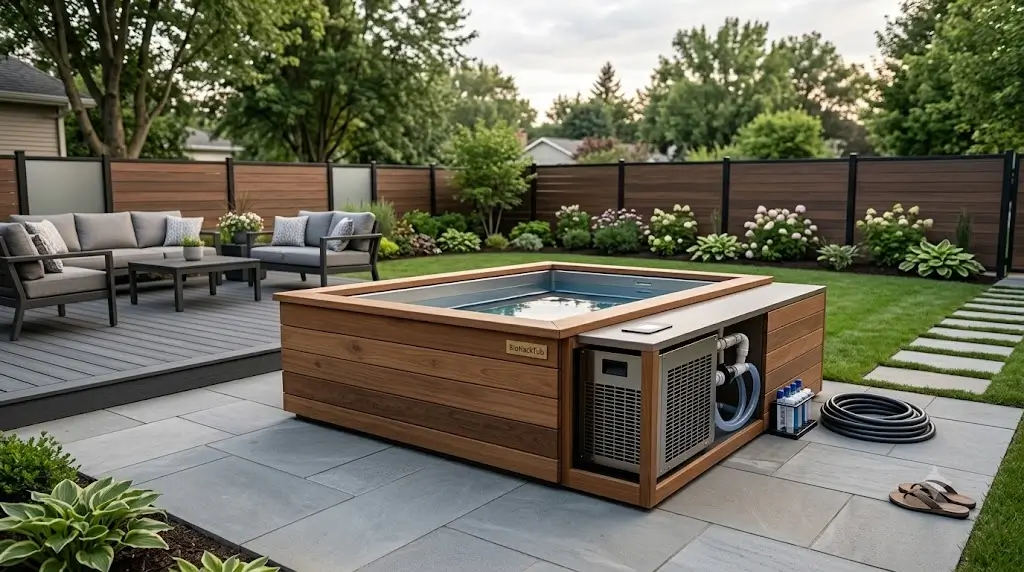
Quick Reference Specification: Outdoor Cold Plunge Engineering Benchmarks
Environmental thermodynamics dictates refrigeration compressor capacity, thermal insulation density, and sanitization loops for exterior cold plunge systems. The technical benchmark matrix below synthesizes component standards, fluid metrics, and operational limits across outdoor cold-water immersion installations:
| System Element | Outdoor Engineering Baseline | Critical Operating Benchmark | Technical Failure Mode if Overlooked |
|---|---|---|---|
| Cabinet Insulation | Closed-cell polyurethane spray foam (R-12 to R-20) | Full envelope (walls, floor, plumbing jackets) | Continuous thermal gain causes severe compressor short-cycling |
| Refrigeration Chiller | 0.5 HP to 1.0 HP with titanium coaxial heat exchanger | Ambient rating up to 105°F (40.5°C) | Undersized chillers freeze evaporators or fail during summer peaks |
| Filtration Architecture | 20 to 50-micron pleated sediment cartridge filter | Continuous 500–1000 GPH circulation flow | Suspended organic debris clogs heat exchanger capillaries |
| Water Sanitization | Active CD ozone generator and/or germicidal UV-C (254 nm) | Non-chlorine oxidizer or low-ppm stabilizer regimen | Rapid biofilm and algal colonization in sun-exposed standing water |
| Electrical Service | Weatherproof NEMA 3R/4X with dedicated GFCI protection | 115V/15A or 20A branch circuit (code compliant) | Catastrophic shock hazards and nuisance breaker tripping from rain ingress |
| Structural Support | Rigid reinforced concrete pad or engineered level deck | Load bearing capacity ≥ 100–150 lbs/sq ft | Deck joist deflection, basin seam warping, and unlevel waterlines |
Outdoor vs Indoor Cold Plunge: What Changes?
Environmental exposure introduces severe solar heat loads, airborne debris, and sub-freezing winter challenges to outdoor plunge systems. The biggest difference is the thermal environment surrounding the water. An indoor tub is usually protected from direct sunlight, rain and large outdoor temperature swings. An outdoor tub is constantly exchanging heat with its surroundings.
That affects both passive and actively chilled systems. A well-insulated outdoor tub with a fitted cover can retain its water temperature considerably better than an uncovered container sitting in direct sun. To evaluate target temperature ranges for clinical recovery vs. hypothermia risks, see our comprehensive cold plunge temperature guide.
| Factor | Outdoor Cold Plunge | Indoor Cold Plunge |
|---|---|---|
| Sun exposure | Potentially significant | Usually minimal |
| Rain | Must be considered | Usually not an issue |
| Wind | Can increase heat exchange and evaporation | Usually limited |
| Ambient temperature | Can vary dramatically | More stable |
| Debris | Leaves, pollen, insects and dirt | Usually lower |
| Freezing conditions | Major consideration in cold climates | Usually easier to control |
| Drainage | Critical | Still important |
| Electrical exposure | Requires careful weather-rated installation | Usually simpler |
Outdoor Cold Plunge Tub Construction
Tub structural materials dictate thermal retention efficiency, weather resistance, and portable versus permanent installation profiles. Outdoor tubs are available in several basic construction categories. The choice affects durability, portability, insulation, maintenance and long-term stability.
Inflatable tubs
Inflatable tubs are generally lightweight and relatively easy to move. Their major engineering limitation is thermal performance. Thin walls provide less resistance to heat transfer than heavily insulated rigid systems.
An inflatable tub can therefore be practical as a temporary or lower-cost setup—such as when exploring the best portable cold plunge on Amazon—but outdoor users should pay particular attention to insulation, cover quality and protection from sharp surfaces.
Rigid insulated tubs
Rigid tubs can incorporate foam insulation into the walls and base. This increases thermal resistance and can reduce the rate at which environmental heat reaches the water.
The trade-off is weight, cost and reduced portability.
Stock tanks and converted containers
Metal or plastic stock tanks are sometimes used as DIY cold-water containers. They can hold substantial water volume, but the container itself may provide little thermal insulation.
A DIY setup therefore often requires additional insulation, a cover, circulation equipment and a compatible cooling system if active temperature control is desired.
Hard-shell dedicated systems
Purpose-built cold plunge systems may integrate insulation, filtration, circulation and temperature-control hardware into one package. This simplifies the system architecture but increases purchase price and makes compatibility between replacement components more important.
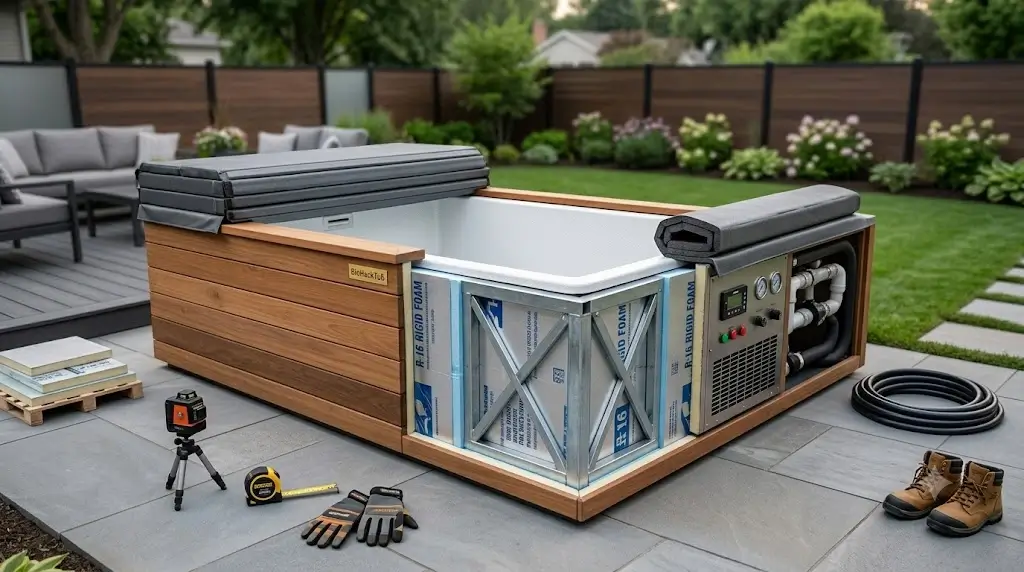
Why Insulation Matters in an Outdoor Cold Plunge
High R-value foam barriers slow conductive heat gain to substantially decrease chiller electricity consumption. Insulation slows heat transfer between the water and the surrounding environment. It does not actively cool the water.
That distinction is important.
If the outdoor air is warmer than the water, heat naturally moves toward the colder water. The greater the temperature difference and the greater the exposed surface area, the more thermal energy the system must reject to maintain a low water temperature.
Common insulation locations
- Side walls.
- Bottom of the tub.
- Plumbing lines.
- Chiller enclosure.
- Water-return plumbing.
- Insulated external cabinet.
Insulating only the side walls while leaving the base or plumbing exposed can reduce the overall benefit because heat can still enter through other parts of the system.
Why an Outdoor Cold Plunge Needs a Good Cover
Tapered marine-grade thermal covers block solar radiation, limit evaporative cooling losses, and seal out environmental pollutants. A cover performs several jobs at once:
- Reduces heat entering from sunlight.
- Limits debris entering the water.
- Reduces evaporation.
- Helps reduce contamination.
- Protects the tub when it is not being used.
For outdoor systems, the cover can be one of the most important accessories because the water is otherwise continuously exposed to the environment.
What to look for in a cover
- Weather-resistant construction.
- Secure fit.
- UV resistance.
- Water resistance.
- Sufficient structural support.
- Compatibility with the tub’s shape.
A cover should not be treated as a cosmetic accessory. It is part of the thermal and water-management system.
How a Cold Plunge Chiller Works
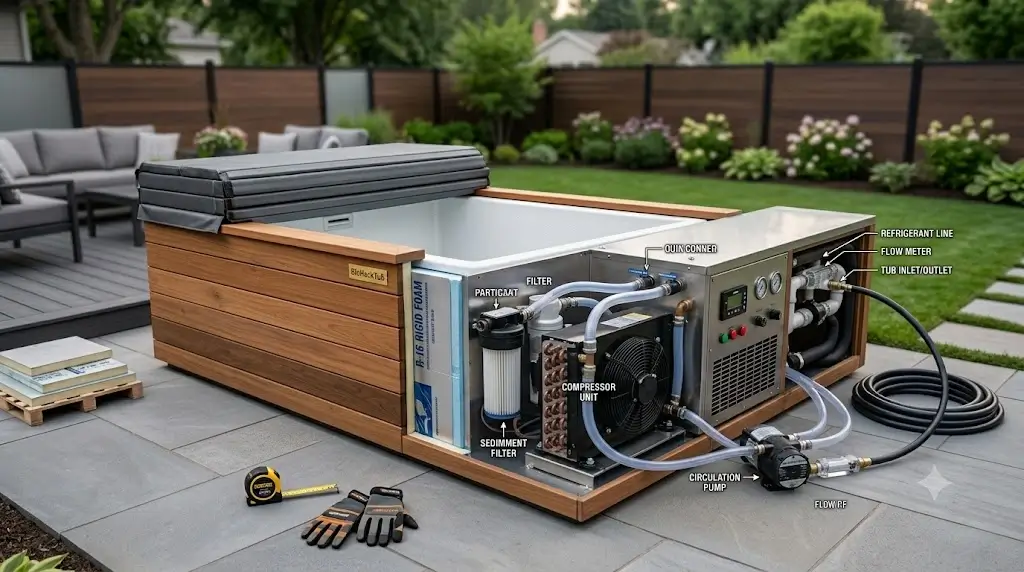
Refrigerant vapor compression loops circulate water through titanium heat exchangers to continuously extract caloric energy. An active cold plunge chiller operates similarly to a refrigeration system. Water circulates through a heat exchanger where thermal energy is removed from the water. The cooled water then returns to the tub.
The important components can include:
- Refrigeration compressor.
- Heat exchanger.
- Water pump or circulation loop.
- Temperature controller.
- Refrigerant circuit.
- Water inlet and outlet connections.
Why chiller horsepower alone is not enough
A larger compressor does not automatically mean a better cold plunge system. Actual cooling performance depends on the refrigeration architecture, heat-exchanger design, water flow, ambient temperature and heat load.
Manufacturers may advertise a compressor rating, but buyers should also examine the system’s operating conditions and cooling specifications.
| Specification | Why it matters |
|---|---|
| Cooling capacity | Indicates how much heat the system can remove under specified conditions. |
| Water flow | Determines how quickly water circulates through the cooling loop. |
| Maximum water volume | Helps determine whether the system is appropriately sized. |
| Ambient operating range | Important for outdoor installations. |
| Heat exchanger material | Relevant to durability and water-system compatibility. |
| Electrical requirement | Determines installation requirements. |
| Noise | Important when installed near living areas. |
Do You Need a Chiller for an Outdoor Cold Plunge?
Active chillers provide automated setpoint stability while passive manual ice additions require constant labor and ongoing supply costs. Not necessarily.
Some systems rely on naturally cold water, ice or a combination of environmental cooling and periodic ice addition. Others use active refrigeration to maintain a target water temperature more consistently.
The practical difference is convenience and control.
| Cooling method | Advantages | Limitations |
|---|---|---|
| Natural cold water | Simple hardware | Temperature depends on local conditions |
| Ice | Does not require refrigeration equipment | Requires repeated ice purchases or production |
| Active chiller | Automated temperature management | Higher equipment and electrical complexity |
| Chiller + insulation + cover | Better system-level thermal control | Higher upfront cost |
Cold Plunge Filtration: Why Outdoor Systems Need It
Pleated cartridge filter media capture airborne sediment and organic detritus before water enters the pump impeller. Outdoor water is exposed to more contamination than water in a protected indoor environment. Leaves, pollen, dust, insects and other debris can enter an uncovered tub.
A filtration system removes suspended particles from circulating water. It does not, by itself, make the water sanitary. For a deep dive into clean water strategies, review our step-by-step guide to cold plunge water maintenance.
Mechanical filtration
Mechanical filters physically capture particles as water passes through the filter media. Common designs include cartridge filters and pleated sediment filters.
Filter micron rating
A micron rating describes the size range of particles a filter is designed to capture under specified testing conditions. A smaller nominal micron number generally indicates finer filtration, but pressure drop and flow requirements also matter.
A filter that is too restrictive for a circulation pump can reduce water flow.
Filtration Is Not the Same as Sanitation
Physical mechanical filters remove suspended solids while active sanitation agents neutralize microscopic pathogens. This is one of the most important distinctions in cold plunge ownership.
Filtration removes physical particles. Sanitation is intended to control microorganisms.
Outdoor systems therefore need a water-management strategy appropriate for the equipment, water chemistry and manufacturer’s instructions.
Common sanitation technologies
- Appropriate chemical sanitation.
- Ozone systems.
- UV systems.
- Combined filtration and sanitation systems.
No single technology should be assumed to eliminate the need for water maintenance. The manufacturer’s maintenance schedule and water-treatment instructions remain important.
Outdoor Cold Plunge Electrical Requirements
National Electrical Code regulations mandate weather-rated GFCI protection for outdoor aquatic refrigeration circuits. Electrical installation deserves particular attention because water and electricity create a higher-risk environment.
The exact electrical requirements depend on the chiller, pump, filtration system and other equipment. A system may require a standard household circuit, while larger equipment can have different requirements.
Important considerations include:
- Voltage.
- Amperage.
- Circuit capacity.
- Ground-fault protection where required.
- Weather-rated electrical equipment.
- Proper grounding and bonding where applicable.
- Cord and outlet location.
- Protection from standing water.
- Compliance with local electrical codes.
Outdoor Cold Plunge Drainage and Site Preparation
Filled plunge vessels generate substantial structural loads exceeding eight hundred pounds per hundred gallons of volume. Water weighs approximately 8.34 pounds per US gallon. That means even a relatively compact tub can place a substantial load on the supporting surface.
For example, a 100-gallon tub contains roughly:
The tub, equipment and user add additional weight.
Site requirements
- Stable and level surface.
- Adequate structural support.
- Safe walking surface.
- Drainage away from the installation.
- Access for maintenance.
- Space around equipment.
- Protection from falling objects.
- Suitable access to electrical service.
A balcony, elevated deck or rooftop location requires particular care because structural capacity can become a limiting factor.
Outdoor Cold Plunge by US Climate
Regional ambient temperature extremes dictate chiller compressor sizing in the South and freeze protection in the North. The United States contains several very different climate zones. An outdoor cold plunge should therefore be evaluated against the local environment rather than a generic national temperature assumption.
Hot and humid climates
In places such as Florida, Louisiana and parts of Texas, warm ambient temperatures can create a significant cooling load.
Direct sunlight can add another source of heat. Shade, insulation and a fitted cover become particularly useful.
Hot and dry climates
Desert regions such as Arizona and Nevada can experience intense daytime heat and strong solar exposure. Equipment placed in direct sun can face a substantially higher thermal load than equipment installed in shade.
Temperate climates
States across much of the Midwest, Mid-Atlantic and Pacific regions may have more moderate summer temperatures, but seasonal weather changes still need to be considered.
Cold climates
Northern states can create the opposite problem. When outdoor temperatures fall below freezing, water inside plumbing and chillers can freeze.
Can an Outdoor Cold Plunge Freeze in Winter?
Sub-freezing ambient temperatures crack uninsulated chiller heat exchangers and burst external plumbing loops. Yes.
A water-filled outdoor tub can freeze when the surrounding conditions remain below freezing for long enough. The greater concern is not only the water inside the main basin but also water trapped inside pumps, filters, hoses, heat exchangers and plumbing.
Winter considerations
- Follow the equipment manufacturer’s minimum operating temperature.
- Determine whether the chiller has freeze protection.
- Do not assume a cover prevents freezing.
- Protect exposed plumbing.
- Drain equipment when required by the manufacturer.
- Store removable components appropriately.
- Never operate equipment outside its rated environmental conditions.
Winterization procedures differ significantly between systems. The manufacturer’s instructions should take precedence over generic internet advice.
Condensation Around an Outdoor Cold Plunge
Temperature differentials between cold basin walls and humid summer air produce heavy moisture pooling on surrounding surfaces. Cold water can create condensation when humid air contacts surfaces that are colder than the surrounding air.
This can make surrounding surfaces wet and increase slip risk.
Outdoor installations should therefore consider:
- Slip-resistant flooring.
- Positive drainage.
- Water-resistant surrounding materials.
- Distance from sensitive electronics.
- Clear access around the tub.
A cold plunge should not be installed where routine splashing can damage electrical equipment, structural materials or finished surfaces.
Outdoor Cold Plunge Placement: Sun vs Shade
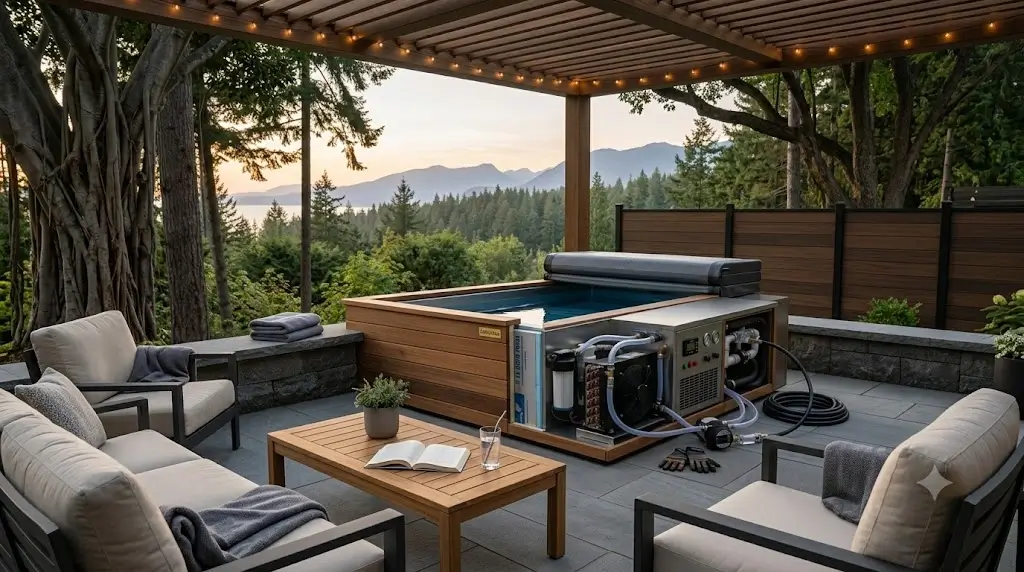
Covered patio installations prevent direct solar ultraviolet degradation while avoiding organic canopy tree litter. Shade is generally advantageous for an actively chilled outdoor tub because direct solar radiation adds heat to the tub and surrounding equipment.
However, placing equipment beneath trees creates another trade-off: leaves, pollen, branches and insects can increase maintenance.
A covered but open-air location can therefore be preferable to either full sun or directly beneath dense vegetation.
How Much Water Does an Outdoor Cold Plunge Use?
Larger basin capacities increase total thermal mass but demand longer initial refrigeration pull-down cycles. Water capacity varies substantially between tubs. A larger basin requires more water and therefore more energy to cool or heat when its temperature changes.
Water volume also influences maintenance cost, drain time and the amount of sanitizer required according to the manufacturer’s water-treatment instructions.
| System characteristic | Effect of larger water volume |
|---|---|
| Thermal mass | More water stores more thermal energy. |
| Cooling time | More thermal energy may require more cooling capacity or time to remove. |
| Water replacement | More water is required when the system is drained. |
| Equipment sizing | Chiller and circulation capacity should match the system. |
| Weight | Total installation weight increases substantially. |
Outdoor Cold Plunge Maintenance Checklist
Routine maintenance protocols prevent algae accumulation, cartridge filter binding, and premature chiller compressor wear. Outdoor systems generally require more environmental maintenance than indoor systems. A simple schedule helps prevent small problems from becoming equipment failures.
Every use or regular inspection
- Check the surrounding area for standing water.
- Inspect the cover.
- Look for visible debris.
- Check the water condition.
- Inspect hoses and connections for obvious leaks.
Weekly or according to equipment instructions
- Inspect and clean the filter as required.
- Check water-treatment parameters.
- Inspect circulation performance.
- Clean the tub surfaces.
- Check the equipment enclosure.
Seasonally
- Inspect insulation.
- Inspect outdoor plumbing.
- Check cover condition and UV damage.
- Review winterization requirements.
- Inspect drainage around the installation.
Actual maintenance frequency depends on usage, water volume, filtration, sanitation, weather and manufacturer recommendations.
Outdoor Cold Plunge Water Maintenance
Water sanitization chemistry prevents bacterial proliferation in cold outdoor tubs exposed to windblown pollen and spores. Water quality is affected by usage, environmental exposure and the sanitation system. Outdoor tubs receive additional contamination from dust, pollen, insects and precipitation.
A good maintenance strategy should account for:
- Water testing.
- Filter cleaning or replacement.
- Appropriate sanitation.
- Regular surface cleaning.
- Water replacement according to system requirements.
- Inspection of plumbing.
A manufacturer-provided water-maintenance schedule is more useful than assuming that every cold plunge can follow the same replacement interval. If you are integrating deliberate cold shock into a structured contrast routine, review our clinical contrast therapy protocol guide.
How to Evaluate an Outdoor Cold Plunge System
Holistic engineering evaluations prioritize thermal shell construction, pump flow rates, and replacement part accessibility. Instead of judging an outdoor cold plunge by appearance or a single temperature claim, evaluate the complete system:
| Specification | What to investigate |
|---|---|
| Water capacity | Actual usable volume, not only external dimensions. |
| Insulation | Wall, floor and plumbing insulation. |
| Cover | Fit, weather resistance and insulation. |
| Chiller | Cooling capacity, ambient limits and electrical requirements. |
| Pump | Flow rate and compatibility with filter/chiller loop. |
| Filter | Type, micron rating, size and replacement availability. |
| Sanitation | Actual treatment method and maintenance requirements. |
| Materials | Resistance to outdoor exposure and water chemistry. |
| Electrical system | Voltage, amperage, protection and installation requirements. |
| Winter operation | Freeze protection and manufacturer’s environmental limits. |
| Drainage | How and where the water is discharged. |
| Warranty | Coverage of tub, chiller, pump and electronics. |
Portable vs Permanent Outdoor Cold Plunge
Inflatable portable tubs maximize mobility for renters while permanent rigid acrylic systems deliver superior thermal insulation. Portability is useful when the tub needs to be moved seasonally, but it usually comes with trade-offs in rigidity, insulation and equipment integration.
Portable systems
- Lower installation commitment.
- Easier relocation.
- Often lighter.
- Potentially less insulation.
- May require separate cooling equipment.
Permanent systems
- Better integration with outdoor infrastructure.
- Potentially stronger insulation.
- More stable installation.
- Higher initial installation effort.
- Less convenient to relocate.
For outdoor ownership, the best design is often determined by whether the user needs mobility or long-term thermal and structural stability.
Common Outdoor Cold Plunge Mistakes
Neglecting winter freeze protection and direct solar exposure dramatically degrades outdoor refrigeration hardware. Avoid these critical installation oversights:
1. Putting the tub in direct sun
Solar radiation can increase heat entering the water and increase cooling demand.
2. Ignoring insulation
A chiller may have to work harder when the tub continuously gains heat from the environment.
3. Treating a filter as a sanitizer
Mechanical filtration and microbial control are different functions.
4. Underestimating water weight
Water alone is extremely heavy. Elevated installations require proper structural evaluation.
5. Running electrical equipment without proper outdoor protection
Water, rain and electrical equipment require careful installation and code compliance.
6. Forgetting winterization
Freezing water can damage plumbing, pumps and heat exchangers.
7. Installing directly on an unprotected wood surface
Persistent moisture and water runoff can damage surrounding materials and increase slip risk.
8. Buying based only on the advertised minimum temperature
A displayed temperature target does not describe the system’s cooling capacity under hot outdoor conditions.
9. Ignoring replacement filters
A sophisticated filtration system becomes inconvenient if replacement cartridges are difficult to source.
10. Installing without maintenance access
Pumps, filters and chillers eventually require cleaning, inspection or service. Leave enough space to reach them.
Outdoor Cold Plunge: What Matters Most?
Reliable long-term performance hinges on total system integration rather than individual component marketing claims. The most important specifications depend on the environment, but several principles apply to almost every outdoor installation:
- Thermal control: insulation, cover and chiller capacity.
- Water quality: circulation, filtration and sanitation.
- Site: stable surface, drainage and service access.
- Electrical safety: weather-rated installation and appropriate protection.
- Climate: heat gain in summer and freezing conditions in winter.
- Maintenance: filter access, replacement parts and cleaning requirements.
These factors usually matter more to long-term ownership than cosmetic features or a single headline specification.
Outdoor Cold Plunge Setup Checklist for US Homeowners
Pre-installation site assessments confirm foundation load ratings, dedicated GFCI electrical service, and positive drainage slopes. Complete the checklist below before filling your outdoor vessel:
- Confirm the tub’s filled weight.
- Verify the supporting surface.
- Plan drainage before filling the tub.
- Choose a location with appropriate shade.
- Keep the system away from roof runoff.
- Confirm electrical requirements.
- Use appropriate outdoor electrical protection.
- Plan filter access.
- Plan chiller airflow and service clearance.
- Install a properly fitted cover.
- Understand the water-maintenance procedure.
- Check winterization requirements.
- Keep the surrounding floor slip-resistant.
Outdoor Cold Plunge vs Cold Plunge Pool
Compact immersion tubs require lower electrical operating costs and smaller physical footprints than large commercial plunge pools. A cold plunge tub is generally a smaller dedicated immersion vessel, while a cold plunge pool can refer to a substantially larger installation with more water volume and greater infrastructure requirements.
The distinction matters because larger systems increase the importance of structural support, water circulation, filtration, cooling capacity and operating cost.
For most residential buyers, the correct system size should be based on actual use and available installation space rather than choosing the largest possible water volume.
Can You Put a Cold Plunge on a Deck?
Elevated wooden decks require structural engineering calculations before placing water-filled vessels weighing over one thousand pounds. Potentially, but the structural load must be evaluated first.
Water weighs approximately 8.34 pounds per gallon before adding the weight of the tub, equipment and occupants.
A 100-gallon installation therefore contains approximately 834 pounds of water. A larger system can easily reach several thousand pounds once the tub and occupant are included.
Is an Outdoor Cold Plunge Better Than an Indoor One?
Backyard recovery aesthetics trade off against interior climate stability and simplified flood risk management. Not automatically.
Outdoor placement provides convenience for people who want a dedicated backyard recovery area, but it also exposes the system to weather, debris, temperature swings and more complicated electrical and drainage considerations.
Indoor placement offers greater environmental control but requires careful consideration of floor loading, drainage, condensation and water damage.
The better location is the one that provides a safe structure, appropriate drainage, reliable equipment access and a suitable electrical installation.
Outdoor Cold Plunge Safety Considerations
Extreme hypothermic shock triggers uncontrolled breathing gasps and elevated cardiovascular strain during sudden submersion. Cold-water immersion can produce an abrupt physiological response. Cold exposure can affect breathing, heart rate, blood pressure and coordination. For research-backed exposure dosing, see our review of the Huberman cold plunge protocol.
That makes the surrounding environment important as well as the water itself:
- Use a stable, slip-resistant access area.
- Avoid isolated locations where assistance would be difficult.
- Keep electrical equipment appropriately protected from water.
- Follow the tub and equipment manufacturer’s instructions.
- Do not rely on internet protocols as a substitute for medical advice.
- People with medical conditions or concerns about cold exposure should consult a qualified healthcare professional before using cold-water immersion.
How BioHackTub Evaluates Outdoor Cold Plunge Equipment
Calibrated flow meters and thermal cameras evaluate actual BTU heat extraction efficiency across variable climates. BioHackTub’s technical evaluation framework focuses on the complete ownership system rather than a single marketing specification:
- Actual water capacity.
- Insulation design.
- Cover construction.
- Cooling-system architecture.
- Water circulation.
- Filter type and replacement availability.
- Sanitation system.
- Electrical requirements.
- Outdoor environmental limitations.
- Drainage requirements.
- Noise.
- Maintenance accessibility.
- Warranty and serviceability.
For outdoor equipment, climate compatibility is particularly important. A system that performs well in a mild environment may have a substantially different cooling workload in a hot, sunny location.
Final Takeaway: Choosing an Outdoor Cold Plunge System
Successful outdoor cold plunge ownership requires balancing thermal insulation, weatherized electrical circuits, and sanitary water loops. An outdoor cold plunge is best understood as a combination of thermal management, water treatment, electrical equipment and site infrastructure.
The tub itself is only one component.
For a reliable outdoor installation, pay particular attention to insulation, cover design, chiller capacity, circulation, filtration, sanitation, drainage, electrical protection and climate compatibility.
Hot climates increase cooling demand. Cold climates introduce freezing risks. Wet environments increase the importance of drainage and electrical protection. Sunny locations increase heat gain. Every installation therefore needs to be evaluated in its actual environment.
Outdoor Cold Plunge FAQ
Comprehensive technical responses resolve home installation concerns regarding deck load limits, winter freezes, and electrical hookups. Direct technical answers are outlined below:
Can you keep a cold plunge outside year-round?
Some systems are designed for year-round outdoor use, but this depends on the manufacturer’s environmental specifications and the local climate. Freezing temperatures can require specific winterization procedures.
Does an outdoor cold plunge need a chiller?
Not necessarily. Some systems use naturally cold water or ice, while others use active refrigeration. A chiller becomes more useful when consistent temperature control is desired.
Does insulation matter for an outdoor cold plunge?
Yes. Insulation reduces the rate of heat transfer between the surrounding environment and the water. This can reduce the cooling workload in warm weather.
Does a cold plunge need a cover?
A cover is highly useful for outdoor systems because it can reduce heat gain, debris, evaporation and environmental contamination when the tub is not being used.
Can rainwater enter an outdoor cold plunge?
Yes, unless the tub is covered or otherwise protected. Rainwater can introduce contaminants and dilute or alter the water chemistry.
How do you keep an outdoor cold plunge clean?
Use the manufacturer’s recommended combination of filtration, sanitation, surface cleaning and water replacement. Outdoor tubs generally require more attention to debris than indoor systems.
Can an outdoor cold plunge freeze?
Yes. Freezing conditions can damage water-filled plumbing, pumps and heat exchangers. Follow the manufacturer’s winterization instructions.
Can you put an outdoor cold plunge on a deck?
Only after confirming that the deck can safely support the filled system. Water weighs approximately 8.34 pounds per US gallon, before adding the tub, equipment and user.
Should an outdoor cold plunge be in the sun or shade?
Shade is generally preferable because direct solar radiation adds heat to the tub and can increase cooling demand. The location should still allow adequate drainage and equipment access.
Is filtration enough to keep cold plunge water safe?
No. Filtration removes particles, while sanitation addresses microorganisms. A complete water-management system may require both.
How often should an outdoor cold plunge be drained?
There is no universal interval that applies to every system. Water volume, usage, filtration, sanitation, environmental exposure and manufacturer instructions all affect the appropriate maintenance schedule.
How much does an outdoor cold plunge weigh when filled?
Water weighs approximately 8.34 pounds per US gallon. A 100-gallon tub therefore contains about 834 pounds of water before the tub, equipment and user are included.
Can you use an extension cord for an outdoor cold plunge?
Do not assume an extension cord is appropriate. Follow the equipment manufacturer’s electrical requirements and applicable US electrical codes. A qualified electrician should determine the appropriate installation when necessary.
Does an outdoor cold plunge need drainage?
Yes. Water replacement, splashing, cleaning and accidental overflow all require a suitable drainage plan.
Editorial & Safety Notes
Cold water submersion exerts abrupt autonomic cardiovascular strain on human physiology. This article provides general educational information about outdoor cold plunge equipment, installation and maintenance. It is not medical advice and does not establish a recommended cold-water immersion protocol.
Cold-water immersion can cause significant physiological stress. Anyone with cardiovascular conditions, blood-pressure concerns, pregnancy, circulation problems, cold sensitivity or other medical concerns should obtain individualized medical guidance before attempting cold exposure.
Electrical installation around water should comply with applicable local requirements and manufacturer specifications.
