
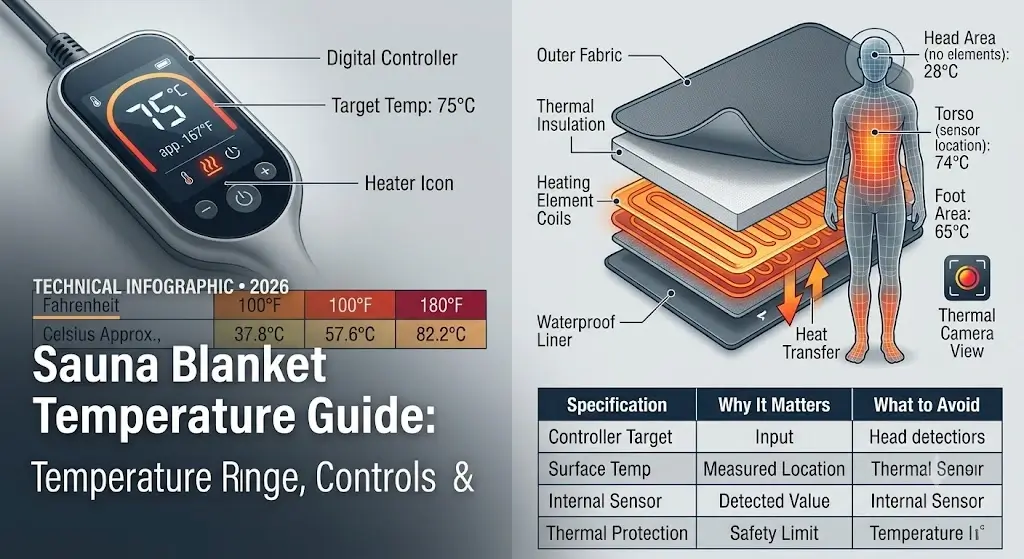
Sauna Blanket Technical Guide • 2026
Hardware Verification
Sauna Blanket Temperature Guide: Temperature Range, Controls & Specifications
•
Technical Audit: Dr. Alex Mercer, CSCS
•
Updated October 2026
Sauna blanket temperature can be confusing because manufacturers may use several different measurements to describe the same product: a controller temperature range, an advertised maximum temperature, a measured surface temperature, or a temperature recorded at a particular location inside the blanket.
Those numbers are not necessarily interchangeable. The temperature shown on a controller is not automatically the temperature of every part of the blanket, and an advertised maximum does not mean that the entire surface reaches that temperature uniformly.
This guide explains how to interpret sauna blanket temperature specifications, compare Fahrenheit and Celsius ratings, understand temperature sensors and thermal protection, and identify the technical information that matters when evaluating a product listing.
Quick Reference Specification: Sauna Blanket Thermal Metrics
Laboratory thermal imaging separates controller settings from active surface contact and embedded sensor cutoffs. The diagnostic specification table below details the thermodynamic differences, measurement methods, and verified operating ranges found in consumer infrared sauna blankets:
| Specification Parameter | Typical Operating Range | Sensor / Measurement Source | Technical Significance |
|---|---|---|---|
| Controller Target Setting | 86°F – 176°F (30°C – 80°C) | Handheld Digital Microcontroller | Determines duty cycle and heating power modulation via PWM firmware |
| Actual Contact Surface Temp | 115°F – 155°F (46°C – 68°C) | Calibrated Thermocouple / FLIR E8-XT | Represents true thermal transfer to cotton barrier garments during sessions |
| Internal Heating Element Rating | 160°F – 190°F (71°C – 88°C) | Carbon Fiber Ribbon Embedded Probe | Peak core wire temperature prior to diffusion across PU/TPU layers |
| Thermal Cutoff Threshold | 185°F – 195°F (85°C – 90°C) | Bi-Metallic Thermostat / Thermal Fuse | Hardwired safety interrupt preventing thermal runaway and polymer melting |
| Pre-Heat Ramp Latency | 8 to 15 Minutes | Time-to-140°F Bench Test (70°F Ambient) | Varies based on presence of thermal mass layers (e.g. tourmaline, clay) |
Sauna Blanket Temperature: The Short Answer
Flexible sauna wraps generate differing thermal readings depending on sensor placement and conductive diffusion barriers. Different products use different heating systems, materials, controllers and temperature sensors, so their published temperature ranges cannot always be compared directly.
The most useful approach is to separate four concepts:
| Term | What It Usually Describes |
|---|---|
| Temperature setting | The value selected through the product’s controller. |
| Advertised maximum | The highest temperature claimed by the manufacturer under specified conditions. |
| Surface temperature | The temperature measured at a particular location on the blanket surface. |
| Internal sensor temperature | The temperature detected by a sensor within the heating system or product. |
These measurements can differ substantially because heat moves through layers of insulation, fabric, heating elements and surrounding air. To see how these numbers translate to physical cabin chambers, consult our broader analysis on how hot do infrared saunas get.
What Does Sauna Blanket Temperature Actually Mean?
Manufacturer temperature ratings reflect bench-tested electronic limits rather than uniform cutaneous contact heat. When a product listing says that an infrared sauna blanket reaches a certain temperature, the statement should be treated as a manufacturer specification, not as proof that every point on the product reaches exactly that temperature.
Temperature depends on the measurement location, sensor design, ambient conditions, insulation, heating-element placement and control algorithm.
A technical comparison therefore needs more than one number.
- Published temperature range
- Temperature-unit information
- Sensor location
- Controller resolution
- Heating-element type
- Thermal protection information
- Manufacturer test conditions
- Whether the value represents a target, limit or measured temperature
Why Can One Sauna Blanket Have Several Temperature Numbers?
Discrepant documentation values stem from the distinction between microcontroller inputs, component limits, and thermal camera surface readouts. A product can legitimately have different temperatures reported in different parts of its documentation.
For example, a controller may display a selected temperature while a technical document describes a maximum operating temperature for a component. A retailer may also describe a maximum temperature based on manufacturer information.
These values should not automatically be treated as contradictory.
Target vs. measured temperature
A controller target is a control input. A measured temperature is an observation made by a sensor or thermometer.
The system may continually adjust electrical power to move the measured temperature toward a selected target.
Maximum temperature vs. normal operating range
A maximum rating may describe the upper limit of a system rather than the temperature a user should select.
That distinction is important when reading product specifications.
Sauna Blanket Temperature: Fahrenheit to Celsius
Standard thermodynamic formulas convert imperial US marketing numbers into metric scientific research baselines. US product listings generally use Fahrenheit, while many international specifications use Celsius.
°F = (°C × 9/5) + 32
| Fahrenheit (°F) | Celsius Approx. (°C) |
|---|---|
| 100°F | 37.8°C |
| 110°F | 43.3°C |
| 120°F | 48.9°C |
| 130°F | 54.4°C |
| 140°F | 60.0°C |
| 150°F | 65.6°C |
| 160°F | 71.1°C |
| 170°F | 76.7°C |
| 180°F | 82.2°C |
These conversions are mathematical equivalents, not recommendations for operating a sauna blanket.
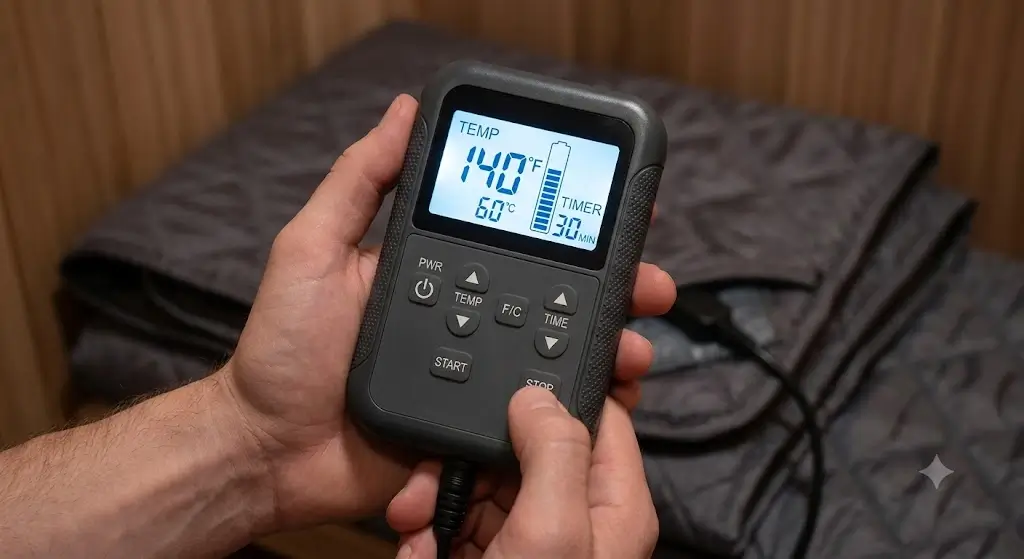
What Is the Controller Temperature?
Digital handheld controllers regulate electrical power cycles rather than sensing real-time skin contact temperatures. The controller is the interface used to communicate with the heating system. Depending on the product, it may allow the user to select temperature, power level or another operating parameter.
A controller display should not automatically be interpreted as an independent measurement of the temperature at every point on the blanket.
Important controller specifications
- Temperature range displayed
- Temperature increments
- Timer interface
- Control cable construction
- Sensor integration
- Error or fault indicators
- Automatic thermal protection
A controller with smaller temperature increments may offer finer adjustment, but that does not necessarily mean the underlying temperature measurement is more accurate.
What Is Surface Temperature?
Polymer surface boundaries measure ten to twenty degrees cooler than internal carbon heating arrays due to insulating fabric dissipation. Surface temperature refers to the temperature measured at a particular point on the exterior surface of the blanket.
This can differ from the controller reading because heat must travel through multiple layers before reaching the outer surface.
Surface temperature can also vary from one part of a flexible blanket to another depending on heating-element layout and insulation.
How Temperature Sensors Work in Sauna Blankets
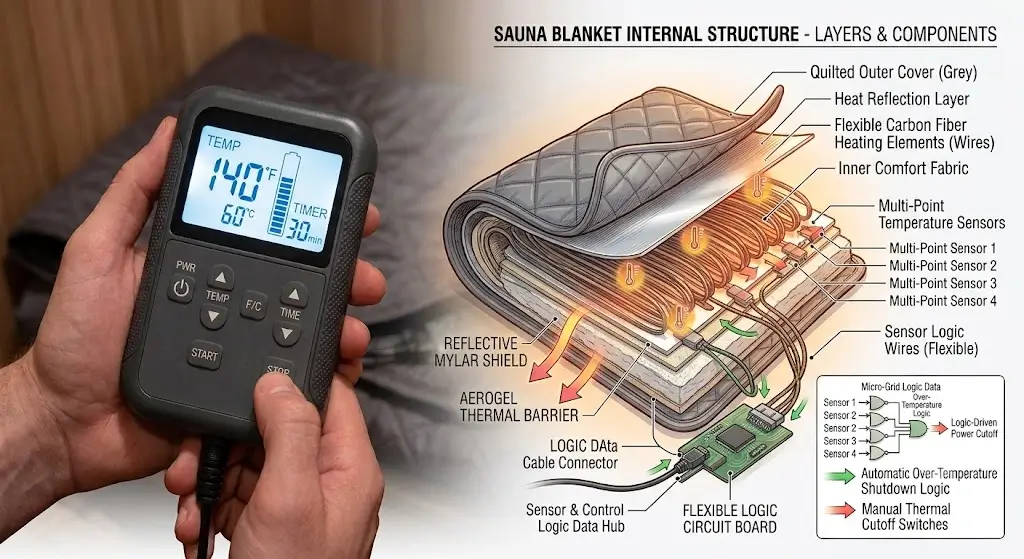
Internal negative temperature coefficient thermistors monitor localized carbon grid heat to modulate power relays. A temperature-control system needs some method of detecting thermal conditions. The sensor may be positioned near a heating element, within a control assembly or in another location specified by the manufacturer.
The sensor’s location matters because temperature changes across a flexible heating product are not necessarily uniform.
Why sensor location matters
A sensor close to a heating element can experience a different temperature from a sensor positioned farther away.
The controller’s displayed value therefore depends partly on what the sensor is actually measuring.
What to look for in documentation
- Temperature sensor information
- Over-temperature protection
- Fault detection
- Manufacturer testing information
- Electrical safety certifications where applicable
Thermal Protection: An Important Specification
Integrated bimetallic thermal fuses disconnect electrical current when interior elements exceed critical thresholds. Temperature control and temperature protection are related but different functions.
A controller regulates the heating system according to its control logic. A protective system is designed to reduce or stop heating when an abnormal condition is detected.
Potential protection mechanisms include:
- Temperature sensors
- Thermal cutoffs
- Over-temperature protection
- Fault detection
- Automatic shutdown features
The exact protection architecture varies by manufacturer and model. Do not assume that two blankets have identical safety systems simply because they have similar advertised temperature ranges. For step-by-step cleaning protocols that protect sensitive interior sensors, follow our guide on how to clean an infrared sauna blanket.
How Infrared Heating Changes the Temperature Discussion
Far-infrared radiant emissions warm vascular tissue through direct resonant absorption rather than convective air transfer. Infrared sauna blankets are commonly described according to their heating technology rather than simply by air temperature.
Infrared radiation transfers energy differently from a conventional system that primarily heats surrounding air.
That means an infrared product’s advertised temperature should not automatically be compared one-to-one with the temperature rating of a traditional sauna room.
The heating technology, element placement, insulation and surface construction all influence how heat is distributed. To explore how direct radiant wraps compare to wooden cabins, review our comparison of infrared vs traditional sauna environments.
Why Sauna Blanket Temperature Is Not Uniform
Thermal camera imaging proves that wire spacing and perimeter seam folds create localized heat gradients across flexible shells. A flexible heating blanket is a layered structure rather than a single solid temperature source.
Temperature can vary because of:
- Heating-element geometry
- Spacing between heating elements
- Insulation thickness
- Outer fabric layers
- Controller logic
- Ambient room temperature
- Product position
- Measurement location
For that reason, claims such as “the blanket reaches X°F” should be interpreted as a product-level specification rather than proof of perfect thermal uniformity.
How Materials Affect Sauna Blanket Temperature
Multi-layer composite layers alter thermal conductivity, volatile off-gassing rates, and radiant dispersion profiles. The materials surrounding a heating element influence heat transfer.
Outer fabric
The outer material affects heat transfer, durability, cleaning characteristics and thermal behavior.
Insulation
Insulating layers reduce heat transfer to the surrounding environment and influence how efficiently heat is retained within the product.
Heating elements
Heating-element design determines where electrical energy becomes thermal energy. Different products can use different element configurations.
Internal structure
The arrangement of conductive layers, insulation and protective materials affects both temperature distribution and thermal response.
How to Read a Sauna Blanket Temperature Specification Sheet
Technical datasheets specify operating temperature ranges, controller resolution increments, and certified electrical inputs. When evaluating a product, do not stop at the largest temperature number printed in the listing.
Record these specifications:
- Temperature range: What range does the manufacturer publish?
- Unit: Is the rating listed in °F, °C or both?
- Resolution: How precisely does the controller display settings?
- Heating technology: What type of heating system is used?
- Sensor: Is temperature sensing described?
- Protection: Is over-temperature protection specified?
- Power: What electrical input does the product require?
- Certification: Are applicable electrical certifications identified?
- Warranty: What components are covered?
- Documentation: Is a manual available?
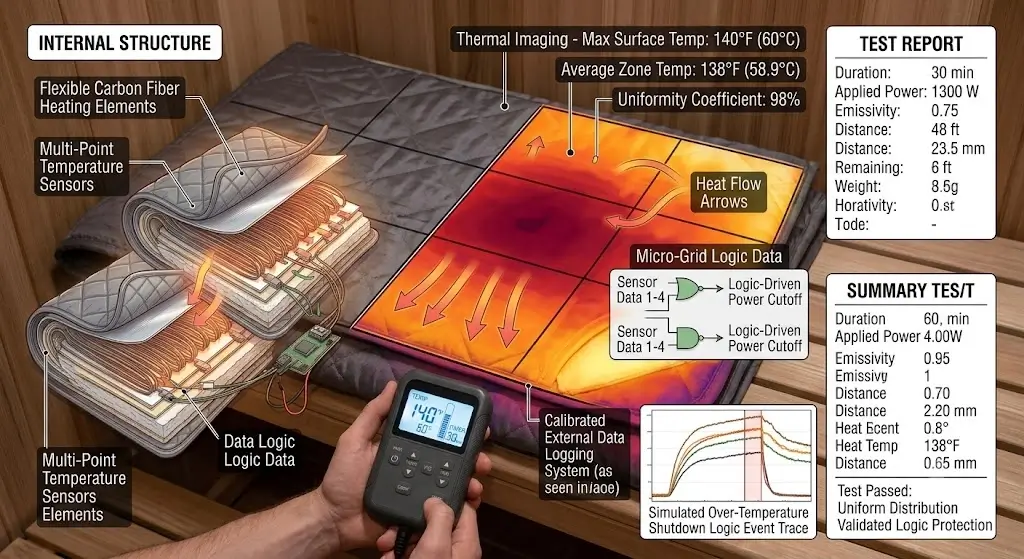
How to Compare Sauna Blanket Temperature Specifications
Rigorous product comparisons cross-reference published thermal ranges against safety protection architectures and verified power consumption. Review our engineering evaluation matrix below:
| Specification | Why It Matters | What to Avoid |
|---|---|---|
| Published temperature range | Shows the manufacturer’s stated operating range. | Comparing numbers without checking measurement definitions. |
| Temperature sensor | Provides information about how temperature is monitored. | Assuming the controller display equals every surface location. |
| Thermal protection | Shows whether protective temperature controls are documented. | Assuming every model uses the same protection architecture. |
| Heating technology | Helps explain heat distribution. | Comparing only maximum temperature. |
| Power specification | Provides useful electrical information. | Ignoring the manufacturer’s electrical requirements. |
Why Independent Temperature Measurements Can Differ
Instrument emissivity settings and probe contact pressure produce substantial variance in thermal bench test results. Two people can measure the same product and obtain different readings without either measurement necessarily being fraudulent.
Thermometers and thermal cameras measure under specific conditions. Infrared thermometers, for example, rely on assumptions about surface emissivity and can be affected by distance and reflected radiation.
Variables include:
- Thermometer type
- Sensor location
- Surface material
- Emissivity setting
- Measurement distance
- Ambient temperature
- Product position
- Time after heating begins
A credible independent test should therefore document the measurement method rather than simply publish one temperature number.
How to Evaluate Sauna Blanket Temperature Claims on Amazon
Verified engineering user manuals supersede promotional marketplace copy when auditing maximum thermal outputs. Amazon product pages often combine manufacturer specifications, retailer copy, customer reviews and automatically generated product information. These sources should not be treated as equally authoritative.
Use this evidence hierarchy:
- Manufacturer manual
- Manufacturer technical specification
- Manufacturer product page
- Verified certification documentation
- Retailer specification
- Customer review
If an Amazon listing claims a temperature that differs from the manufacturer’s current documentation, the manufacturer’s documentation deserves closer attention.
Common Sauna Blanket Temperature Mistakes
Confusing controller setpoints with skin contact temperatures leads to improper session dosing and safety risks. Avoid these widespread misunderstandings:
Mistake #1: Treating the maximum temperature as a performance score
A higher advertised maximum does not automatically mean a better product. Temperature control, construction, sensor accuracy and thermal protection can be more informative.
Mistake #2: Confusing controller temperature with surface temperature
The controller is part of the control system. It does not necessarily measure every location on the blanket.
Mistake #3: Assuming uniform temperature
Flexible heating products can have spatial temperature differences depending on element placement and insulation.
Mistake #4: Comparing infrared blankets directly with traditional sauna temperatures
The heating mechanism and thermal environment are different, so a simple numerical comparison can be misleading.
Mistake #5: Ignoring the manual
A product page may simplify technical information. The current manufacturer’s manual is a better source for operating limitations, electrical requirements and safety information.
Mistake #6: Trusting a single customer measurement
Customer measurements rarely document enough information about the instrument, measurement location or test conditions to establish laboratory-level accuracy.
Temperature Range vs. Temperature Accuracy
Broader operating dials do not guarantee tighter thermal tolerances around desired setpoints. These are two separate specifications.
A product can have a wide published temperature range while providing limited information about the accuracy of its temperature measurement.
Conversely, a product may publish a narrower range while providing better documentation about sensors and control.
- Temperature range
- Temperature resolution
- Temperature accuracy
- Temperature uniformity
- Sensor location
- Thermal protection
What Makes a Sauna Blanket Temperature Specification Trustworthy?
Transparent laboratory documentation defines testing ambient baselines, sensor probe positions, and thermal tolerance margins. A strong specification is precise about what the number represents.
The best technical documentation identifies the measurement or control method, operating conditions and applicable limitations rather than presenting an isolated maximum temperature.
For editorial product testing, the strongest evidence combines manufacturer documentation with a repeatable measurement methodology.
Sauna Blanket Temperature and Electrical Specifications
Operational wattage determines rapid heat-up velocity while internal resistance governs maximum element thermal dissipation. Temperature output is connected to the heating system’s electrical design, but electrical power alone does not determine temperature.
Insulation, heating-element resistance, control logic, thermal losses and product construction all influence thermal performance. To assess overall power draw and operational costs, explore our breakdown on sauna electricity cost.
A product listing that advertises a large temperature number without clearly identifying its electrical specifications deserves additional scrutiny.
Sauna Blanket Temperature vs. Traditional Sauna Temperature
High convective ambient air heat contrasts with direct radiant tissue warming at significantly lower operating thresholds. The two categories should not be evaluated using temperature alone.
A traditional sauna heats an enclosed room and its surfaces, while an infrared blanket is a flexible personal heating system with its own layered construction and control system.
Consequently, the temperature number printed on a blanket listing is not equivalent to the air temperature specification of a traditional sauna room.
For a broader comparison of the technologies, see our comprehensive guide on Infrared vs Traditional Sauna.
Related BioHackTub Guides
Our technical laboratory testing audits electromagnetic radiation, cabin heating dynamics, and personal recovery hardware. Explore our related performance manuals below:
Sauna Blanket Temperature FAQ
Direct technical responses resolve common consumer questions regarding controller readouts, thermal uniformity, and safety cutoffs. Key engineering answers are detailed below:
What temperature do sauna blankets reach?
There is no single temperature applicable to every sauna blanket. Published temperature ranges vary by model, heating technology, controller and manufacturer specifications.
Is sauna blanket temperature the same as traditional sauna temperature?
No. The two systems use different heating environments and should not be compared solely by their numerical temperature ratings.
What does the temperature on a sauna blanket controller mean?
It generally represents a selected control value or a value associated with the product’s temperature-control system. It should not automatically be interpreted as the exact temperature at every point on the blanket.
Why can different parts of a sauna blanket have different temperatures?
Heating-element placement, insulation, material layers and sensor location can create differences across the surface.
What is thermal protection on a sauna blanket?
Thermal protection refers to systems designed to monitor or limit abnormal temperature conditions. The exact mechanism depends on the manufacturer and model.
How do I convert sauna blanket temperature from Fahrenheit to Celsius?
Use the formula °C = (°F − 32) × 5/9. For the reverse conversion, use °F = (°C × 9/5) + 32.
Is a higher sauna blanket temperature better?
Not necessarily. Maximum temperature is only one specification. Temperature control, uniformity, construction, sensor information and thermal protection also matter when evaluating a product.
Should I trust the temperature shown on an Amazon listing?
Treat it as a manufacturer or retailer claim until it can be confirmed through the current product documentation. Product listings can contain outdated or simplified specifications.
Why does an infrared sauna blanket have a different temperature rating from a sauna room?
The heating mechanisms are different. A sauna room describes the thermal environment of an enclosed space, while a blanket is a layered flexible heating system.
Where should I find the most reliable temperature specification?
Start with the current manufacturer’s manual and technical documentation for the exact model. Those documents are generally more useful than generic retailer descriptions or isolated customer measurements.
Final Verdict: How to Read Sauna Blanket Temperature Correctly
Reliable product evaluations assess sensor probe architecture, thermal fuse safety limits, and verified contact heat rather than peak marketing numbers. The phrase sauna blanket temperature sounds like a simple specification, but it can represent several different things.
The most useful technical comparison separates the controller setting, advertised temperature range, sensor reading and actual surface temperature.
When evaluating a product, look beyond the highest temperature printed in the marketing copy. Check the heating technology, sensor information, thermal protection, electrical specifications, manufacturer documentation and measurement methodology.
