
Cryo-Hydrotherapy
Exercise Physiology
What Is a Cold Plunge? How It Works, Temperature, Benefits & Risks
•
Exercise Science Audit: Dr. Alex Mercer, CSCS
•
Updated October 2026
A cold plunge is a form of cold-water immersion in which a person partially or fully immerses their body in cold water for a short period. It can be performed in a purpose-built cold plunge tub, an ice bath, a bathtub filled with cold water, or another suitable water container.
Cold plunging is also called cold-water immersion (CWI), ice bathing, or cold therapy. The basic concept is simple: expose the body to cold water for a controlled period and then exit the water and rewarm.
Quick Reference Specification: Cold-Water Immersion Parameters & Clinical Thresholds
Clinical exercise science defines cold-water immersion through strict thermal boundaries, duration windows, and physiological targets. The reference matrix below summarizes evidence-based protocols, cooling systems, and systemic responses for home and athletic recovery setups:
| Immersion Metric | Beginner Protocol | Conditioned / Athletic Target | Physiological Mechanism | Clinical Safety Threshold |
|---|---|---|---|---|
| Water Temperature | 50°F – 59°F (10°C – 15°C) | 42°F – 48°F (5.5°C – 8.8°C) | Conductive heat extraction (25x faster than air) | Avoid < 40°F (tissue injury risk) |
| Exposure Duration | 60 – 120 seconds | 2 – 5 minutes | Norepinephrine release plateau; core defense | Cap at 10 min max (hypothermia onset) |
| Hemodynamic Action | Initial tachycardia (cold shock) | Controlled vagal tone increase | Peripheral vasoconstriction shunts blood to core | Contraindicated in severe hypertension |
| Training Compatibility | Post-endurance / cardio | Separate 4–6 hrs from lifting | Suppresses mTOR phosphorylation & satellite cells | Do not plunge immediately post-hypertrophy |
| Weekly Frequency | 1 – 2 sessions / week | 3 – 4 sessions (11 min total) | Brown adipose tissue (BAT) activation window | Daily use optional, not clinically required |
Technical Snapshot: What Defines a Cold Plunge?
- Core Definition: Controlled full or partial immersion in cold water (typically below 60°F) designed to trigger acute vasoconstriction, thermal shock adaptation, and systemic norepinephrine secretion.
- Recommended Temperatures: Beginners should target 50°F to 59°F (10°C–15°C) for 1 to 2 minutes; temperatures below 40°F (4.4°C) represent extreme exposure and are discouraged for casual wellness protocols.
- Primary Recovery Benefits: Alleviates post-exercise delayed-onset muscle soreness (DOMS) and enhances short-term subjective alertness via autonomic nervous system stimulation.
- Strength Hypertrophy Trade-Off: Immediate cold-water immersion post-resistance training blunts muscular inflammation signaling (mTOR pathway), potentially impairing long-term strength and muscle hypertrophy adaptations.
The modern cold-plunge market includes everything from inexpensive insulated tubs that require bags of ice to powered systems with filtration, circulation and refrigeration. The equipment can differ dramatically, but the underlying practice remains cold-water immersion.
What Does “Cold Plunge” Actually Mean?
The term cold plunge designates intentional, controlled immersion of the human body into cold water for therapeutic recovery. There is no universal requirement that a cold plunge must contain ice, use a mechanical chiller, or reach one exact temperature.
For example, a person could use a bathtub containing sufficiently cold water, while another person could use a purpose-built outdoor tub connected to a refrigeration-based chiller. Both can fall under the broader category of cold-water immersion.
Clinical authorities, including the Cleveland Clinic, describe a cold plunge as a dip into cold or icy water, noting that cold-water immersion is another established clinical term for the practice.
How Does a Cold Plunge Work?
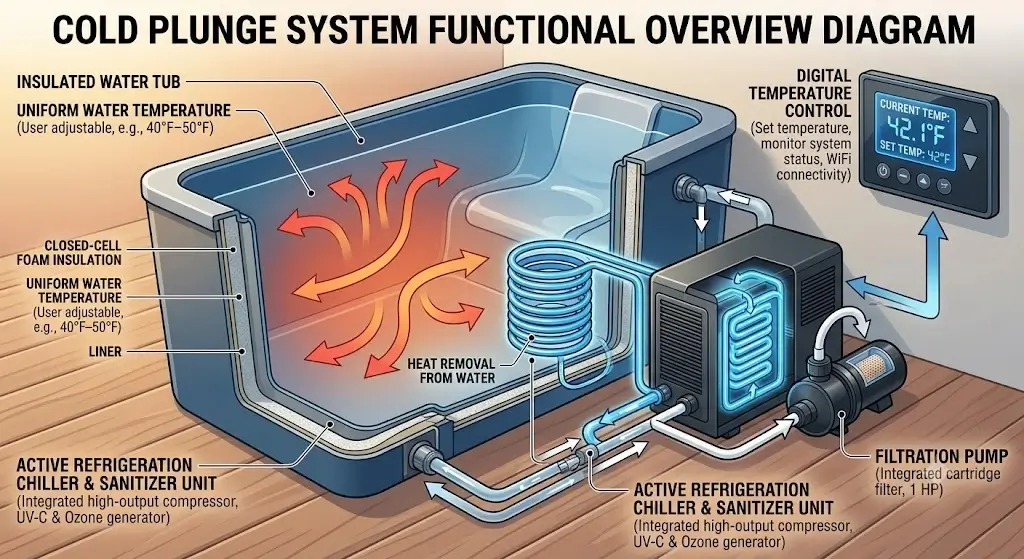
Water extracts body heat approximately twenty-five times faster than air through high-density thermal conduction. When the body enters cold water, the initial response can include rapid breathing, increased alertness and constriction of blood vessels near the skin.
The body then works to maintain its internal temperature while exposed to the cold environment.
This is one reason cold-water immersion can feel dramatically different from simply standing outside on a cool day.
The physiological response is also why temperature and exposure duration matter. Colder water and longer exposure increase the thermal challenge rather than simply making the experience “better.”
How Cold Is a Cold Plunge?
Operational water temperatures range from sixty degrees down to forty degrees Fahrenheit depending on individual experience levels. There is no single temperature that legally or universally defines a cold plunge.
In consumer cold-plunge discussions, water temperatures commonly fall somewhere below approximately 60°F, with many dedicated systems designed to operate in the 40s or 50s°F.
Medical guidance is more conservative about very cold water. Clinical recommendations suggest that beginners start around 50°F–59°F and advise against going below 40°F.
| Water Temperature | General Description | Important Consideration |
|---|---|---|
| 60°F–70°F | Cool water | Less intense than conventional cold-plunge temperatures |
| 50°F–59°F | Cold | A commonly suggested starting range in medical guidance |
| 45°F–49°F | Very cold | Greater thermal stress |
| 40°F–44°F | Extremely cold | Requires greater caution |
| Below 40°F | Very extreme cold exposure | Not appropriate to treat as a casual beginner target |
The important point is that colder is not automatically better. The body’s response becomes more demanding as water temperature decreases.
Cold Plunge vs. Ice Bath: What’s the Difference?
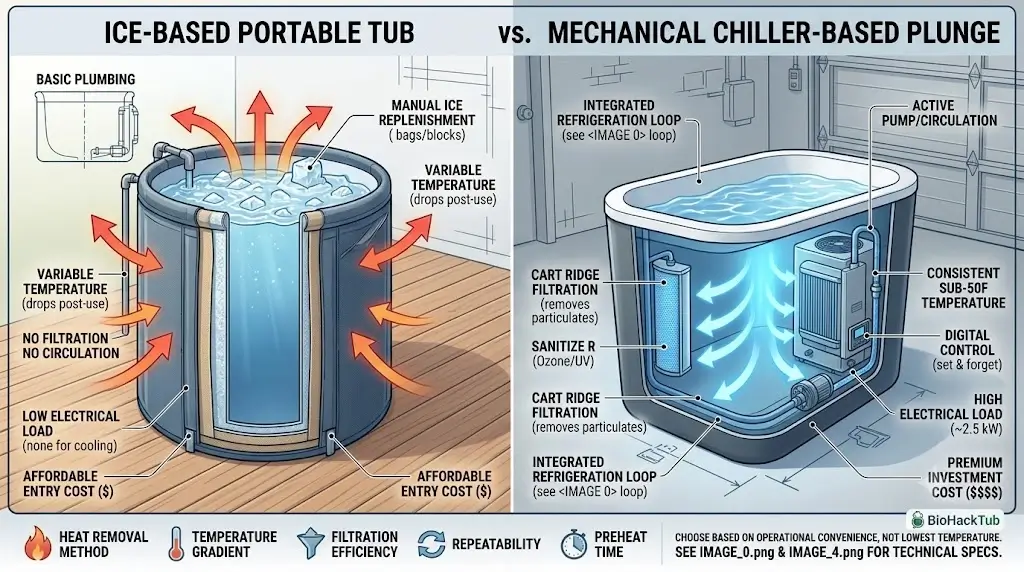
Chiller-driven cold plunge tubs maintain exact continuous temperatures while ice baths rely on melting ice bags. The terms are often used interchangeably, but there is a practical equipment distinction.
| Feature | Cold Plunge | Ice Bath |
|---|---|---|
| Water cooling | May use a chiller, ice or naturally cold water | Usually relies on ice or very cold water |
| Temperature control | Often more precise with a powered chiller | Changes as ice melts |
| Filtration | Often available on dedicated systems | Usually absent unless separately installed |
| Circulation | Often integrated | Usually manual or absent |
| Repeatability | Generally higher with a chiller | Depends on ice quantity and starting water temperature |
An ice bath can therefore be a cold plunge, but not every cold plunge requires literal ice.
Is a Cold Plunge the Same as a Cold Shower?
Full-body submersion exerts continuous hydrostatic pressure and surrounds all surface receptors unlike moving shower streams. Both expose the body to cold water, but immersion surrounds a much larger portion of the body with water simultaneously.
A shower also involves continuously moving water, whereas a plunge generally involves sitting or standing in a relatively stationary body of water.
The thermal environment is therefore different even when the measured water temperature is similar.
Why Do People Take Cold Plunges?
Athletes and wellness practitioners utilize cold immersion to accelerate acute recovery and stimulate central nervous alertness. Research and clinical commentary do not support treating cold plunging as a universal health solution. Evidence is stronger for some short-term recovery outcomes than for many of the broader claims commonly used in marketing.
Clinical data highlight potential benefits, including reduced muscle soreness, improved alertness and possible sleep benefits, while emphasizing that cold plunging also carries cardiovascular risks.
Common reasons include:
- Post-exercise recovery
- Temporary reduction in perceived muscle soreness
- A feeling of alertness
- Personal wellness routines
- Exposure to a controlled cold stimulus
- Contrast therapy when combined with heat

Does a Cold Plunge Help Muscle Recovery?
Cold-water immersion reduces delayed-onset muscle soreness by blunting localized tissue inflammation and cellular edema. Medical literature supports reductions in exercise-related muscle soreness and muscle damage markers following cold-water immersion.
That does not mean cold plunging is required for recovery. Sleep, nutrition, appropriate training load, hydration and rest remain fundamental components of recovery.
Cold plunging can also have a trade-off for strength training
The inflammatory response involved in exercise is part of the body’s adaptation process. Sports medicine research indicates that cold-water immersion immediately after resistance training may interfere with some of the signaling associated with long-term strength and muscle growth (hypertrophy).
That makes timing an important consideration for people whose primary goal is hypertrophy rather than short-term soreness reduction.
Potential Cold Plunge Benefits
Scientific studies validate acute analgesic relief and autonomic stimulation while disproving passive body fat loss claims. Review the summary across major wellness endpoints below:
| Potential Effect | What the Evidence Suggests |
|---|---|
| Muscle soreness | Evidence supports a potential reduction in post-exercise soreness. |
| Short-term recovery | May help restore perceived recovery and some physical performance measures. |
| Alertness | Cold exposure can produce an acute stimulating response. |
| Mood | Some people report improved mood, but evidence is not a reason to treat cold plunging as a mental-health treatment. |
| Sleep | Some research suggests possible benefits, but results are not universal. |
| Weight loss | Not a reliable primary weight-loss strategy. |
What Happens to Your Body During a Cold Plunge?
Sudden cutaneous cooling triggers massive sympathetic activation that elevates plasma norepinephrine and constricts arterioles. Cold exposure stimulates the body’s stress-response systems and causes peripheral blood vessels to constrict. Breathing can also become faster and less controlled initially.
This response explains why entering cold water can feel dramatically more intense than the same temperature might suggest.
What Is the Cold Shock Response?
The cold shock response triggers an involuntary gasping reflex and rapid tachycardia upon initial water entry. It can involve rapid breathing, increased heart rate and blood-vessel constriction.
This is one reason the first moments of immersion can feel much more difficult than the later part of a short exposure.
Cold shock is also one reason a controlled environment is preferable to entering unknown natural water, where dangerous currents create secondary hazards.
What Is a Home Cold Plunge?
A home cold plunge provides a dedicated residential containment tub engineered for consistent cold-water immersion protocols. The simplest setup may consist of an insulated container and cold water.
More advanced systems can include:
- Mechanical water chiller
- Circulation pump
- Water filtration
- Sanitization system
- Digital temperature control
- Insulated cover
- Drainage system
The primary engineering advantage of a dedicated system is repeatability. Instead of repeatedly buying and adding ice, a chiller can maintain a selected water temperature.
Types of Cold Plunge Tubs
Residential immersion hardware categorizes into inflatable drop-stitch barrels, rotomolded hard tubs, and powered chiller assemblies. Review the core design formats:
1. Inflatable Cold Plunge
Inflatable tubs are generally among the easiest options to transport and store. Many are designed for garages, patios or temporary setups. Their major advantage is low storage and installation complexity, though their trade-offs involve thinner insulation and puncture vulnerability. If you are exploring this segment, check out our field-tested roundup of the best portable cold plunge on Amazon to see how different inflatable fabrics hold up against intense heat gain.
2. Hard-Shell Cold Plunge
Hard-shell tubs provide a rigid structure and can be maintained as a permanent installation. They are commonly available in rotomolded or acrylic designs and pair cleanly with integrated or external chillers.
3. Cold Plunge With Chiller
A chiller-based system uses active refrigeration to remove heat from the water. This is the most convenient configuration for anyone requiring repeatable sub-50°F water without the manual labor of handling ice blocks.
4. Ice Bath Tub
An ice bath tub relies primarily on ice and cold water rather than mechanical refrigeration. It carries a lower upfront cost, but temperature consistency fluctuates as the ice melts.
What Does a Cold Plunge Chiller Do?
Vapor-compression refrigeration loops circulate tub water through heat exchangers to extract thermal energy continuously. Water passes through the cooling system, heat is transferred out of the water, and the cooled water returns to the tub.
The cooling capacity required depends on several variables:
- Water volume
- Desired water temperature
- Starting water temperature
- Ambient temperature
- Tub insulation
- Cover quality
- Heat generated by the pump
- Frequency of use
This is why a chiller’s horsepower or wattage should never be evaluated without considering the size and insulation of the tub it is expected to cool.
Why Does Filtration Matter in a Cold Plunge?
Circulating cartridge filters extract sloughed skin cells and physical particulates to maintain water clarity. A dedicated cold plunge is a small body of recirculated water. Sweat, skin cells, dust and other contaminants can enter the water during normal use.
Filtration physically removes suspended particles from circulating water. Some systems also use additional sanitation technologies, but filtration and sanitation are distinct processes. A filter captures particles; a sanitizer controls microorganisms through a separate chemical or UV/ozone mechanism.
Does a Cold Plunge Need Water Maintenance?
Regular sanitizer dosing and periodic water replacement prevent bacterial biofilm proliferation in cold aquatic environments. A cold plunge is not automatically self-cleaning simply because the water is cold. A home system requires mechanical filtration, water treatment (such as hydrogen peroxide or gentle spa sanitizers), and periodic draining and scrubbing according to the manufacturer’s guidelines.
Why Temperature Control Matters
Calibrated digital thermostats enable exact recovery protocol replication without guesswork or thermal stratification. A controlled temperature makes it easier to repeat the same exposure rather than guessing how cold the water is. A digital controller can also reduce the need to add ice manually.
However, a displayed temperature reflects readings from a specific sensor location. Water circulation helps minimize thermal gradients across the water column.
Ice vs. Chiller: Which Cold-Plunge System Is Better?
Active chillers provide unmatched temperature precision while manual ice tubs offer lower upfront equipment acquisition costs. Compare the functional trade-offs below:
| Factor | Ice-Based System | Chiller-Based System |
|---|---|---|
| Initial equipment cost | Usually lower | Usually higher |
| Temperature consistency | Variable | Generally better |
| Manual work | More frequent | Less frequent |
| Electricity use | Little or none for cooling | Requires electricity |
| Installation | Simple | More complex |
| Long-term convenience | Depends on access to ice | Generally higher |
For occasional use, an ice-based setup can be adequate. However, for athletes aiming for daily thermal conditioning, manual ice replenishment can quickly become expensive and logistically frustrating. As analyzed in our The Pod Company Standard Ice Pod review, passive budget barrels face strict thermodynamic and plumbing limits when users later attempt to retrofit active chillers to avoid buying bags of ice.
Cold Plunge vs. Cryotherapy
Water immersion conducts heat away from skin tissue significantly faster than cold gaseous air inside cryo-cabins. Whole-body cryotherapy exposes the body to extremely cold air or gas vapor for a short period.
| Feature | Cold Plunge | Whole-Body Cryotherapy |
|---|---|---|
| Medium | Cold water | Very cold air/gas environment |
| Direct water contact | Yes | No |
| Home setup | Possible | Usually specialized commercial facility equipment |
| Primary engineering challenge | Water cooling and sanitation | Cryogenic nitrogen or compressed cooling units |
What Is Contrast Therapy?
Contrast therapy alternates hot sauna vasodilation with cold water vasoconstriction to stimulate vascular pumping action. A home recovery setup might combine a sauna with a cold plunge, creating a hot-cold sequence.
The practice has become popular in athletic recovery and wellness environments, but the ideal temperature, timing and sequence should be customized based on individual tolerance. To understand the thermal physics of the hot phase, review our baseline analysis on what is a sauna.
Does Cold Plunging Cause Weight Loss?
Non-shivering thermogenesis burns minimal calories and fails to produce clinically meaningful adipose fat reductions. Cold exposure increases the body’s energy expenditure because the body must work to maintain temperature, but that does not make cold plunging a reliable weight-loss method.
The short-term changes in body weight after a cold plunge reflect transient fluid loss or measurement fluctuations rather than adipose tissue lipolysis. Cold plunging should be evaluated primarily as a cold-exposure or recovery practice rather than as a substitute for nutrition and exercise.
Can Cold Plunging Affect Muscle Growth?
Immediate post-lift immersion suppresses muscle protein synthesis by blunting p70S6K and mTOR pathway signaling. Timing matters if strength and hypertrophy are priorities. Cold-water immersion suppresses post-exercise inflammatory signaling, which can interfere with the physiological adaptations produced by resistance training.
Sports science recommendations advise separating heavy hypertrophy lifting sessions and cold plunging by at least 4 to 6 hours to avoid blunting muscle growth.
Who Should Be Careful With Cold Plunging?
Individuals with cardiovascular disorders, hypertension, and Raynaud’s phenomenon face severe medical risks during cold immersion. Cold-water immersion creates sudden cardiovascular and respiratory stress. Consult a healthcare provider before plunging if you have conditions including heart disease, high blood pressure, diabetes, pregnancy, peripheral neuropathy, or poor circulation.
Cold Plunge Safety Basics
Calibrated thermometers, brief initial exposures, and unobstructed exit pathways prevent accidental cold-water hypothermia. Cold water can become hazardous quickly. The objective should be controlled exposure rather than pushing through extreme cold limits.
- Measure the water temperature with a reliable thermometer.
- Do not assume colder water is automatically more beneficial.
- Keep initial exposure short (1–2 minutes).
- Do not force yourself to remain in the water if you feel unwell.
- Ensure a safe, clear exit path from the tub.
- Keep warm towels and clothing nearby.
- Avoid natural bodies of water with dangerous currents or unstable ice.
- Do not use a cold plunge as an endurance test.
What Should a Beginner Know Before Trying a Cold Plunge?
Beginners must prioritize breathing regulation and moderate temperatures over near-freezing endurance challenges. The biggest beginner mistake is focusing on reaching near-freezing temperatures rather than learning how the body responds to cold water.
For healthy adults, starting around 50°F–59°F for 60 to 120 seconds provides an effective entry point to establish breathing control and avoid severe cold shock.
What Should You Look for in an Amazon Cold Plunge?
Purchasing evaluations require verifying chiller horsepower ratings, internal tub dimensions, and dedicated filtration loops. If your goal is to purchase a cold plunge through Amazon, separate the tub itself from the cooling system. Some Amazon listings are simply insulated tubs, while others bundle a chiller, pump and filtration equipment.
Important specifications:
- Internal dimensions: Ensure the tub accommodates your body frame comfortably.
- Water capacity: Influences chiller sizing and structural floor load.
- Insulation: Reduces thermal leakage from ambient air.
- Chiller capacity: Verify BTU/HP ratings for your local climate.
- Filtration: Cartridge filters remove physical particulates.
- Sanitization: Ozone or UV generators help maintain hygienic water.
- Drainage & Covers: Ensure easy drainage routing and tight insulated lids.
How Much Does a Cold Plunge Cost?
System pricing ranges from one hundred dollars for simple vinyl tubs to over three thousand dollars for commercial chiller units. Review the pricing tiers across market segments:
| System Type | Relative Cost | Main Tradeoff |
|---|---|---|
| Basic portable tub | $ (Under $150) | Low entry cost but requires manual ice loading |
| Insulated tub | $$ ($150–$500) | Better temperature retention and structural durability |
| Tub + external chiller | $$–$$$ ($800–$2,500) | Consistent cooling with separate plumbing components |
| Integrated cold-plunge system | $$$–$$$$ ($3,000+) | All-in-one convenience, integrated filtration, plug-and-play |
Does a Cold Plunge Use a Lot of Electricity?
Active plunge chillers consume between two hundred and five hundred watts during active compressor cooling cycles. A powered cold plunge uses electricity primarily for its chiller and circulation pump. A well-insulated, covered tub dramatically reduces thermal heat intrusion, allowing the compressor to cycle off once target temperatures are achieved.
Can You Put a Cold Plunge Outdoors?
Weatherproof plunge cabinets require dedicated GFCI outlets and UV-resistant covers for patio or garage placement. Many cold plunges are engineered for exterior settings. Ensure proper GFCI electrical protection, protect the chiller from direct rainfall or standing water, and use an insulated thermal cover to limit UV degradation and heat gain.
Is a Lake or Ocean a Cold Plunge?
Natural water bodies provide cold immersion but present dangerous hazards from unpredictable rip currents and rapid temperature drops. However, open water introduces uncontrollable variables like undertows, sudden drop-offs, shifting currents, and hypothermia hazards. A dedicated home tub provides a substantially safer, controlled environment.
Common Cold Plunge Mistakes
Common plunging errors include forcing extreme temperatures, staying submerged too long, and skipping water sanitization. Avoid the five frequent mistakes detailed below:
1. Chasing the lowest temperature
Extreme cold increases thermal stress without proportional physiological benefits.
2. Staying in too long
Prolonged exposure increases the risk of severe hypothermia.
3. Ignoring water temperature
Always verify actual water temperature with a calibrated thermometer.
4. Assuming filtration equals sanitation
Filtration removes debris; sanitation neutralizes bacteria and biofilms.
5. Plunging immediately after hypertrophy training
Wait 4 to 6 hours after resistance training to protect muscle growth adaptations.
Cold Plunge Myths vs. Reality
Scientific evidence debunks claims that cold plunges replace healthy diets or require literal ice to produce benefits. Examine the facts below:
| Claim | Reality |
|---|---|
| “A cold plunge must contain ice.” | No. Water can be chilled mechanically or naturally. |
| “The colder the water, the better.” | Lower temperatures simply increase physiological stress. |
| “Cold plunging is a cure-all.” | Evidence supports soreness reduction and alertness, but claims beyond recovery are often overstated. |
| “A cold plunge is just a cold shower.” | Full immersion creates a far more intense hydrostatic and thermal load. |
| “A chiller means the water is maintenance-free.” | Water still requires sanitizers, filtration changes, and periodic draining. |
Cold Plunge Temperature Guide
Water temperature classifications range from mild sixty-degree exposure down to extreme sub-forty-degree immersion. Refer to the clinical breakdown below:
| Temperature (°F) | Temperature (°C) | General Classification |
|---|---|---|
| 60°F | 15.6°C | Cool / mild cold exposure |
| 55°F | 12.8°C | Cold (Beginner window) |
| 50°F | 10.0°C | Cold (Standard starting target) |
| 45°F | 7.2°C | Very cold (Experienced users) |
| 40°F | 4.4°C | Extremely cold (High caution) |
| Below 40°F | Below 4.4°C | Extreme exposure (Not recommended for casual wellness) |
What Is a Cold Plunge? FAQ
Authoritative clinical responses clarify common homeowner inquiries regarding exposure duration, beginner temperatures, and muscle hypertrophy impacts. Key answers are detailed below:
What exactly is a cold plunge?
A cold plunge is a short period of partial or full-body immersion in cold water (usually under 60°F). It is also known as cold-water immersion, ice bathing, or cold therapy.
Does a cold plunge have to contain ice?
No. A cold plunge can use cold tap water, ice, or a mechanical water chiller. The defining feature is controlled immersion in cold water.
How cold is a cold plunge?
Consumer systems commonly operate between 45°F and 55°F. Medical authorities recommend that beginners start between 50°F and 59°F and avoid going below 40°F.
What is the difference between an ice bath and a cold plunge?
An ice bath typically uses physical ice to cool water, while a modern cold-plunge system frequently utilizes a dedicated refrigeration chiller. An ice bath is essentially a manual subtype of cold plunge.
What is cold-water immersion?
Cold-water immersion is the clinical term for partially or fully submerging the body in cold water for therapeutic or recovery purposes.
What are cold plunges used for?
They are widely used for post-exercise recovery, reducing delayed onset muscle soreness (DOMS), boosting central nervous system alertness, and mood elevation.
Can a cold plunge help muscle soreness?
Yes. Clinical trials support reductions in perceived muscle soreness and localized tissue inflammation following cold-water immersion.
Can cold plunging interfere with muscle growth?
Yes. Immediate cold-water immersion after resistance training can blunt mTOR signaling, suppressing long-term muscle hypertrophy and strength gains.
Is cold plunging good for weight loss?
While shivering and thermal defense burn modest calories, cold plunging is not an effective primary strategy for long-term body fat loss.
Can you use a cold plunge every day?
Yes, provided you are in good health. However, daily use is not required to achieve recovery benefits; 3 to 4 sessions per week is often optimal.
What temperature should a beginner use?
A safe starting window for beginners is 50°F to 59°F (10°C to 15°C) for 1 to 2 minutes.
How long should a cold plunge last?
Most recovery benefits are achieved within 2 to 5 minutes. Prolonged stays beyond 10 minutes increase the risk of hypothermia without additional benefits.
Who should avoid cold plunging?
Individuals with cardiovascular conditions, hypertension, arrhythmias, Raynaud’s syndrome, or pregnant individuals should avoid cold-water immersion without explicit physician approval.
Is a cold plunge the same as cryotherapy?
No. Cold plunges utilize direct water contact (high thermal conductivity), whereas cryotherapy utilizes sub-zero air or nitrogen gas vapor.
Can you build a cold plunge at home?
Yes. DIY setups can be built using stock tanks, chest freezers, or inflatable barrels paired with external aquarium or commercial plunge chillers.
The Bottom Line: What Is a Cold Plunge?
Cold plunging represents controlled cold-water immersion designed to elicit targeted neuroendocrine and vascular adaptations. The practice does not require a particular brand, tub, chiller or amount of ice.
A basic ice bath can qualify as a cold plunge, while a premium home system adds refrigeration, filtration, circulation, insulation and digital temperature control.
Sources & Editorial References
Clinical trials, sports cardiology reviews, and physiology consensus statements substantiate our cold-water immersion guidelines:
- Cleveland Clinic: Clinical overviews on cold-water immersion, safety boundaries, physiological stress, and beginner temperature protocols.
- Mayo Clinic: Research analyses covering post-exercise recovery, delayed onset muscle soreness, and the blunting effects of cold immersion on resistance training adaptations.
- National Institutes of Health (NIH / PubMed): Peer-reviewed trials examining cardiovascular adjustments, peripheral vasoconstriction, and hypothermic risk factors.
