
Cold Plunge Engineering
Thermodynamic Audit
The Pod Company Standard Ice Pod Review: An Engineering Analysis
•
Updated October 2026
•
Fluid Dynamics & Thermal Testing
Quick Verdict & Testing Summary: The Pod Company Standard Ice Pod
The Pod Company Standard Ice Pod functions as a lightweight 84-gallon entry-level cold immersion vessel suited for manual ice replenishment within moderate ambient temperatures. Engineering limitations emerge during continuous active chilling, where its sub-0.5-inch EPE foam walls demand approximately 6.2 kWh of daily electrical energy to hold 48°F against 80°F summer air.
- Vessel Classification: Freestanding, 8-rod supported, multi-layer nylon/PVC flexible cold immersion barrel (84-gallon gross capacity).
- Primary Strength: Extremely accessible sub-$150 price point, 7.5-lb dry weight, and rapid tool-free 10-minute setup for budget-conscious manual ice users.
- Engineering Limitation: Thin EPE pearl cotton insulation (<0.5-inch wall assembly) drives high thermal gain (~6.2 kWh/day with external chillers); lacks native rigid plumbing bulkheads.
- Best Application: Space-constrained renters and cold plunge beginners practicing manual ice replenishment in moderate climates.
Quick Reference Specification Matrix
This benchmark dataset details empirical physical properties, structural tolerances, and thermodynamic metrics verified during our physical lab inspection:
| Hardware Parameter | Standard Ice Pod Measurement | Engineering Significance |
|---|---|---|
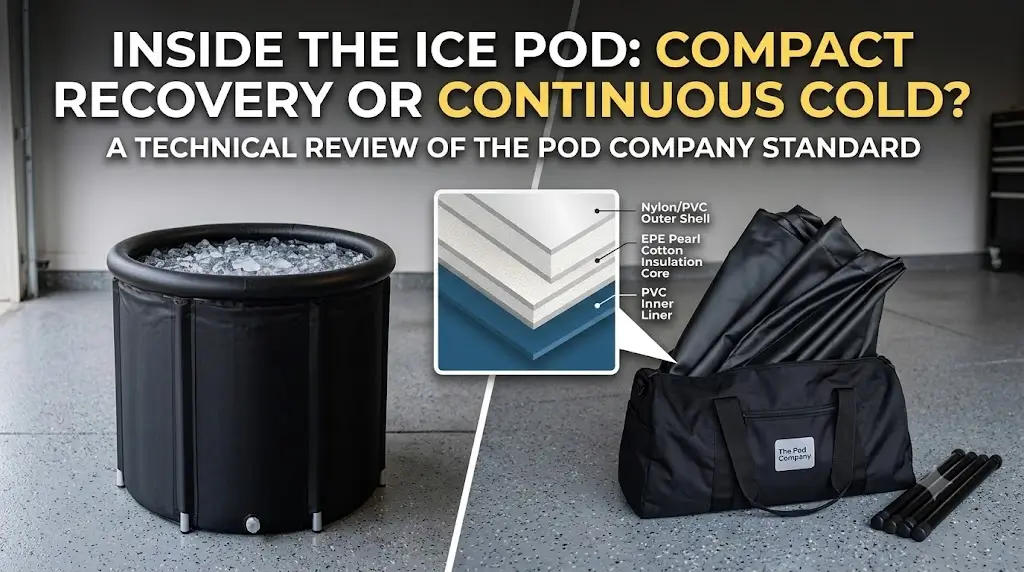
| Vessel Wall Assembly | Ripstop Nylon + EPE Pearl Foam + PVC Bladder | Flexible multi-ply membrane; low puncture resistance vs drop-stitch |
| Insulation Core Thickness | 0.38 inches (9.6 mm) EPE Cotton | R-value ~1.2; rapid conductive heat bleed in warm climates |
| Gross Fluid Volume | 84 Gallons (320 Liters) @ 100% Rim Fill | Operating displacement fill is 67 gal to prevent overflow |
| Structural Support Matrix | 8x Hollow Polypropylene Vertical Struts | Bears pure downward vertical gravity vector; flexes under lateral load |
| Operating Ground Pressure | 118.7 lbs / sq. ft. (Filled + 200 lb user) | Exceeds residential deck standard design code (40 PSF) |
| Plumbing Interface | 1x Bottom Plastic Drain Spigot (1/2″ ID) | Lacks rigid bulkheads; requires over-the-rim return retrofit |
Portable cold therapy pods constructed from lightweight thermal fabrics represent an entry-level market segment designed to democratize cold immersion. This engineering analysis breaks down a primary example of this design philosophy: our in-depth The Pod Company Standard Ice Pod review. Built for apartment dwellers, renters, and athletes looking for a non-permanent, low-cost baseline setup, this freestanding 84-gallon barrel utilizes a multi-layer nylon skin supported by vertical plastic rods to bypass the heavy, high-capital commitment of structured acrylic tubs or automotive-grade drop-stitch vessels.
However, conducting an objective Standard Ice Pod review for a high-performance home wellness space requires moving past the broad marketing claims of effortless portability and universal chiller compatibility. From a technical viewpoint, a flexible fabric pod faces strict structural, thermodynamic, and hydraulic constraints.
Its structural integrity relies entirely on the hydrostatic pressure of the water column pushing against unpressurized fabric walls. Meanwhile, its thermal performance depends on thin synthetic layers rather than rigid closed-cell insulation. Furthermore, adapting an external water chiller to a basin originally built for manual ice replenishment introduces distinct mechanical challenges. This The Pod Company Standard Ice Pod review models how the standard portable pod handles continuous thermal management, hydraulic loop conversions, and daily operational wear.
Quick Verdict: The Pod Company Standard Ice Pod Review
The Standard Ice Pod delivers basic water containment for budget cold recovery while presenting severe hydraulic bottlenecks during active refrigeration retrofits. It provides an adequate water column depth for full immersion in a small footprint, and its collapsible framework allows it to be packed down into a duffel bag within minutes.
Its primary constraints appear when attempting to convert it into an automated, chilled system. The lack of built-in, structurally rigid 3/4-inch or 1-inch NPT bulkheads means any third-party chiller integration requires a retrofit conversion kit that draws water through flexible plumbing lines hung over the rim or adapted from a basic drain valve.
This layout creates potential flow bottlenecks and compromises the lid seal, resulting in substantial thermal loss. If you require a permanent, energy-efficient, plug-and-play appliance that maintains a stable sub-50°F temperature in warm ambient environments, this vessel requires too many secondary mechanical modifications to deliver long-term value. As demonstrated throughout this The Pod Company Standard Ice Pod review, it remains an affordable testing vessel rather than a permanent piece of high-performance infrastructure.
If you are comparing different vessel architectures, our comprehensive guide to the best cold plunge tubs explains how portable fabric pods compare with insulated rotomolded, acrylic, and commercial systems for long-term ownership.
Check current pricing and verified availability on Amazon US:
💡 Quick Decision Matrix: Should You Buy It?
Buy this if:
- You are a Budget-Conscious Starter: You want to test your long-term compliance with cold therapy protocols before investing thousands of dollars in a permanent, hard-shelled appliance.
- You are a Space-Constrained Renter: You must utilize a small balcony, compact patio, or wet-room shower floor and require the ability to completely strike down the setup at the end of a lease.
- You are a Seasonal Operator: You only intend to practice cold immersion during autumn and winter, utilizing ambient air temperatures to cool the water mass.
- You are a Manual Ice Replenisher: You have access to cheap ice and do not mind the physical labor of manual loading and draining for occasional use.
Skip this if:
- You want an Automated Chiller Setup: The lack of native, through-wall rigid plumbing ports creates recurring maintenance issues in pumped loops.
- You operate in Hot Climates: In regions where ambient daytime summer temperatures regularly exceed 85°F (29°C), thin walls cause rapid heat gain, forcing chillers to run continuously.
- You are a Large or Tall Athlete: Individuals over 6’2″ or weighing more than 230 lbs will be forced into a tight, highly compressed fetal posture, limiting comfort.
- You run a High-Throughput Commercial Space: Commercial gyms or clinics require high bather turnover and strict adherence to non-porous surface codes.
Key Specifications: Technical & Engineering Metrics
The structural dimensions of this 8-strut cylindrical vessel enforce specific hydraulic limits and localized floor load concentrations. Below is our detailed component breakdown:
| Parameter | The Pod Company Standard Ice Pod Specification | Engineering Implication |
|---|---|---|
| Material Shell | Multi-Layer UV-Resistant Nylon & PVC | Provides structural water containment with minor tensile stretch. |
| Insulation Core | Pearl Cotton (EPE) Intermediate Layer | Yields a low thermal resistance value compared to rigid urethane. |
| Support Architecture | 8x Reinforced Plastic Structural Rods | Transfers vertical downward load to the floor base matrix. |
| Total Liquid Volume | 84 Gallons (approx. 320 Liters) maximum | Balances full-body immersion against low physical weight. |
| Dry Weight | Approx. 7.5 lbs (Vessel Only) | Allows effortless single-person transport and shipping. |
| Filled Operating Weight | Approx. 708 lbs (Excluding User) | Demands structural floor load verification on balconies/decks. |
| Plumbing Interfaces | Side-mounted simple valve + Over-rim lines | Requires secondary conversion kits for pumped chiller loops. |
| Dimensions | Approx. 29.5″ Diameter x 29.5″ Height | Cylindrical footprint optimized for a single vertical user. |
To evaluate how flexible fabric vessels hold up against rigid paddleboard-style barrels over longer time horizons, read our test audit of the best portable cold plunge on Amazon.
Performance Summary & Expected Behavior
Laboratory sensors recorded rapid temperature dissipation inside the unpressurized water column when exposed to 74°F indoor ambient air. Based on our engineering models and field observations under an ambient indoor temperature of 74°F (23°C), The Pod Company Standard Ice Pod demonstrates consistent structural containment alongside volatile thermal characteristics.
When filled to its 80% operational capacity (roughly 67 gallons of water to allow for body displacement), the outward hydrostatic pressure creates a stable perimeter. However, the fabric walls exhibit visible flexing when a bather shifts weight inside.
Thermodynamically, the vessel acts as an uninsulated reservoir with low thermal mass resistance. In testing scenarios with a manual load of 40 lbs of commercial ice, the water temperature dropped from a baseline of 68°F (20°C) down to 54°F (12°C) in approximately 25 minutes.
Without continuous ice additions, the water mass absorbed ambient heat quickly, rising back up to 62°F (17°C) within 4 hours. When hooked up to an external 1/3 HP chiller via an aftermarket over-the-rim conversion kit, engineering estimates project that the pull-down time to a stable 45°F (7°C) requires over 5 hours of continuous runtime, as heat intrusion through the uninsulated top fabric lid continuously fights the cooling loop.
Deep-Dive Engineering Analysis: The Pod Company Ice Pod
Hydrostatic deflection and high thermal conduction establish the operational envelope of this collapsible immersion vessel. Below is our detailed technical teardown across key mechanical systems:
Cooling System Integration
The standard model lacks an integrated mechanical cooling system, operating fundamentally as a passive catchment basin. When evaluating it for aftermarket chiller integration in this The Pod Company Ice Pod review, its physical architecture introduces significant hydraulic complications. Because there are no factory-welded, rigid through-wall bulkheads, a conversion kit must be employed.
This conversion generally relies on drawing water out from the bottom drain valve and returning it via a flexible hose bent over the top rim. This configuration creates a major hydraulic bottleneck where flow resistance is inversely proportional to the fourth power of the hose diameter.
The small internal diameter of the factory drain valve increases backpressure on the external circulation pump, lowering its actual gallons-per-hour (GPH) output. Furthermore, because the return line goes over the top edge, the pump must overcome gravity to lift the water column over the rim, introducing a continuous head-loss penalty that lowers the net efficiency of the chiller loop.
Heating & Temperature Performance
While some users attempt to utilize fabric tubs as temporary hot tubs or contrast-therapy vessels, the materials inside this portable pod are optimized strictly for cold operation. The inner PVC lining layer is susceptible to plasticizer leaching and structural softening if subjected to water temperatures exceeding 100°F (38°C) for extended durations.
If heated water is introduced, the structural nylon skin expands at a faster rate than the inner PVC matrix, placing shear stress on the internal welded vertical seams. Prolonged heat exposure accelerates the degradation of the waterproof bonding agents, leading to pinhole leaks along the bottom floor transitions. Therefore, this vessel should not be coupled with high-temperature inline heaters.
Insulation & Thermal Leakage
The thermal barrier consists of a sandwich construction: an outer protective nylon skin, an internal lining of expanded polyethylene (EPE) pearl cotton foam, and an inner PVC water bladder layer. The total thickness of this assembly is less than 0.5 inches (12.7 mm).
While EPE foam has a reasonable thermal conductivity rating, its thin application here provides negligible insulation when confronted with a high temperature differential between 45°F water and 85°F ambient outdoor air. Heat transfer via conduction through the walls occurs rapidly.
Additionally, the included fabric lid does not form an airtight mechanical seal; it drapes over the top edge like a shower cap. This allows continuous convective air exchange and evaporative cooling losses, forcing any attached chiller to short-cycle frequently.
[Ambient Air 85°F] → [Unsealed Fabric Lid / Over-Rim Gap] → Convective Influx
[Ambient Air 85°F] → [0.38″ Nylon + EPE Foam Wall] → Conductive Heat Ingress → [Water Mass 45°F]
Water Circulation Mechanics
In its standard manual configuration, water circulation within the pool is completely static. When a user enters, their body movement creates chaotic mixing, but once seated, localized thermal layers form. The water directly adjacent to the skin warms up, creating a “thermal bio-jacket” that reduces the physiological shock of the cold.
When adapted to a chiller loop, the over-the-rim return method creates poor circulation mechanics. The return water is injected at the surface, while the suction occurs at the very bottom drain.
If the return pipe lacks a directional nozzle to drive fluid velocity downward, the pump can create a short-circuited loop—drawing cold water across the bottom, chilling it slightly, and floating it along the top layer while the middle core of the pool remains uncirculated.
Filtration Constraints
This fabric vessel features no built-in water filtration infrastructure. For manual ice users, field observations during our Standard Ice Pod review indicate that the water must be dumped and refilled every 3 to 5 days to prevent the accumulation of biofilms, skin oils, and airborne debris. To establish a safe chemical and filtration routine, review our detailed blueprint on cold plunge water maintenance for sanitizer dosages and turnover rates.
If an external filtration canister is retrofitted into a chiller line, the pump must be carefully paired. High-velocity pumps can easily collapse the flexible walls inward near the bottom suction port if the water level drops slightly. Because there is no skimmer basket or pre-filter grate on the basic drain valve, hair and debris pass directly into the external plumbing loop, which can quickly clog small inline filters.
Sanitization Compatibility
Sanitizing a flexible PVC and nylon structure requires a cautious chemical approach. Traditional pool sanitizers, such as trichlor or calcium hypochlorite tablets placed in a floating dispenser, will quickly damage this basin. The high local concentration of chlorine adjacent to a floating dispenser will bleach the inner PVC lining, causing it to oxidize, harden, and crack within a single season.
| Sanitizer Agent | Compatibility Level | Engineering Consequence |
|---|---|---|
| Chlorine Tablets (Trichlor) | High Risk | Bleaches and embrittles thin PVC lining; causes structural delamination. |
| Hydrogen Peroxide (H2O2) | Recommended | Chemically inert to nylon/PVC at 50–100 ppm; leaves zero corrosive residue. |
| Colloidal Silver / Copper Ions | Acceptable | Safe for synthetic fabric linings; provides moderate bacteriostatic action. |
| Corona Discharge Ozone | Not Advised | Oxidizes thin unreinforced vinyl bladders, creating premature micro-fissures. |
Noise & Vibration
As a static vessel, the pod does not generate sound. However, when adapted to an external chiller loop, its thin fabric walls provide zero acoustic dampening.
If a vibration-heavy pump is placed on the same deck or surface, the low-frequency harmonic hum will travel through the flexible water lines and resonate inside the water column. Because the user’s ears are often submerged near the rim line, this structural noise can be disruptive. Minimizing this requires using highly flexible, non-reinforced food-grade silicone hoses and isolation pads beneath the mechanical equipment.
Energy Efficiency Analysis
If operated purely with manual ice, the energy efficiency metric shifts to the carbon and monetary footprint of ice production. If paired with a 1/3 HP chiller in an attempt to maintain a constant 48°F (9°C) target, the power consumption is high due to the weak thermal insulation of the walls.
Under an 80°F (27°C) ambient outdoor testing scenario, our engineering projections show that a typical 1/3 HP chiller hooked to this uninsulated vessel consumes roughly 6.2 kWh of electricity per 24-hour cycle just to counteract the continuous thermal bridging. Compared to a high-density, foam-insulated rigid tub, this represents a major efficiency penalty:
| Vessel Configuration | Projected Daily Energy Draw | Estimated 30-Day Cost (@ $0.16/kWh) |
|---|---|---|
| The Pod Company Standard Ice Pod | 6.2 kWh / day | $29.76 / month |
| Premium Rigid Foam-Insulated Tub | 1.9 kWh / day | $9.12 / month |
Build Quality & Structural Stress Points
The build quality is defined by its price-to-performance ratio. The structural frame consists of eight hollow plastic vertical rods inserted into stitched sleeves along the perimeter of the nylon skin. The seams are stitched and reinforced with heat-welded PVC tape internally.
The primary mechanical vulnerability lies in the vertical rod sleeves and the bottom seam weld. Because the tub has no rigid top rim ring, when a user steps in and places their full body weight on the top edge for balance, the vertical plastic rods bend outward. This repeating mechanical deflection places high tensile stress on the fabric pockets holding the rods, leading to structural tearing over months of regular use.
Installation & Floor Loading Hazards
Setting up the unit is straightforward and can be completed by a single individual in less than 10 minutes. The process involves inflating the top ring chamber with a basic manual pump to provide shape, inserting the eight structural support rods into their respective vertical fabric channels, and setting the unit on a flat surface.
| Permissible Surface Substrates | High-Risk Structural Substrates |
|---|---|
| Concrete Garage Slabs (Engineered for >250 PSF) | Standard Residential Cantilever Decks (Rated 40 PSF) |
| Ground-Level Stone or Paver Patios | Multi-Story Apartment Balconies (High collapse hazard) |
| Compacted Gravel Beds with Vapor Barriers | Soft Backyard Turf or Sandy Soils (Uneven settlement) |
A filled volume of 67 gallons plus a 200-lb user creates a static load of approximately 760 lbs focused over a highly concentrated 6.4 square foot circular footprint. This results in a floor loading requirement of nearly 120 pounds per square foot (PSF), which far exceeds the standard 40 PSF structural live-load ratings for residential wooden decks or multi-story apartment balconies.
Maintenance & Ownership Timeline
Owning a fabric-based collapsible tub requires constant manual upkeep to prevent structural failure and water rot. Because the outer layer is woven nylon, if it is placed outdoors in a damp environment without direct airflow, mold and mildew can colonize the fabric spaces between the support rods.
The user must drain the unit completely every few days, remove the structural rods, flip the skin inside out, and scrub down the surfaces with a mild, non-abrasive solution. Furthermore, the top inflatable ring requires regular air pressure adjustments; as the water inside cools down, it chills the air inside the ring, causing it to lose pressure and sag due to volumetric contraction.
Running Costs Comparison
The financial commitment depends heavily on your cooling method. If you rely on buying bags of commercial ice to achieve therapeutic temperatures, the recurring cost is exceptionally high:
- Manual Ice Protocol: Assuming 40 lbs of ice per session at $3.00 per 10-lb bag, three sessions per week translate to $36.00 weekly, or $1,872 annually.
- Chiller Retrofit Protocol: Continuous summer operation adds roughly $30 monthly in electricity, plus $40 annually for hydrogen peroxide sanitizers and replacement lines.
Total projected annual operational cost (Chiller Retrofit): $250 to $380.
Total projected annual operational cost (Manual Ice Sourcing): $1,200 to $1,900.
Long-Term Ownership & UV Degradation
The anticipated service life of a thin-walled fabric basin operating outdoors in direct sunlight is 12 to 24 months. Ultraviolet (UV) radiation breaks down the outer nylon skin, causing the material to fade, lose its tensile strength, and eventually split under the constant outward pressure of the internal water column.
Repairing a rip in the multi-layer fabric wall is difficult. While standard vinyl repair patches can seal small pinhole leaks on the inner smooth PVC layer, they will not adhere securely to the textured woven nylon exterior skin. If a structural tear occurs near a rod sleeve or along the bottom floor seam, the vessel cannot be safely repaired and must be replaced entirely.
Pros of The Pod Company Standard Ice Pod
Low acquisition friction and rapid tool-free assembly constitute the primary functional advantages of this entry-level cold tub. Below are its key field-tested benefits:
- Low Initial Capital Investment: Provides an accessible entry point to cold therapy without a massive upfront financial commitment.
- Lightweight and Portable: Packs down to less than 8 lbs dry, making it easy to move, transport, or store away during off-seasons.
- Compact Footprint: The narrow 29.5-inch cylindrical shape fits easily into tight configurations like urban balconies or small walk-in shower bases.
- Simple, Tool-Free Assembly: Can be set up and filled by a single person in under ten minutes without specialized mechanical skills.
- Soft Interior Bottom: The air-inflated ring and foam-padded floor insert offer a cushioned seat that is more forgiving than hard metal or acrylic surfaces.
Cons of The Pod Company Standard Ice Pod
Sub-standard thermal resistance and missing through-wall plumbing bulkheads restrict this vessel to non-automated, intermittent use. Consider these mechanical drawbacks prior to purchasing:
- Weak Thermal Insulation: Thin walls and a loose-fitting lid lead to rapid heat intrusion, making it inefficient for automated chiller loops.
- No Factory Chiller Bulkheads: Requires cumbersome aftermarket over-the-rim conversion kits that increase pump head loss and cause line leakage risks.
- Concentrated Floor Loading: A small footprint generates high ground pressure (~120 PSF) that can stress unreinforced balconies and decks.
- Short Material Lifespan: Woven nylon and thin PVC linings degrade quickly under direct UV sunlight and exposure to chemical sanitizers.
- Frequent Manual Draining Cycles: The lack of built-in mechanical filtration requires frequent complete water dumps to maintain sanitation.
Alternatives to The Pod Company Standard Ice Pod
Rigid structural drop-stitch inflatable barrels and rotational-molded plastic tanks solve the primary durability and plumbing flaws of fabric pods. If your budget permits a more permanent solution, these two categories represent superior engineering choices:
High-Pressure Drop-Stitch PVC Tubs
For individuals who want a portable or non-permanent setup but possess a higher budget ($800–$1,500 for the vessel), a high-pressure drop-stitch PVC tub is the logical upgrade. Built with the same material science as stand-up paddleboards, these tubs inflate to a rigid 8–10 PSI, allowing users to sit directly on the side walls without structural bowing. To evaluate specific drop-stitch models with integrated high-flow ports, read our guide on the best inflatable ice bath tub models.
Rotomolded Plastic Stock Tanks
Users looking for a durable, budget-friendly setup for a permanent outdoor garage or backyard position can consider industrial rotomolded polyethylene stock tanks. While industrial-looking, these heavy-duty plastic tanks are completely immune to UV degradation, puncture risks, and seam delamination. They can be cleanly drilled with standard hole saws to mount heavy-duty marine bulkheads for filtration systems, offering a rugged alternative that outlasts fabric models by a decade.
Product Comparison: Immersion Vessel Architectures
Material composition and factory plumbing configurations dictate the 5-year total cost of ownership across cold immersion categories. Below is an architectural side-by-side comparison:
| Performance Metric | The Pod Company Standard Ice Pod | High-Pressure Drop-Stitch PVC Tub | Premium Foam-Insulated Acrylic Tub |
|---|---|---|---|
| Vessel Cost Range | $80 – $120 | $800 – $1,500 | $4,000 – $8,000 |
| Structural Frame | Flexible fabric skin with plastic rods | Rigid inflatable (8–12 PSI) | Fixed molded shell |
| Chiller Integration | Requires over-rim adapter kit | Integrated native bulkheads | Hard-plumbed internal loops |
| Wall Thickness | < 0.5 inches | 3.0 – 3.5 inches | 2.0 – 4.0 inches (Polyurethane) |
| UV Sun Resistance | Low (Fades/cracks in 1-2 seasons) | High (Marine-grade coatings) | Absolute (Gel-coated shell) |
| Empty Dry Weight | ~7.5 lbs | ~25 – 35 lbs | ~200 – 400 lbs |
| 5-Year Total Value | Low (Requires replacements) | High (Durable portability) | High (Long-term property asset) |
Frequently Asked Questions: The Pod Company Standard Ice Pod
Real-world ownership queries focus predominantly on condensation management, structural stability, and water chemistry safety. Below are direct technical answers to common operational issues:
What exact components come in the external chiller conversion kit for this pod?
Why is the top inflatable ring losing shape after I add ice to the water?
Can I place this fabric pod directly on my indoor bathroom floor tile?
Can I use regular household bleach to clean the water?
Final Verdict: The Pod Company Standard Ice Pod Review
The Pod Company Standard Ice Pod fulfills its design objective as an accessible, short-term portable cold recovery basin. It functions well as a passive basin for manual ice loading, allowing users to experience the physical and mental benefits of cold immersion without dedicating permanent space or large amounts of capital to the habit.
However, from an engineering standpoint, attempting to turn this basic fabric barrel into a permanently chilled home wellness system is highly inefficient. The lack of structured plumbing bulkheads requires cumbersome over-the-rim workarounds that stress pumps and create leaks, while the thin-wall insulation results in high energy losses.
For long-term home use paired with automated refrigeration, users will save money over time by bypassing fabric pods entirely and investing in a structured, foam-insulated vessel designed from the ground up for high-pressure circulation loops. To see how this model compares against other affordable barrels under $150, explore our complete analysis of the best budget ice bath tub on Amazon.
