
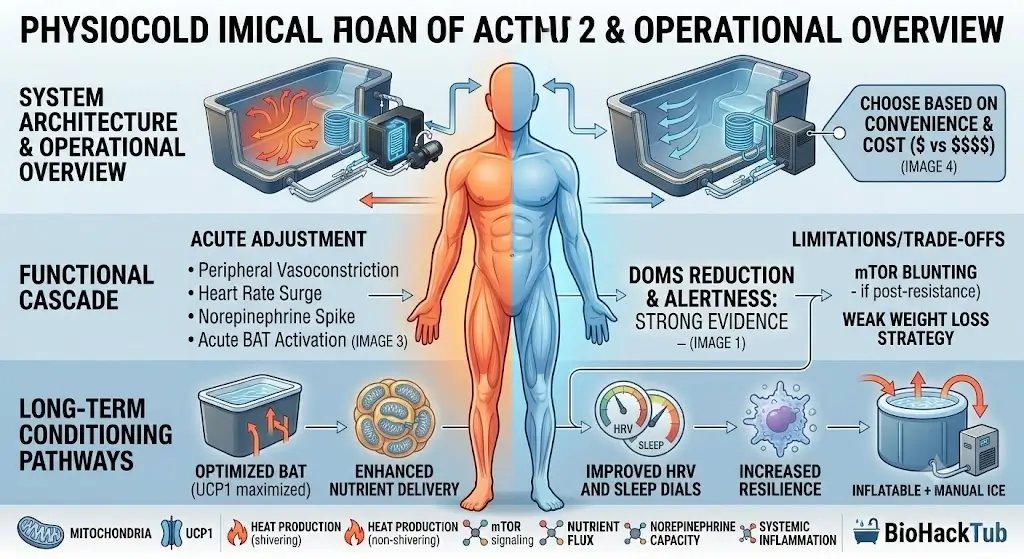
Neuroendocrine Response
Evidence-Based Cryo Guide • 2026
Cold Plunge Benefits: What Cold Water Immersion Can Actually Do
Key Clinical Takeaways: Cold Plunge Benefits & Realities
- Proven Benefits: Significant reduction in perceived Delayed Onset Muscle Soreness (DOMS) after high-demand endurance/competition, acute surge in alertness via norepinephrine secretion, and temporary sympathetic tone activation.
- Unproven Marketing Claims: Cold water immersion does NOT meaningfully detoxify the body (liver and kidneys handle filtration) and is NOT a reliable standalone protocol for body-fat loss.
- Hypertrophy Trade-off: Plunging immediately after resistance training blunts post-workout muscular inflammation signaling (mTOR pathway), which can diminish long-term strength and muscle growth adaptation.
- Recommended Practice: 50°F to 59°F for 2 to 5 minutes provides optimal recovery without excessive cardiovascular distress.
Cold water immersion has moved from athletic recovery rooms into home wellness setups, with portable ice baths, insulated tubs and refrigerated cold-plunge systems now widely available in the United States.
The important question is not simply whether cold plunging “works.” The more useful question is what it is likely to do, how strong the evidence is, and when the potential downside matters.
This guide separates established physiological effects from promising but uncertain claims so you can evaluate cold plunging based on the outcome you actually want.
Quick Reference Specification: Cold Plunge Evidence Hierarchy & Physiological Parameters
Clinical trials confirm distinct recovery and hormonal adaptations across standardized water temperature and duration thresholds. The technical benchmark matrix below synthesizes verified clinical outcomes, physiological mechanisms, recommended dosing parameters, and evidence confidence levels:
| Outcome Domain | Primary Biological Mechanism | Target Temperature & Time | Clinical Endpoints | Evidence Strength |
|---|---|---|---|---|
| DOMS Muscle Soreness | Vasoconstriction & reduced interstitial edema | 50°F – 59°F (10°C – 15°C) • 10–15 min | Reduced serum creatine kinase; blunted pain signaling | Moderate to High (Meta-Analyses) |
| Central Alertness & Mood | Sympathetic surge; 250% norepinephrine elevation | 45°F – 55°F (7°C – 13°C) • 2–3 min | Heightened vigilance, dopamine release, sympathetic tone | High (Acute Mechanism) |
| Vascular Hemodynamics | Arteriolar vasoconstriction followed by reperfusion | 50°F – 59°F (10°C – 15°C) • 2–5 min | Blood shunted to core; transient blood pressure elevation | High (Well-Established) |
| Hypertrophy Adaptation | Suppression of mTOR phosphorylation & satellite cells | Immediate post-lifting immersion | Blunted muscular hypertrophy and long-term strength gains | Established Negative Trade-Off |
| Metabolic Fat Lipolysis | Non-shivering thermogenesis via brown adipose tissue | Any tolerable temperature | Negligible caloric burn; no direct subcutaneous fat loss | Low / Refuted as Standalone Strategy |
Cold Plunge Benefits at a Glance
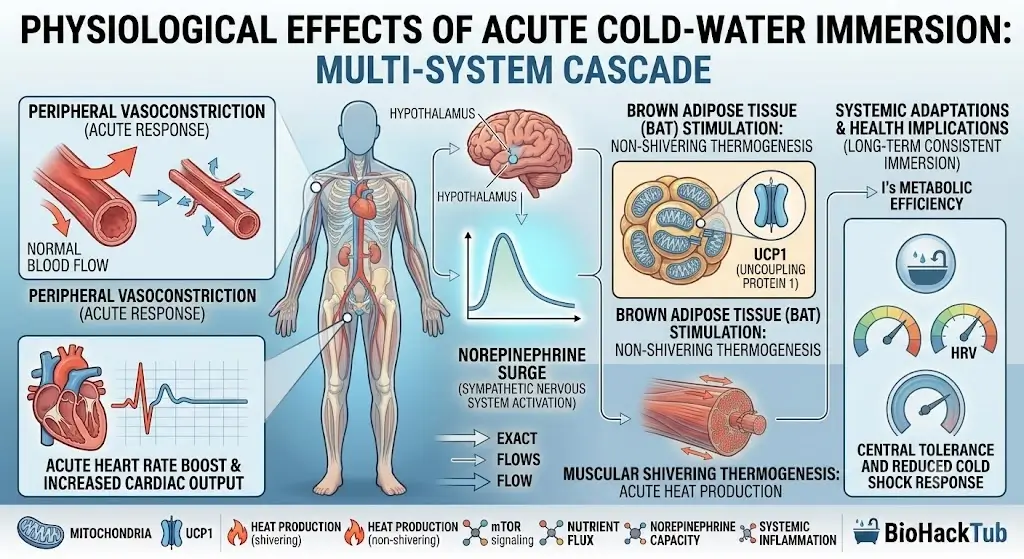
Rapid conductive cooling triggers immediate peripheral vasoconstriction and sympathetic nervous system activation upon water entry. Cold water immersion creates several immediate physiological changes. The skin is exposed to a rapid temperature drop, blood vessels in peripheral tissues constrict, breathing can change abruptly and the sympathetic nervous system becomes more active.
Those effects explain why cold plunging can feel stimulating even after a relatively short exposure.
| Potential benefit | Evidence position | What to realistically expect |
|---|---|---|
| Reduced muscle soreness | Moderate | May reduce perceived soreness after strenuous exercise. |
| Alertness | Strong acute effect | Cold exposure can produce a noticeable increase in arousal and alertness. |
| Circulatory response | Strong acute effect | Cold causes peripheral vasoconstriction followed by changes as the body reheats. |
| Mood / well-being | Promising but variable | Some users report improved mood, but individual responses and study designs vary. |
| Fat loss | Weak as a practical strategy | Cold exposure increases heat production but is not a substitute for nutrition and exercise. |
| Detoxification | Not established | There is insufficient evidence that cold plunges “detox” the body. |
| Immune enhancement | Uncertain | Some research is interesting, but broad claims about immunity are premature. |
1. May Reduce Post-Exercise Muscle Soreness
Cold-water immersion blunts delayed-onset muscle soreness by restricting local microvascular permeability and interstitial fluid accumulation. After hard training, especially unfamiliar or high-volume exercise, delayed-onset muscle soreness can develop over the following day or two. Cold water immersion has been studied as a recovery intervention because cooling changes blood flow, sensory signaling and the body’s response to the stress created by exercise.
Research reviews generally suggest that cold-water immersion can reduce perceived muscle soreness after some types of strenuous exercise.
Who may notice this benefit?
- Athletes participating in repeated competitions.
- People completing unusually demanding training sessions.
- Individuals who need to feel functional again within a short period.
- People experiencing substantial post-exercise soreness.
For ordinary recreational training, the value may be smaller. The more frequently someone needs to perform demanding exercise, the more relevant recovery strategies become.
2. Cold Plunges Can Increase Alertness
Sudden cutaneous thermal shock induces rapid systemic secretion of norepinephrine to elevate vigilance and physiological arousal. A cold plunge is not physiologically neutral. Sudden exposure to cold activates the sympathetic nervous system and produces a rapid increase in arousal.
That is one reason people often describe a cold plunge as mentally stimulating.
Cold exposure can increase catecholamine signaling, including norepinephrine, which is involved in attention, arousal and the body’s response to stress.
This does not mean a cold plunge is a treatment for fatigue or a replacement for sleep. The effect is better understood as an acute stimulation response.
3. Cold Water Immersion Produces a Strong Acute Stress Response
Controlled thermal challenges act as hormetic stressors to stimulate neuroendocrine adaptation across cardiovascular and respiratory systems. The phrase “stress response” can sound negative, but physiological stress is not automatically harmful. The body uses controlled stressors to trigger adaptation.
Cold water immersion is one example of a hormetic stressor: a short, controlled challenge that activates multiple regulatory systems.
The initial response can include:
- Rapid changes in breathing.
- Increased sympathetic nervous system activity.
- Peripheral vasoconstriction.
- Increased alertness.
- Changes in heart rate and blood pressure.
- Increased heat production as the body attempts to maintain core temperature.
The magnitude of this response depends on water temperature, exposure duration, body size, acclimatization and how much of the body is immersed.
This is also why cold plunging should not be treated as a contest. A stronger physiological response is not automatically a better outcome.
4. Cold Plunging Changes Blood Flow and Vascular Response
Cutaneous vessel constriction shunts oxygenated blood toward central organs before reactive hyperemia restores microcirculation upon exit. Cold exposure causes blood vessels near the skin to constrict. This reduces heat loss from peripheral tissues and helps preserve core temperature.
Once the body is removed from the cold environment, blood flow changes again as tissues warm.
This has led to the popular concept of “circulation benefits,” but the wording requires precision.
Cold water immersion definitely produces acute vascular changes. That does not automatically prove that repeated cold plunging improves long-term cardiovascular health.
5. Cold Plunging May Affect Mood and Perceived Well-Being
Beta-endorphin release combined with psychological task completion promotes transient positive mood elevation and mental clarity. Mood is one of the most difficult cold-plunge outcomes to measure because expectations, environment, breathing, exercise and the psychological experience of completing an uncomfortable task can all influence how a person feels afterward.
Some research suggests that cold exposure may influence mood and well-being through changes in sympathetic activity, neurotransmitter signaling and behavioral factors.
However, it would be too strong to describe cold plunging as a proven treatment for depression, anxiety or other mental-health conditions.
A more defensible interpretation is that some people experience a short-term improvement in perceived energy, alertness or well-being after cold exposure.
6. Cold Plunge and Strength Training: Timing Matters
Immediate post-exercise water immersion blunts anabolic p70S6K and mTOR pathway signaling to diminish muscular hypertrophy. This is one of the most important distinctions for people who lift weights.
Cold water immersion can reduce soreness, but using cold exposure immediately after resistance training may not always align with a goal of maximizing muscle adaptation.
Resistance training creates signals that tell the body to repair and adapt. Some of the inflammatory and cellular processes associated with training are part of that adaptation.
Repeatedly suppressing parts of that response immediately after lifting may potentially reduce some training adaptations.
That does not mean cold plunging and strength training are incompatible. It means the protocol should match the goal.
| Primary goal | Potential cold-plunge strategy |
|---|---|
| Reduce soreness | Cold immersion may be useful after particularly demanding sessions. |
| Maximize hypertrophy | Avoid automatically making immediate post-lifting cold immersion a daily habit. |
| Repeated competition | Recovery benefits may be more valuable when another performance session is coming soon. |
| General wellness | Use a tolerable protocol rather than chasing extreme temperatures. |
The correct question is therefore not “Is cold plunging good or bad after workouts?” It is “What adaptation am I trying to optimize?”
7. Does Cold Plunging Help With Weight Loss?
Thermogenic calorie expenditure during brief immersion sessions remains too minimal to drive sustained adipose tissue reduction. Cold exposure increases the body’s demand for heat production. Maintaining core temperature in a cold environment requires energy.
That does not make a cold plunge an efficient weight-loss method.
There is a major difference between increasing energy expenditure temporarily and creating a meaningful, sustainable reduction in body fat.
A short cold plunge does not replace a consistent calorie balance, resistance training, cardiovascular activity or adequate nutrition.
8. Does Cold Plunging Improve the Immune System?
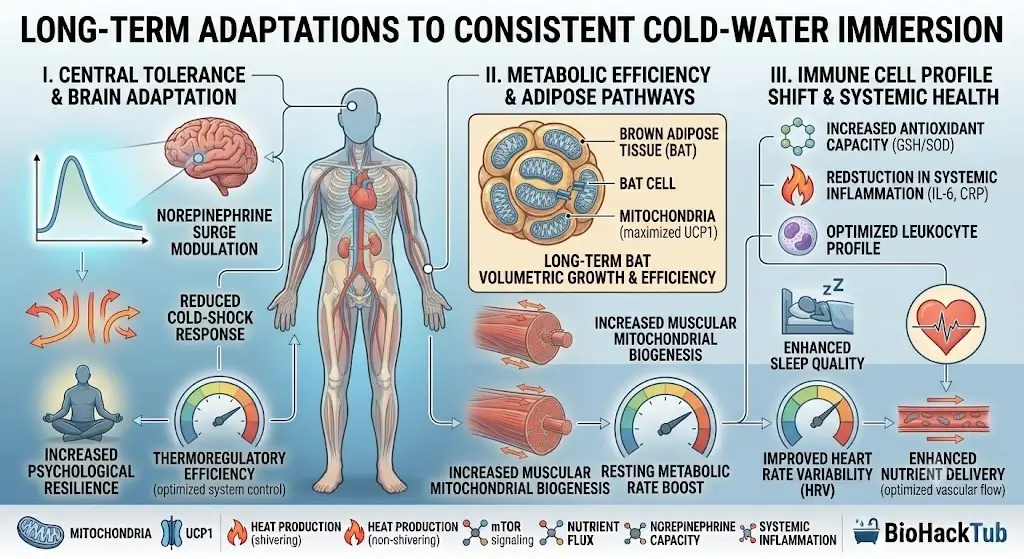
Circulating leukocyte shifts observed after cold immersion represent transient stress responses rather than overall disease immunity enhancement. Cold exposure interacts with the nervous, endocrine and cardiovascular systems, and researchers have investigated whether repeated cold exposure influences immune-related outcomes.
There are interesting findings in this area, but the evidence does not justify saying that cold plunges simply “boost immunity.”
The immune system is a complex network rather than a single dial that can be turned up.
For practical purposes, sleep, nutrition, physical activity and vaccination remain far more established components of maintaining health than cold plunging.
9. Does Cold Plunging Detox the Body?
Renal filtration and hepatic enzymatic metabolism execute bodily detoxification independently of surface water immersion. This is one of the weakest common cold-plunge claims.
The human body already has sophisticated systems for processing and eliminating metabolic waste, primarily involving organs such as the liver and kidneys.
Cold water immersion changes circulation, nervous system activity and heat regulation. That does not establish that it removes unspecified “toxins” from the body.
Therefore, BioHackTub does not recommend evaluating a cold plunge based on vague detox claims.
10. Does Colder Mean Better?
Sub-forty-degree water escalates cardiovascular shock hazards without yielding additional clinical recovery benefits. Lower temperatures produce a stronger cold stimulus, but stronger stimulation also increases discomfort and physiological stress.
A cold plunge should be viewed as a dose-response intervention.
Three variables matter:
- Water temperature
- Exposure duration
- Frequency
Changing any one of these changes the overall exposure.
| Water temperature | General interpretation |
|---|---|
| 59°F+ | Cold for many people but generally easier to tolerate. |
| 50–59°F | A practical range frequently encountered in recreational cold-water protocols. |
| 40–50°F | Much stronger stimulus; exposure should be conservative. |
| Below 40°F | Very cold water with substantially greater discomfort and physiological stress. |
These ranges are descriptive rather than prescriptions. Individual response, medical status and acclimatization matter. For detailed thermal classifications, consult our fundamental guide on what is a cold plunge.
11. How Long Should a Cold Plunge Last?
Therapeutic cold-water immersion protocols optimize recovery benefits within a two to five-minute exposure window. There is no universal “perfect” cold-plunge duration.
The required exposure depends on temperature and the intended outcome. A colder bath requires less exposure to create a substantial stimulus than warmer water.
For home users, the biggest mistake is assuming that longer automatically produces greater benefits.
Longer exposure also means more heat loss and potentially greater physiological stress.
12. When Should You Cold Plunge?
Targeted protocol timing aligns immersion sessions with morning alertness demands or delayed post-workout recovery intervals. Timing should be based on the goal rather than a universal morning-versus-evening rule.
For morning alertness
Some people prefer cold exposure early in the day because the sympathetic response can feel stimulating.
After demanding exercise
Cold immersion may be useful when reducing soreness and improving perceived recovery are more important than maximizing every possible training adaptation.
Immediately after resistance training
If maximizing muscle growth is the primary objective, frequent immediate post-training cold immersion deserves more caution.
Before bed
Responses vary. Some people find cold exposure stimulating rather than relaxing, so a late-night session is not automatically a sleep intervention.
13. Cold Plunge Risks and Precautions
Sudden whole-body cold immersion poses severe risks of cardiac arrhythmias, hyperventilation, and peripheral nerve palsy. Cold water immersion is a real physiological stressor. The fact that it is sold as a wellness product does not make it risk-free.
The initial cold shock can cause rapid involuntary breathing and cardiovascular changes.
Potential problems include:
- Cold shock and uncontrolled breathing.
- Dizziness or lightheadedness.
- Loss of coordination.
- Excessive heat loss.
- Rapid changes in blood pressure.
- Cardiovascular stress.
Never treat an ice bath as a test of endurance.
14. Who Should Be Especially Careful?
Individuals with pre-existing coronary artery disease or autonomic dysregulation face elevated risk during acute cold immersion. Cold exposure can place additional demand on the cardiovascular system.
People with cardiovascular disease, uncontrolled high blood pressure, significant circulation problems, a history of fainting or other medical conditions that could make sudden cold exposure hazardous should discuss cold-water immersion with a qualified healthcare professional before starting.
The same principle applies to anyone taking medication that may affect cardiovascular function, blood pressure or thermoregulation.
This article is educational and does not replace individualized medical advice.
15. Cold Plunge at Home: What Actually Matters
Reliable residential cold immersion systems require high-density thermal insulation and active filtration to maintain stable water hygiene. The cold-plunge market now includes simple insulated tubs, inflatable models, hard-shell systems and units with integrated refrigeration. For budget-conscious homeowners looking for flexible setups, our hands-on field testing of the best portable cold plunge on Amazon breaks down which inflatable architectures deliver dependable containment versus high thermal loss.
The product itself does not create the health benefit; the relevant variable is the quality and consistency of the cold-water exposure.
Water temperature control
A built-in chiller provides much more predictable temperature control than manually adding ice. Without active cooling, uninsulated barrels can become labor-intensive. In our detailed The Pod Company Standard Ice Pod review, we modeled how thin-walled portable tubs experience rapid conductive heat gain, requiring continuous ice replenishment to maintain therapeutic windows.
Insulation
Better insulation reduces heat transfer from the surrounding environment and can lower the cooling workload.
Filtration
A filtration system helps remove suspended particles and makes maintaining the water easier.
Water sanitation
Cold plunge water can still accumulate contaminants. Temperature alone does not make standing water sanitary.
Drainage
A practical drainage system matters more than many decorative features because water maintenance is part of owning the tub.
Electrical safety
Systems with chillers and pumps should be installed according to the manufacturer’s electrical requirements and applicable U.S. electrical safety practices.
Cold Plunge Benefits: Strong Evidence vs Popular Claims
Scientific consensus distinguishes proven DOMS attenuation from commercial myths regarding passive weight loss. Review the clinical assessments below:
| Claim | Evidence assessment | BioHackTub interpretation |
|---|---|---|
| Reduces perceived muscle soreness | Moderate | One of the more useful evidence-supported applications. |
| Increases alertness | Strong acute physiological effect | Cold exposure clearly produces arousal and sympathetic activation. |
| Improves circulation | Acute effect established | Cold changes vascular tone; long-term health claims require more evidence. |
| Improves mood | Promising but variable | Possible benefit, but not a substitute for mental-health treatment. |
| Burns significant body fat | Weak | Not a reliable weight-loss strategy. |
| Detoxifies the body | Not established | Avoid using detox claims to evaluate a cold plunge. |
| Boosts immunity | Uncertain | Interesting research exists, but broad claims are premature. |
| Improves muscle growth | Not established | Immediate repeated use after resistance training may be counterproductive for some adaptations. |
A Practical Cold Plunge Framework for Home Users
Gradual thermal acclimation protocols establish breathing control before advancing to lower water temperatures. Rather than copying an extreme protocol from social media, use a simple progression:
- Start with a tolerable temperature. Do not begin by chasing the coldest setting available.
- Keep the first exposures short. Your response to cold is more important than the number displayed on a timer.
- Control your breathing. The initial cold shock can cause rapid breathing. Focus on staying calm rather than forcing long breath holds.
- Exit before control deteriorates. Cold exposure is not a test of willpower.
- Warm up normally afterward. Allow your body to restore thermal comfort without using extreme heat immediately.
- Track your response. Note temperature, duration, perceived recovery, alertness and how you feel later in the day.
This approach gives you something many generic cold-plunge guides lack: a way to determine whether the intervention is actually useful for you.
Frequently Asked Questions About Cold Plunge Benefits
Authoritative medical responses clarify common inquiries regarding DOMS recovery, weight training interference, and safe protocols. Key answers are detailed below:
What are the main benefits of a cold plunge?
The strongest practical evidence is around reducing perceived muscle soreness after some strenuous exercise and producing an acute increase in alertness. Cold exposure also creates clear vascular and nervous-system responses. Evidence for broader long-term benefits remains less certain.
Does cold plunging help muscle recovery?
It can help reduce perceived muscle soreness following some forms of demanding exercise. Whether it improves every aspect of physiological recovery is a different question.
Does a cold plunge burn fat?
Cold exposure requires the body to produce heat, which uses energy. However, a short cold plunge should not be considered a meaningful standalone fat-loss strategy.
Can I cold plunge every day?
Frequency should depend on the purpose of the exposure and how your body responds. More frequent or colder exposure is not automatically better.
Is cold plunging good after weight training?
It may reduce soreness, but frequent immediate cold exposure after resistance training may interfere with some cellular adaptations to strength training. If hypertrophy is your main goal, timing deserves careful consideration.
What is a good cold plunge temperature?
There is no universal best temperature. Many recreational users find approximately 50–59°F more manageable than very cold water, while lower temperatures create a stronger stimulus.
Is a cold plunge better than an ice bath?
They are essentially different implementations of cold-water immersion. A modern cold plunge may use a chiller and filtration system, while a traditional ice bath may rely on adding ice to a tub.
Does cold plunging detox your body?
There is not good evidence that cold plunging removes unspecified toxins from the body. The body already has specialized organs and systems for waste processing and elimination.
Can cold plunging replace exercise recovery?
No. Cold exposure is an optional recovery tool. Sleep, adequate nutrition, sensible training volume and hydration remain foundational.
Is cold plunging safe for everyone?
No. Sudden cold exposure can create substantial cardiovascular and respiratory stress. People with relevant medical conditions should seek individualized medical advice before using cold immersion.
The Bottom Line on Cold Plunge Benefits
Cold plunging operates as a targeted recovery intervention rather than an all-inclusive wellness remedy. Its most defensible benefits are relatively specific: cold exposure can increase alertness, produce pronounced cardiovascular and vascular responses, and may reduce perceived muscle soreness after strenuous exercise.
The evidence becomes less convincing when the claim expands to “detoxification,” substantial fat loss, disease prevention or universal immune enhancement.
For athletes, the key issue is also timing. A strategy that reduces soreness may not always be the same strategy that maximizes long-term training adaptation.
That is why the best cold-plunge protocol is not necessarily the coldest, longest or most uncomfortable one. It is the protocol that produces a useful outcome without creating unnecessary physiological stress.
What Should You Read Next?
If you’re researching cold-water immersion for home use, the next step is to understand the variables that determine the actual dose: water temperature, exposure duration, water sanitation, insulation and cooling technology.
Continue with our in-depth Cold Plunge Fundamentals & Temperature Guide to understand how water temperature changes the physiological stimulus and how different equipment options fit your recovery space.
