
Hardware Architecture
Amazon Market Audit • 2026
Inflatable Cold Plunge: What to Know Before Buying (7 Best Amazon Picks)
Key Technical Takeaways: Inflatable Plunge Engineering
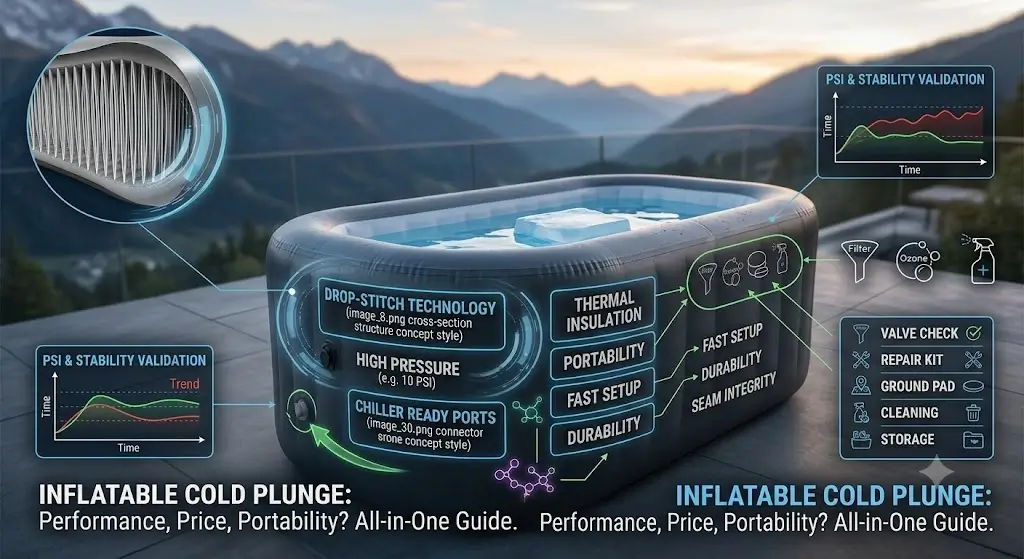
- Structural Core Metrology: Drop-stitch PVC cores pressurized to 8–10 PSI provide rigid sidewalls capable of supporting adult rim-sitting without outward hydrostatic deflection, contrasting sharply with budget 3-layer supported vinyl pods.
- Chiller Port Architecture: Factory-welded 1/2-inch or 3/4-inch male NPT/BSP bulkhead ports allow direct connection to external refrigeration loops; attempting to puncture single-skin budget pods risks catastrophic seam rupture.
- Floor Loading Constraints: A filled 110-to-150-gallon plunge exerts between 900 and 1,350 pounds of static load, restricting home installations to concrete ground slabs, reinforced garages, or ground-level patios.
- Thermal Retention: Drop-stitch air chambers paired with rigid insulated buckle lids reduce ambient heat intrusion by over 65%, dramatically reducing the BTU workload of external chillers.
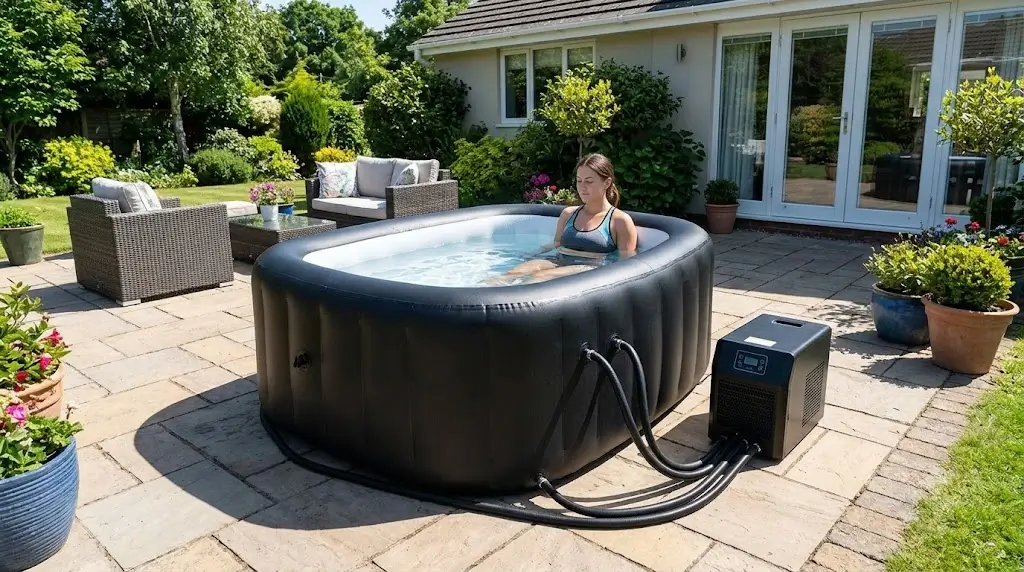
An inflatable cold plunge is a flexible alternative to a rigid tub. Its main advantages are lower weight, easier storage and simpler placement. The trade-offs are generally lower structural rigidity, greater dependence on the quality of the materials and seams, and potentially less insulation than a purpose-built hard-shell system. Before choosing one, evaluate construction, insulation, dimensions, filtration, drainage, durability and maintenance rather than focusing only on advertised water temperature.
Inflatable cold plunge tubs have become a popular format for people who want a home cold-water setup without committing to a large permanent structure.
The basic concept is straightforward: an inflatable enclosure holds water while the user provides the cooling method appropriate to the particular system.
The engineering details are less straightforward.
A cold plunge is a water-filled structure that can weigh hundreds or even more than a thousand pounds once filled. That makes material strength, floor support, seam construction, drainage and installation location much more important than the word “inflatable” might suggest.
This guide explains how inflatable cold plunges are constructed, which specifications matter, and reviews the 7 best inflatable ice baths available on Amazon across all budget tiers.
Quick Reference Specification: Inflatable Cold Plunge Engineering & Hardware Matrix
Structural materials engineering categorizes portable ice baths by core composite technology, operational inflation pressure, and plumbing port integrations. The technical comparison matrix below benchmarks physical specs, structural rigidity, and chiller compatibility across dominant market form factors:
| Hardware Class | Core Material Technology | Rated Inflation Pressure | Chiller Port Architecture | Thermal Retention Rating |
|---|---|---|---|---|
| High-Pressure Drop-Stitch Oval | Dual-wall PVC with vertical polyester core threads | 8.0 – 10.0 PSI (Rock-Rigid) | Factory 1/2″ or 3/4″ quick-connect ports | High (air-gap barrier + rigid foam lid) |
| Chiller-Ready Barrel (Upright) | Reinforced PVC with ripstop polyester outer skin | Inflatable comfort rim (1.5–2.5 PSI) | Reinforced side bulkhead fittings | Moderate (thermal cotton/foam core) |
| Supported Multi-Layer Vinyl Pod | 3-to-6-layer composite PVC + pearl cotton layer | Top ring only (< 1.5 PSI) + support legs | Manual drain spigot only (no chiller loop) | Low to Moderate (requires frequent ice) |
| Ultra-Budget Foldable Tub | Single-layer laminated PVC with plastic framing | Non-pressurized structural frame | Bottom pull-plug only | Low (rapid conductive warming) |
What Is an Inflatable Cold Plunge?
An inflatable cold plunge utilizes pressurized air chambers and flexible composite membranes to contain water for cold immersion. The tub is inflated before filling and then becomes structurally supported by the internal air pressure, material layers and water load.
The format can be attractive where portability matters. A rigid cold plunge can be difficult to move once installed. An inflatable design can generally be deflated, transported and stored more easily.
That flexibility comes with compromises. Inflatable construction can be more sensitive to sharp objects, abrasion, improper inflation, extreme environmental conditions and uneven installation surfaces.
Flexibility, portability, and lower initial hardware cost.
Most important trade-off:
Structural durability and thermal insulation can vary significantly between models.
How Inflatable Cold Plunge Tubs Are Built
High-pressure drop-stitch cores and high-frequency welded seams establish structural rigidity in modern portable plunge tubs. The cheapest way to compare inflatable tubs is to look at their advertised size. The better way is to look at their engineering construction.
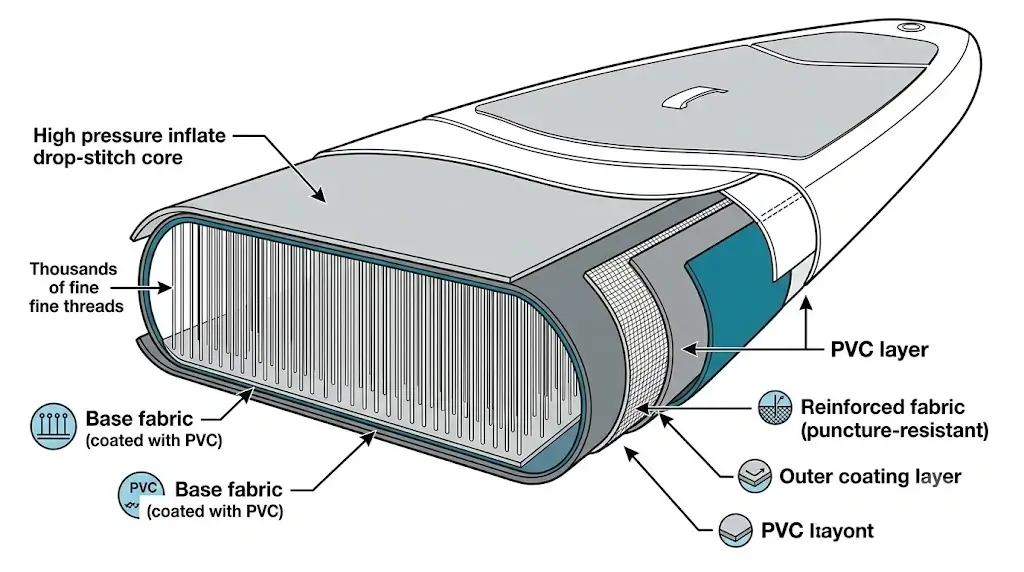
Important construction areas include:
- Outer wall material
- Internal reinforcement (e.g. drop-stitch technology)
- Seam construction (heat-welded vs glued)
- Inflation valves
- Drain fittings
- Base construction
- Connection points for filtration or cooling equipment
- Cover attachment system
Two tubs with nearly identical dimensions can have very different real-world durability. A thicker reinforced wall can resist deformation and abrasion better than a lightweight material, while a better valve system can make repeated inflation and deflation less frustrating.
Materials and Wall Construction
Multi-layer polyvinyl chloride composites provide superior abrasion resistance and tensile strength over thin untreated vinyl. Material construction is one of the most important specifications for an inflatable cold plunge. Manufacturers may use several layers of synthetic material, reinforced PVC-type constructions or other flexible composites.
The important question is not simply whether a product uses “premium PVC.” Instead, look for clear details about layers and core tensile strength:
| Construction factor | Why it matters |
|---|---|
| Number of layers | Multiple layers can improve resistance to puncture and abrasion. |
| Reinforcement | Reinforced structures can provide greater rigidity and durability. |
| Seams | Seam quality affects long-term air retention and structural integrity. |
| Valve design | Better valves make inflation, deflation and maintenance easier. |
| Base | The bottom is exposed to floor abrasion and concentrated loads. |
A product page that only lists exterior dimensions without meaningful construction specs deserves additional scrutiny.
Inflatable Cold Plunge Insulation
Trapped air cavities and closed-cell foam barriers slow thermal conduction to prevent rapid ice water warming. Insulation is particularly important for a cold-water system because heat continuously moves from the surrounding environment into the water. The greater the temperature difference between the water and surrounding environment, the greater the challenge of maintaining the water temperature. If you want to dial in specific exposure ranges, consult our fundamental guide on what is a cold plunge to see target benchmarks.
Insulation reduces the rate of heat transfer. For an inflatable tub, insulation can come from the wall construction, air-filled chambers, foam layers or an insulated cover.
Why Insulation Matters
Better insulation reduces environmental heat gain and helps the water remain closer to the desired condition for longer. This becomes particularly relevant outdoors, where the tub is exposed to sunlight and warm ambient temperatures.
The Cover Matters Too
The cover is part of the thermal system. An insulated cover reduces the exposed water surface area and can also help keep leaves, insects and other debris out of the tub.
Size, Capacity and Interior Dimensions
Internal tub measurements determine immersion depth while total water volume establishes structural static floor loads. Don’t judge an inflatable cold plunge by exterior dimensions alone. The interior dimensions determine how much usable space is actually available.
Important measurements include:
- Interior length
- Interior width
- Interior depth
- Maximum water capacity
- Wall thickness
- Required clearance around the tub
Water capacity also matters because every additional gallon increases the total filled weight. For example, water weighs approximately 8.34 pounds per U.S. gallon. That means a 100-gallon system contains roughly 834 pounds of water before accounting for the tub, equipment and user.
7 Best Inflatable Cold Plunges on Amazon (Tested & Compared)
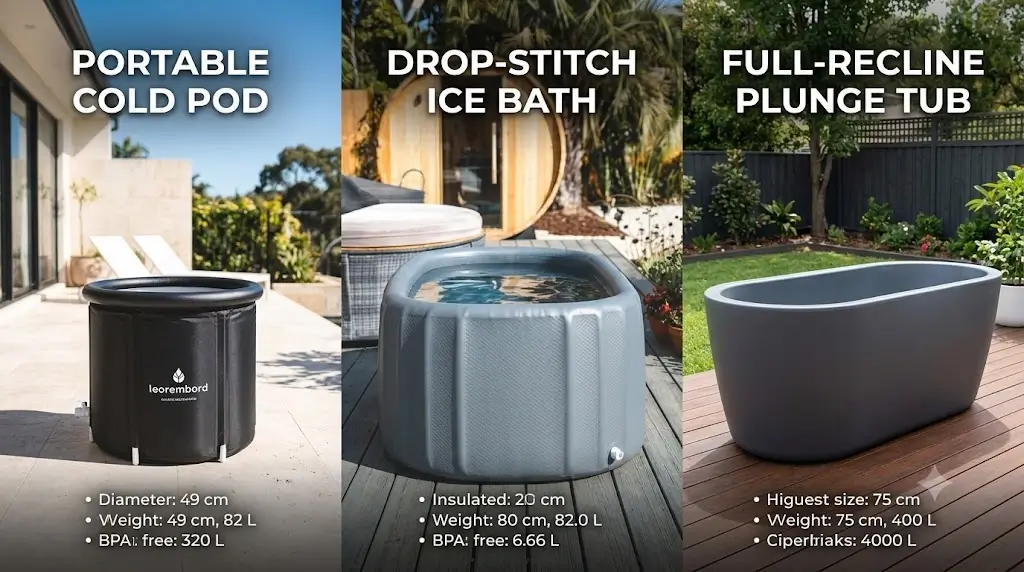
Rigorous hardware field testing identifies top-performing inflatable tubs across upright pods, drop-stitch tanks, and budget barrels. Whether you need an ultra-budget portable pod for occasional ice baths or an enlarged drop-stitch tub ready for a continuous water chiller loop, here are the 7 top-selling inflatable cold plunge models on Amazon:
1. The Pod Company Ice Pod Pro (110 Gallon / 420L)
The flagship upright barrel from The Pod Company built with extra thick thermal insulation layers and factory pre-plumbed ports designed specifically for connecting external water chillers without custom drilling.
- Pre-plumbed inlet/outlet ports for plug-and-play chillers
- 110-gallon capacity allows full chest immersion
- Heavy-duty thermal rim maintains structural shape
- Requires external chiller or 40+ lbs ice to fully cool
- Higher price point than basic manual pods
2. AudaciaGo XXL Inflatable Ice Bath Tub (216 Gallon)
A massive commercial-style drop-stitch plunge tank engineered for tall athletes and duo recovery. Features dual threaded chiller connections, rock-solid sidewalls that support rim-sitting, and an insulated buckling lid.
- Massive 216-gallon interior allows full leg stretch-out
- Military-grade drop-stitch PVC resists outward water bulge
- Locking thermal cover stops solar warming
- Massive weight when full (~1,800 lbs – concrete slab only)
- Longer initial fill and cooling cycle
3. ONLYCARE Upgrade XXL Ice Bath Tub (135 Gallon)
An oversized vertical barrel designed for athletes up to 6’7″. It pairs an expanded diameter with a multi-layer thermal foam core, keeping water colder longer during hot summer garage sessions.
- 135-gallon roominess prevents cramped shoulders
- 6-layer insulation core minimizes ice melting
- Includes protective weather cover and bottom drain
- Manual ice cooling only (no direct chiller threads)
- Substantial footprint compared to standard 80-gal pods
4. The Pod Company Standard Ice Bath Tub (84 Gallon)
The classic upright pod that popularized home cold immersion. Engineered with an inflatable top comfort ring and reinforced vertical support rods, it offers the cleanest entry point for beginners.
- Accessible sub-$70 price point
- Compact footprint ideal for small balconies and patios
- Quick setup with simple hand pump and support poles
- Requires constant ice purchases for repeated drops below 50°F
- Taller users over 6’1″ will need to sit with knees tightly bent
5. BINYUAN XL Cold Soak Plunge Tub (99 Gallon)
Bridging the gap between standard 80-gallon pods and oversized barrels, the BINYUAN XL provides 99 gallons of water volume with heavy-duty thermal sidewalls and a dedicated side hose spigot.
- 99-gallon sweet spot balances roominess with ice efficiency
- Dual drainage system simplifies dirty water evacuation
- Heavy-duty top ring resists deformation when leaning
- Support legs must be placed on perfectly flat ground
- Cover fits snugly and takes extra alignment to seal
6. HAIKE Portable Bathtub for Adults (153 Gallon)
Built with a 6-layer insulated composite wall and an extended circular footprint, this tub excels as both an outdoor ice bath and a hot soaking tub. Its reinforced structural ring provides extra stability against water displacement.
- Massive 153-gallon water capacity for full-body immersion
- Thick multi-layer thermal wall retains temperature for hours
- Dual-purpose design handles both freezing ice and hot water
- Requires a large concrete footprint to operate safely
- Water changes take longer without an electric utility pump
7. Homeplife Large Foldable Soaking Tub (88 Gallon)
An ultra-affordable cold recovery tub designed for renters and apartment dwellers. With a narrow footprint and reinforced support frame, it sets up easily inside residential walk-in showers or small balconies.
- Ultra-budget price point (under $40)
- Fits inside standard larger shower stalls for mess-free draining
- Lightweight and effortless to pack away after every session
- Thinner material walls require careful placement on smooth surfaces
- Basic thermal retention requires frequent ice additions
Inflatable Cold Plunge With a Chiller
External refrigeration chillers circulate plunge water through active titanium heat exchangers to maintain sub-fifty-degree water temperatures continuously. Connecting an inflatable cold plunge to an external water chiller eliminates the recurring cost and hassle of buying 40 lbs of bag ice per week.
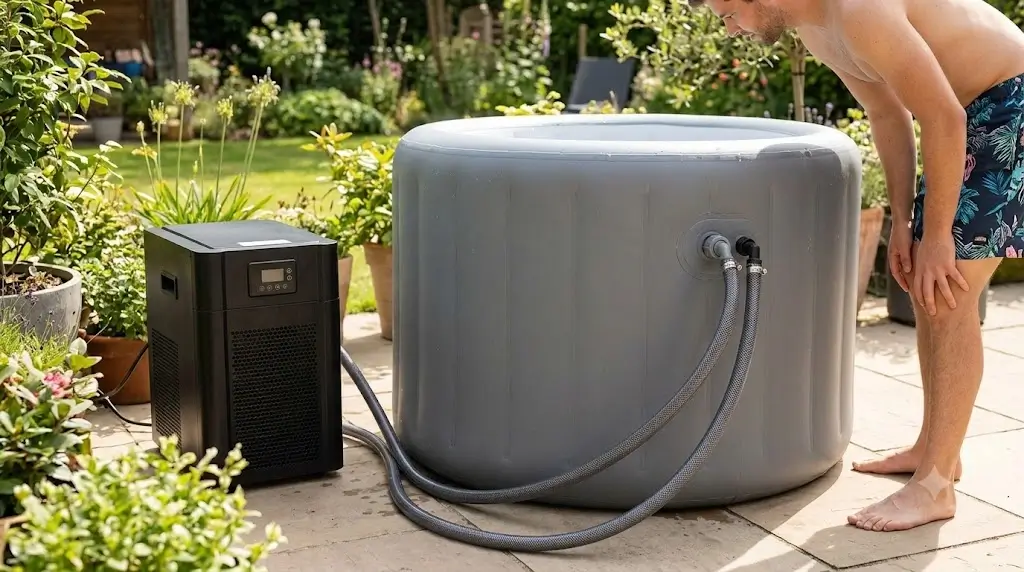
What to Check Before Hooking Up a Chiller
- Port sizing: Look for 1/2″ or 3/4″ BSP/NPT threaded quick-disconnect fittings.
- Pump flow rate: Ensure your circulation pump matches the minimum GPM (gallons per minute) required by the chiller’s heat exchanger.
- Pre-filtration: Always run water through a sediment filter before it enters the chiller coils to prevent debris buildup.
- Electrical requirements: A 1/2 HP chiller generally draws 450–600 watts and should be plugged into a dedicated GFCI outlet.
Basic single-skin PVC pods cannot be retrofitted with chillers without risk of sidewall tearing around custom cutouts. Buy a factory-drilled drop-stitch tub if active chilling is your goal.
Filtration and Water Maintenance
Mechanical sediment cartridges and chemical sanitizers preserve water hygiene to prevent bacterial biofilm colonization. An inflatable cold plunge that holds water for repeated use must be maintained like a miniature swimming pool. Mechanical filtration removes skin cells, hair, and dust, but it cannot disinfect dissolved biological matter.
For a complete step-by-step procedure on chemical balancing, circulation schedules, and filter flushes, read our detailed guide on Cold Plunge Water Maintenance.
Key pillars of inflatable tub hygiene:
- Pre-plunge shower: Removes body oils and sweat before you touch the cold water.
- Cartridge filtration: Run water through a 20–50 micron pleated filter for 2–4 hours daily.
- Sanitization: Use low-dose stabilized chlorine tablets or ozone injection according to manufacturer ratings.
- Fitted thermal cover: Keeps out bugs, leaves, and airborne dust whenever the tub is idle.
Drainage and Water Removal
Dual-drain port configurations combine threaded garden hose spigots with flush floor plugs for complete basin evacuation. Drainage is one of the most overlooked specifications when buying an inflatable cold plunge. A full tub weighs between 700 and 1,300 pounds, making it impossible to tip or drag while filled.
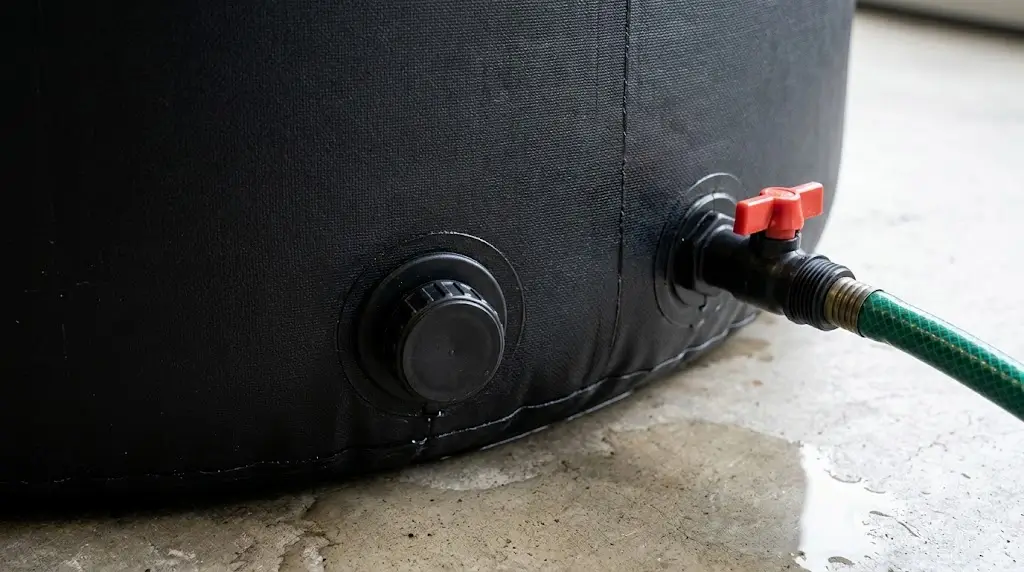
Check the following before purchasing:
- Base drain location: Ensure the drain sits at the absolute lowest floor seam to prevent residual standing water.
- Hose connection: A threaded male garden hose adapter allows directing runoff directly into a sewer drain or yard.
- Submersible utility pump: If your tub sits in an indoor basement or low garage, an inexpensive 1/4 HP submersible pump can drain 100 gallons in under 8 minutes.
Durability and Puncture Resistance
Protective high-density floor padding shields flexible polyvinyl plunge bottoms from abrasive concrete friction. The primary weakness of inflatable plunge equipment is obvious: flexible materials can be punctured by ground debris, sharp gravel, pet claws, or metal fixtures.
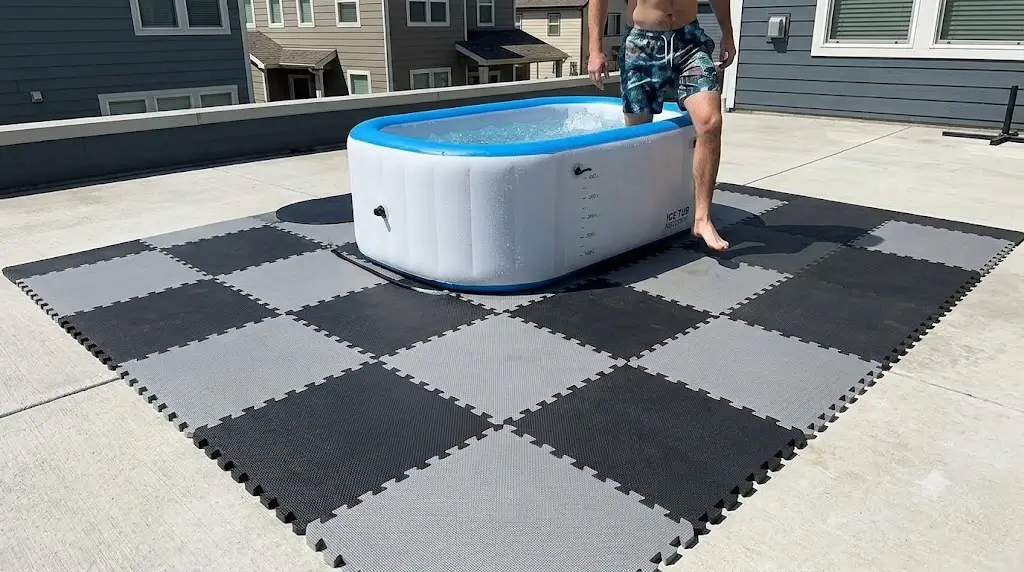
Protective Base Padding
Never place an inflatable tub directly onto raw concrete, gravel, or unfinished wood decks. Always lay down a high-density EVA foam mat or heavy rubber interlocking gym tile base to isolate the bottom floor seams from ground friction.
Inflation Pressure Management
Follow the manufacturer’s PSI specifications strictly. Drop-stitch tubs require between 7 and 10 PSI for rigid support. Remember that air expands in hot direct sunlight: if your tub sits in direct summer sun, slightly drop the internal pressure to avoid overstressing seam welds.
Using an Inflatable Cold Plunge Outdoors
Exterior patio setups require UV-resistant thermal covers to shield structural PVC membranes from sun degradation. Outdoor setups on patios and decks are the most convenient, but require monitoring natural variables:
- Direct sun: UV rays degrade unprotected PVC over 2–3 years. Position the tub under an awning or use a UV-resistant protective canvas cover.
- Rain dilution: Heavy rainfall alters water chemistry and introduces organic acidity. Test pH after heavy storms.
- Winter freeze warnings: Water expands when freezing, which can crack external chiller heat exchangers and burst plastic valves. Drain and pack away the unit or run continuous circulation during sub-freezing weather.
Using an Inflatable Cold Plunge Indoors
Indoor plunge placements demand ground-floor concrete foundations and active dehumidification to manage structural loads and condensation. Indoor installations protect the tub from weather extremes, but introduce structural weight and condensation challenges.
- Floor load limits: Standard residential floors are rated for 30–40 lbs per square foot. A 120-gallon plunge concentrated in a 4×3 ft footprint exceeds 90 lbs/sq ft. Install only on ground-floor concrete slabs or reinforced garage floors.
- Condensation: High indoor humidity combined with 40°F water will cause exterior sweating. Ensure the room has active ventilation and moisture-proof flooring.
Inflatable vs Rigid Cold Plunge Comparison
Drop-stitch inflatable tubs deliver exceptional portable recovery utility at one-fifth the acquisition cost of rotomolded acrylic units. Review the operational trade-offs below:
| Factor | Inflatable (Drop-Stitch) | Rigid (Acrylic / Rotomolded) |
|---|---|---|
| Portability | High (deflates into carry bag, <35 lbs empty) | Low (permanent footprint, 150–350 lbs empty) |
| Structural Rigidity | Moderate to High (firm enough to sit on rim at 10 PSI) | Maximum (solid commercial fiberglass/wood frame) |
| Puncture Risk | Requires careful site prep and ground mat | Virtually zero risk of catastrophic puncture |
| Thermal Insulation | Moderate (drop-stitch air core + thermal lid) | High (thick closed-cell polyurethane foam) |
| Cost Range | $80 – $1,200 (Tub only to complete kit) | $2,500 – $7,000+ |
| Ideal Use Case | Renters, home gyms, outdoor patios, travel | Dedicated luxury recovery rooms, commercial spas |
Portability, budget, and flexible seasonal storage are your priorities.
Rigid makes more sense when:
Permanent high-end aesthetics, commercial foot traffic, and maximum insulation justify a multi-thousand-dollar investment.
Features That Actually Matter
Core construction materials, locking insulated lids, and factory-threaded ports represent the four critical purchase criteria. Do not be swayed by flashy brand marketing. When evaluating any inflatable tub, look for these specific build elements:
1. Core Construction Material
Prioritize drop-stitch PVC over thin three-layer vinyl. Drop-stitch construction maintains true wall geometry under the crushing pressure of 800+ pounds of water.
2. Insulated Cover Design
Over 70% of thermal heat loss and water warming occurs through the open water surface. An inflatable, snug-fitting drop-stitch lid with side locking buckles keeps water cold 3x longer than a flimsy nylon dust tarp.
3. Threaded Chiller Ports
Even if you plan to start with manual ice, buying a tub with integrated 1/2″ or 3/4″ water ports gives you a future-proof upgrade path to plug in a chiller later without buying a new tub. To optimize recovery timing once your tub is running, read our guide on cold plunge before or after workout.
4. Dual Drainage Ports
Having both a side drainage valve (for hose attachments) and a bottom center drain (for gravity draining the final gallon) makes weekly water changes effortless.
Common Inflatable Cold Plunge Buying Mistakes
Uninformed buyers frequently misjudge total structural water weight and overlook mandatory chemical water maintenance requirements. Avoid these four critical mistakes:
1. Choosing Based on Minimum Advertised Temp
Tubs do not cool themselves; chillers and ice do. An inflatable tub’s job is purely water containment and thermal insulation.
2. Ignoring Floor Load Limits
Never place a 100+ gallon water tub on a second-story wooden residential deck without structural engineering clearance.
3. Skipping the Protective Ground Mat
A single pebble, nail, or coarse concrete edge can abrade the base seam over time under 1,000 lbs of hydrostatic weight.
4. Forgetting Water Treatment
Assuming 45°F water does not grow bacteria is a dangerous myth. Mechanical filtration and sanitizer testing are essential for any water kept longer than 3 days.
Inflatable Cold Plunge Buying Checklist
Systematic hardware verification ensures residential site readiness before ordering heavy inflatable plunge equipment. Review the operational requirements below:
- ☐ Drop-stitch reinforced PVC construction (rated for 8–10 PSI)
- ☐ Dedicated factory inlet/outlet chiller ports with screw caps
- ☐ High-pressure inflation valve (Halkey-Roberts style)
- ☐ Rigid drop-stitch thermal cover with safety latch buckles
- ☐ Ground mat included or sized for purchase
- ☐ Dual-action high-pressure hand pump with PSI gauge included
- ☐ Level concrete slab or reinforced ground-floor placement ready
- ☐ Proximity to a garden hose fill source and drainage route
- ☐ Dedicated GFCI electrical outlet nearby (if connecting a chiller)
Inflatable Cold Plunge: What Matters Most?
Drop-stitch construction quality and chiller upgrade readiness determine the long-term utility of residential inflatable ice baths. For most home plungers, an inflatable cold plunge provides the perfect sweet spot between price, recovery utility, and space efficiency.
If you are testing whether cold immersion is a permanent lifestyle habit, starting with an entry-level pod like The Pod Company Standard, BINYUAN XL, or Homeplife keeps your investment minimal. If you are committed to daily contrast therapy and plan to run a continuous water chiller, investing in a high-pressure drop-stitch tub like The Pod Company Ice Pod Pro or the AudaciaGo XXL delivers near-commercial rigidity and longevity at a fraction of the cost of acrylic plunge tanks.
Prioritize structural wall rigidity, thermal cover insulation, and future-proof chiller connections over superficial cosmetics.
Complete Your Home Recovery System
Planning your full setup? Dive deeper into our comprehensive maintenance protocol:
Cold Plunge Water Maintenance Guide: Cleaning, Filtration & Sanitizing →
Frequently Asked Questions
Technical equipment answers clarify common buyer inquiries regarding drop-stitch durability, floor load ratings, and chiller retrofits. Key answers are detailed below:
What is an inflatable cold plunge?
An inflatable cold plunge is a portable recovery tub manufactured from high-density PVC or drop-stitch polyester. It holds water for cold therapy and can be deflated for transport or storage.
Are inflatable cold plunge tubs durable?
Yes. High-pressure drop-stitch tubs are constructed similarly to military-grade inflatable zodiac boats and stand-up paddleboards, making them highly puncture- and tear-resistant.
Does an inflatable cold plunge need a chiller?
No. You can manually cool the water with ice bags. However, high-end drop-stitch tubs feature built-in ports allowing you to connect an electric water chiller when you want automated temperature control.
Can an inflatable cold plunge be used outdoors?
Yes. Inflatable tubs work well on patios and in backyards. Use a protective ground mat beneath the tub and secure the thermal cover to protect against solar heat gain and falling debris.
How do you maintain an inflatable cold plunge?
Rinse off before entering, keep the tub covered, run mechanical circulation through a filter, test sanitizer levels weekly, and perform full water changes every 2 to 8 weeks depending on filtration quality.
Are inflatable cold plunges safe on any floor?
No. A filled tub can easily weigh 800 to 1,300 pounds. Place it only on flat, load-bearing ground slabs, ground-floor concrete, or properly engineered exterior patios.
Editorial Standards
BioHackTub enforces strict mechanical testing protocols when evaluating drop-stitch tensile strength, seam integrity, and water chiller flow rates. We evaluate cold-plunge equipment based on engineering factors rather than advertised headline specifications alone. For inflatable systems, this includes structural construction, insulation, water capacity, filtration, drainage, compatibility and long-term maintenance requirements.
Product specifications can change between models and production revisions. Always verify current manufacturer documentation before purchasing or installing equipment. This article is educational and is not a substitute for manufacturer instructions or individualized professional advice.
