
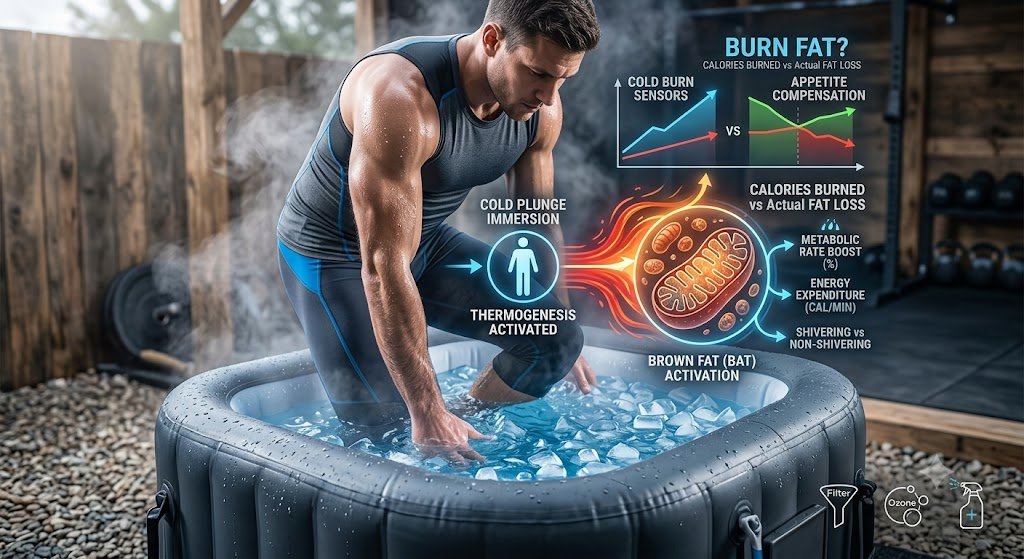
Brown Adipose Tissue (BAT)
Energy Metrology • 2026
Cold Plunge Weight Loss: Does an Ice Bath Help You Lose Fat?
Key Clinical Takeaways: Cold Plunge & Fat Loss Realities
- Metabolic Truth: Cold exposure activates non-shivering thermogenesis through uncoupling protein 1 (UCP1) in brown adipose tissue (BAT), increasing acute calorie expenditure by approximately 100 to 250 kcal per hour of sustained thermal stress.
- Fat Loss Limitation: A typical 2-to-5-minute cold plunge burns only 10 to 30 additional calories. It is not an effective standalone intervention for meaningful subcutaneous adipose reduction.
- Compensatory Appetite: Acute cold shock and post-immersion rewarming often trigger orexigenic hormonal spikes (increased ghrelin), causing post-plunge caloric compensation that easily offsets thermogenic burn.
- Scale Deception: Immediate post-session scale weight drops represent transient fluid loss, transpiration, and vasoconstrictive shifts rather than actual lipid breakdown.
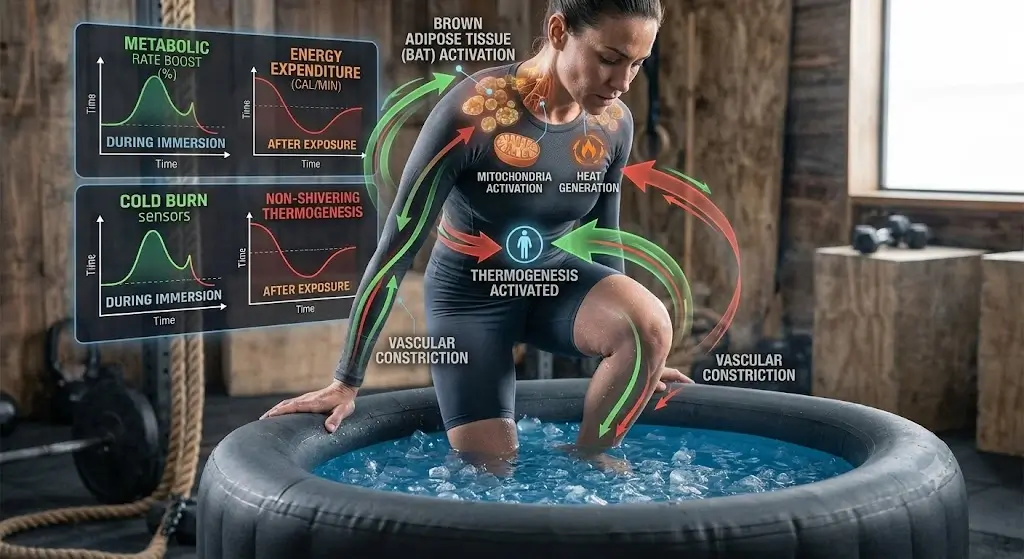
Cold exposure can increase energy expenditure and stimulate thermogenesis, including activity in brown adipose tissue. But that does not mean a cold plunge is a proven standalone weight-loss method. The metabolic response is real; the claim that cold plunging produces meaningful long-term fat loss is much less established.
Searches for cold plunge weight loss often lead to a simple claim: exposing the body to cold makes it burn more calories, so repeated ice baths should help people lose body fat.
There is a real physiological mechanism behind part of that statement.
When the body is exposed to cold, it must produce and conserve heat. This process can increase energy expenditure and activate thermogenic tissues, including brown adipose tissue.
The important question is whether that short-term metabolic response translates into meaningful, sustainable weight loss.
That answer is much less straightforward.
Quick Reference Specification: Cold Immersion Metabolic & Fat Loss Parameters
Metabolic chamber studies confirm that cold-water immersion stimulates acute thermogenic energy expenditure without creating substantial long-term caloric deficits. The clinical reference matrix below summarizes energy expenditure, brown adipose tissue recruitment, hormonal shifts, and weight loss efficacy across cold-exposure modalities:
| Metabolic Parameter | Acute Cold Immersion (3–5 min) | Sustained Cold Exposure (30–60 min) | Primary Biological Mechanism | Evidence-Based Weight Loss Efficacy |
|---|---|---|---|---|
| Active Caloric Burn | 10 – 35 kcal total | 100 – 250 kcal (mild cold air/water) | Non-shivering thermogenesis & shivering reflex | Negligible standalone impact on adipose fat |
| Brown Adipose Tissue (BAT) | Acute UCP1 activation | Increased mitochondrial density (browning) | Mitochondrial uncoupling dissipating proton gradient as heat | Moderate metabolic health benefits; minimal mass loss |
| Hormonal & Neuroendocrine | Norepinephrine up to 250–500% | Sustained epinephrine & cortisol elevation | Sympathetic nervous system fight-or-flight stimulation | Transient lipolytic signaling; blunted by insulin/diet |
| Appetite Compensation | Moderate post-immersion hunger | Marked hyperphagic response | Orexigenic hormone upregulation (ghrelin) to defend energy stores | Frequently cancels out cold-induced caloric deficit |
| Long-Term Body Composition | Neutral directly; aids workout consistency | Modest glucose disposal improvement | Insulin sensitivity modulation through GLUT4 translocation | Supportive secondary tool alongside caloric restriction |
Does Cold Plunge Cause Weight Loss?
Clinical thermoregulatory research confirms that acute cold exposure elevates energy expenditure without acting as an effective standalone fat loss treatment. This distinction matters because “burning more calories” and “losing meaningful body fat” are not identical outcomes.
The human body continuously adjusts energy expenditure, appetite, movement and heat production. A short-lived increase in energy expenditure does not automatically produce a large negative energy balance over weeks or months.
Cold plunging is better understood as a physiological cold-exposure practice than as a dedicated fat-loss tool.
Why Cold Exposure Burns More Energy
Thermogenesis forces human metabolic tissues to consume cellular substrate to maintain stable core body temperatures. The human body maintains a relatively stable internal temperature despite changes in the surrounding environment.
Cold exposure increases the challenge of maintaining that temperature.
The body responds through several mechanisms, including changes in blood flow, heat conservation and thermogenesis.
Thermogenesis literally refers to heat production.
Some of that heat production requires additional energy.
This is the biological reason researchers are interested in cold exposure and metabolism.
| Cold-response mechanism | What it does | Relationship to weight loss |
|---|---|---|
| Non-shivering thermogenesis | Produces heat without relying primarily on visible muscle shivering. | Can increase energy expenditure. |
| Brown adipose tissue | Uses stored chemical energy to generate heat. | Contributes to thermogenesis. |
| Shivering | Rapid involuntary muscle activity produces heat. | Can increase energy expenditure during sufficient cold stress. |
| Vasoconstriction | Reduces blood flow near the skin to conserve heat. | Primarily a heat-conservation response rather than a fat-loss mechanism. |
These mechanisms demonstrate that cold exposure is metabolically active.
They do not demonstrate that an ice bath should be used as a primary weight-management intervention.
Cold Plunges and Brown Fat
Brown adipose tissue utilizes uncoupling protein 1 to dissipate the mitochondrial proton gradient directly as thermal energy. Unlike white adipose tissue, whose primary role is energy storage, brown fat is specialized for heat production.
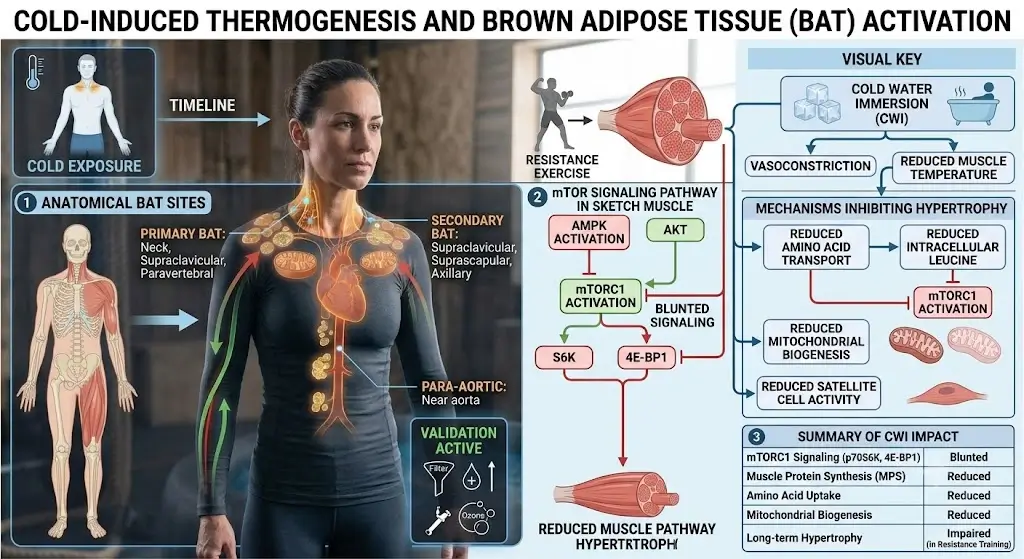
Cold exposure can activate brown adipose tissue.
This process is associated with increased thermogenesis and energy expenditure.
Human research using metabolic imaging has helped establish that adults retain metabolically active brown adipose tissue and that its activity can increase during cold exposure.
Activating brown fat is a measurable biological response. It does not automatically mean that activating brown fat through cold plunging will produce a clinically meaningful reduction in body fat.
That distinction prevents one of the most common errors in cold-plunge marketing: taking a mechanism and presenting it as proof of a large real-world outcome.
How Many Calories Does a Cold Plunge Burn?
Caloric expenditure during brief cold water immersions varies widely from ten to thirty-five calories depending on shivering intensity. There is no reliable universal calorie number for a cold plunge.
A calorie calculator that claims every person burns exactly a specific amount during an ice bath is oversimplifying the physiology.
Energy expenditure during cold exposure can vary with:
- Water temperature.
- Duration of exposure.
- Body size.
- Body composition.
- Amount of immersed body surface.
- Environmental conditions.
- Individual cold tolerance.
- Acclimatization.
- Whether shivering occurs.
Two people can therefore have substantially different metabolic responses to the same cold-water environment.
More importantly, the calories burned during cold exposure should not be interpreted in isolation from the body’s broader energy-regulation system.
Calorie Burn vs Actual Fat Loss
Subcutaneous lipid loss requires sustained long-term negative energy balance rather than transient episodes of shivering thermogenesis. Body-fat reduction occurs when, over time, the body’s energy expenditure exceeds energy intake sufficiently to create a sustained energy deficit.
But energy balance is dynamic.
The body can respond to increased energy expenditure through changes in appetite, spontaneous physical activity and other components of daily energy use.
Therefore, a laboratory measurement showing increased energy expenditure during cold exposure does not automatically tell us how much body fat a person will lose over several months.
| Claim | What it actually means |
|---|---|
| “Cold burns calories.” | Cold exposure can increase energy expenditure. |
| “Cold activates brown fat.” | Cold can stimulate thermogenesis through brown adipose tissue. |
| “Cold makes you lose fat.” | This is a much stronger long-term claim that requires outcome evidence. |
| “Cold plunging replaces exercise.” | There is no basis for treating cold immersion as a replacement for physical activity. |
This is the difference between mechanistic evidence and real-world outcome evidence.
Cold Plunge and Water Weight: Why the Scale Can Mislead You
Acute body weight fluctuations post-immersion reflect peripheral vascular fluid shifts rather than true loss of adipose tissue. Another source of confusion is short-term body-weight fluctuation.
Body weight changes from day to day because of fluid balance, food intake, glycogen storage, sodium intake, bowel contents and other variables.
A change on the scale after a cold-plunge session should therefore not automatically be interpreted as fat loss.
Even when body weight changes rapidly, actual loss of stored body fat occurs on a very different timescale.
For meaningful body-composition assessment, longer-term trends are much more informative than a single weigh-in surrounding a cold-exposure session.
Does Cold Exposure Increase Metabolism?
Metabolic rate increases temporarily during cold stress but returns to baseline levels once rewarming completes. Yes, cold exposure can increase energy expenditure through thermogenesis.
But “increase metabolism” is one of the most frequently misunderstood phrases in wellness content.
A temporary increase in metabolic rate during cold exposure is not the same as permanently raising someone’s resting metabolism.
The body increases heat production because it is responding to an environmental challenge.
Once the cold stimulus is removed, the acute stimulus also changes.
Cold Plunge vs Exercise for Weight Loss
Structured physical activity stimulates cardiovascular adaptations and preserves lean muscle mass far more effectively than cold water therapy. If the objective is long-term body-weight management, exercise has a much stronger practical role than cold exposure.
Physical activity contributes to energy expenditure while also supporting cardiovascular fitness, muscular strength, functional capacity and metabolic health.
Resistance training can additionally help preserve or develop lean mass during changes in body weight.
Cold-water immersion does not provide the same combination of benefits.
| Strategy | Primary role | Weight-management relevance |
|---|---|---|
| Resistance training | Strength and lean-mass development | High practical relevance |
| Aerobic activity | Cardiorespiratory fitness and energy expenditure | High practical relevance |
| Nutrition | Controls energy and nutrient intake | Central component |
| Cold exposure | Thermal stress and thermogenesis | Potentially interesting but not a substitute |
The strongest approach is therefore not to choose cold exposure instead of exercise.
If someone enjoys cold plunging, it can be considered a separate recovery or wellness practice rather than a replacement for the fundamentals of weight management.
Can Cold Exposure Affect Appetite?
Exposure to freezing water stimulates hunger hormones like ghrelin to drive post-immersion caloric compensation. Energy balance involves more than calorie expenditure.
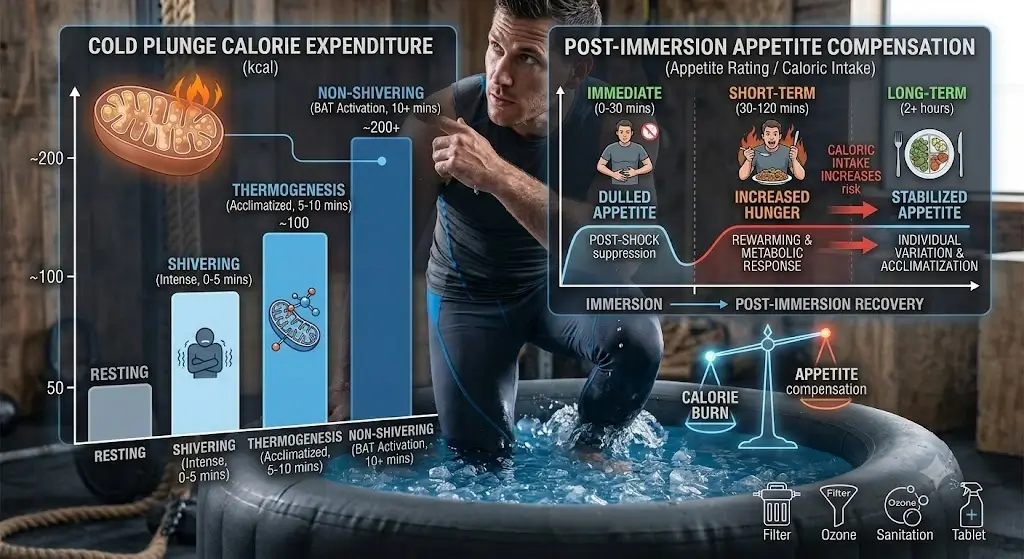
Appetite and food intake can also change in response to environmental conditions and physiological stress.
That makes the relationship between cold exposure and long-term weight management more complicated than simply adding up calories burned during a plunge.
A person who experiences increased hunger after repeated cold exposure could potentially offset some of the additional energy expenditure through food intake.
This is one reason short-term metabolic measurements should not be interpreted as guaranteed long-term weight-loss results.
Cold Plunge, Muscle Recovery and Body Composition
Post-workout cold immersion supports training consistency through soreness relief but can blunt resistance training hypertrophy if mistimed. Cold plunging may have a more defensible role in a body-composition strategy when it is viewed through recovery rather than calorie burning.
Cold-water immersion can reduce perceived muscle soreness after some types of strenuous exercise.
For someone training regularly, maintaining training consistency can matter far more to long-term body composition than trying to extract additional calorie expenditure from cold exposure.
However, people pursuing muscle hypertrophy should also consider the research on repeated immediate post-resistance-training cold exposure. Blunting acute inflammation right after lifting may attenuate anabolic signals like mTOR. If you balance lifting with cold therapy, understanding whether to cold plunge before or after a workout is essential to protect your muscle adaptations.
The potential value of a cold plunge for an active person may be related more to how it fits into recovery and training consistency than to using the plunge itself as a fat-burning tool.
What the Research Actually Shows
Biochemical studies demonstrate real mitochondrial uncoupling in brown fat without establishing long-term clinical obesity reduction. Human research supports several components of the cold-metabolism story.
Cold exposure can increase thermogenesis and stimulate brown adipose tissue activity.
Studies have also demonstrated measurable increases in energy expenditure during controlled cold exposure.
The leap from these findings to “cold plunges cause significant weight loss” is where the evidence becomes much weaker.
This is a classic example of why evidence-based health content needs to separate:
- Mechanism — what the body does during cold exposure.
- Acute effect — what happens during or shortly after exposure.
- Long-term outcome — what happens after repeated use over months.
A mechanism can be scientifically real without producing a clinically meaningful long-term outcome. To explore how duration and exposure volume interact with metabolic stimulus, review our detailed guide on how long to cold plunge.
Brown-fat activation and increased thermogenesis are not the same thing as demonstrated long-term body-fat reduction from cold plunging.
Cold Plunge Weight-Loss Myths
Common commercial marketing claims overstate minor thermogenic spikes into miraculous fat-melting shortcuts. Evaluate these six prevalent misconceptions:
Myth #1: “Cold plunges melt body fat.”
Cold exposure increases heat production, but this phrase dramatically overstates what the evidence demonstrates.
Myth #2: “The colder the water, the more fat you lose.”
A stronger cold stimulus can increase physiological stress, but that does not establish a proportional increase in useful long-term fat loss.
Myth #3: “You can burn hundreds of calories with one plunge.”
There is no universal calorie number that applies to everyone. Individual responses vary substantially.
Myth #4: “Cold plunging replaces cardio.”
Cold exposure and exercise create very different physiological adaptations.
Myth #5: “Sweating and cold exposure both detox the body.”
Detoxification is a commonly abused wellness term. The body already has specialized organs responsible for processing and eliminating many substances, including the liver and kidneys.
Myth #6: “If the scale drops after a plunge, you lost fat.”
Short-term scale changes are not sufficient evidence of body-fat loss.
Can Cold Plunging Help With Weight Loss Indirectly?
Enhanced physical recovery and reduced muscle soreness can indirectly help athletes sustain higher weekly exercise frequency. This is a more reasonable question than asking whether cold water “burns fat.”
Suppose someone uses a cold plunge because it helps them feel recovered after demanding training.
If that person subsequently maintains a more consistent exercise routine, the indirect value could be greater than the calories produced by the cold exposure itself.
That is a behavioral and training effect rather than proof that cold water directly caused significant fat loss.
This distinction matters when evaluating recovery technologies.
Cold Plunge Weight Loss: What Actually Matters Most?
Consistent caloric restriction and progressive resistance training drive sustainable body composition changes far more than cryo-therapy. Compare the primary drivers of body fat management below:
| Factor | Importance for long-term weight management |
|---|---|
| Overall dietary intake | Central driver of energy balance. |
| Physical activity | Supports energy expenditure and metabolic health. |
| Resistance training | Supports strength and lean-mass preservation/development. |
| Sleep and recovery | Important for training consistency and overall health. |
| Cold exposure | Can stimulate thermogenesis but should not be treated as the foundation of weight loss. |
Cold Plunge Safety
Sudden whole-body cold immersion induces profound cardiovascular strain and gasping reflexes that require careful medical screening. Sudden cold exposure can cause rapid changes in breathing, heart rate and blood pressure.
The American Heart Association has warned that cold-water immersion can produce a substantial cold-shock response, particularly in people who are not acclimatized.
Do not use extreme cold exposure as a weight-loss challenge. Cold plunging is not appropriate for everyone, particularly people with certain cardiovascular or other medical conditions. Individual medical guidance may be appropriate before attempting cold-water immersion.
Never combine cold immersion with breath-holding competitions, hyperventilation or underwater endurance challenges.
If a person becomes dizzy, confused, unusually weak or unable to safely exit the water, the exposure should end and appropriate assistance should be obtained.
Should You Use a Cold Plunge for Weight Loss?
Practitioners should adopt cold water immersion for recovery and mental resilience rather than primary fat reduction goals. If your primary objective is losing body fat, a cold plunge should not be your main strategy.
The evidence supports the idea that cold exposure increases thermogenesis and energy expenditure.
But there is a substantial difference between demonstrating a metabolic response and demonstrating meaningful long-term weight loss.
A more defensible way to use a cold plunge is to treat it as an optional recovery or wellness tool that may complement an active lifestyle.
Do not buy a cold plunge because you expect it to replace exercise or create major fat loss by itself. Buy or use one because its recovery, cold-exposure or wellness functions fit your overall routine.
Frequently Asked Questions
Evidence-based medical answers address common questions regarding brown fat, calorie expenditure, and ice bath weight loss. Key clinical answers are detailed below:
Can cold plunges help you lose weight?
Cold exposure can increase energy expenditure through thermogenesis, including brown-fat activity. However, this does not establish cold plunging as a reliable standalone method for meaningful long-term body-fat reduction.
Does an ice bath burn fat?
Cold exposure can stimulate thermogenesis and increase energy expenditure. That metabolic response should not be interpreted as proof that an ice bath produces substantial long-term fat loss.
How many calories does a cold plunge burn?
There is no reliable universal number. Energy expenditure varies with temperature, exposure conditions, body composition, acclimatization and individual physiology.
Does cold exposure activate brown fat?
Yes. Cold exposure can activate brown adipose tissue and increase thermogenesis. The important distinction is that brown-fat activation is a physiological mechanism, not proof of a large weight-loss effect.
Can cold plunges replace exercise for weight loss?
No. Cold-water immersion should not replace physical activity, resistance training or other evidence-based approaches to managing body weight.
Can a cold plunge make you weigh less immediately?
Short-term changes in scale weight can reflect fluid balance and other variables. A rapid change in body weight should not automatically be interpreted as body-fat loss.
Is cold plunging better for weight loss than sauna?
Neither should be treated as a primary fat-loss method. Both can produce acute physiological responses, but temporary changes in fluid balance or energy expenditure should not be confused with meaningful long-term body-fat reduction.
Should you cold plunge after exercise for weight loss?
If the goal is weight management, the more relevant question is whether cold exposure helps you maintain a consistent exercise and recovery routine. Cold plunging itself should not be considered a substitute for training or nutrition.
The Bottom Line on Cold Plunge Weight Loss
Cold exposure triggers genuine brown fat thermogenesis but cannot replace consistent nutrition and exercise for sustained fat loss. Cold plunges do something real: cold exposure increases the body’s demand for heat production.
That process can increase energy expenditure and activate brown adipose tissue.
But the internet often makes one additional leap that the evidence does not justify:
The first part is supported by physiology.
The second part requires much stronger long-term evidence.
For someone trying to change body composition, exercise, nutrition, adequate recovery and sustainable habits remain much more important than attempting to maximize calorie expenditure through cold exposure.
A cold plunge can be a useful part of a recovery-focused home wellness setup—such as using an inflatable ice bath tub for consistent home therapy—but it should be viewed as an accessory to a healthy routine—not a shortcut around it. For foundational equipment setups, review our primer on what is a cold plunge.
Continue Your Cold Plunge Research
Want to understand the variable that changes the cold stimulus most directly? Continue with our Cold Plunge Fundamentals & Temperature Guide to learn how water temperature, exposure conditions and recovery goals affect cold-water immersion.
Editorial Standards
BioHackTub enforces rigorous empirical verification when distinguishing biochemical mechanisms from clinical weight reduction outcomes. We separate mechanistic evidence, acute physiological effects and long-term health outcomes. A measurable increase in thermogenesis is not automatically presented as proof of clinically meaningful weight loss.
Claims concerning body composition, metabolism and recovery are evaluated according to the outcome being measured rather than broad wellness terminology.
This article is for educational purposes and is not individualized medical or weight-management advice.
