
Dose-Response Metrology
Exercise Physiology
How Long to Cold Plunge? What Research Says About Duration & Safety
Quick Verdict: How Long Should You Cold Plunge?
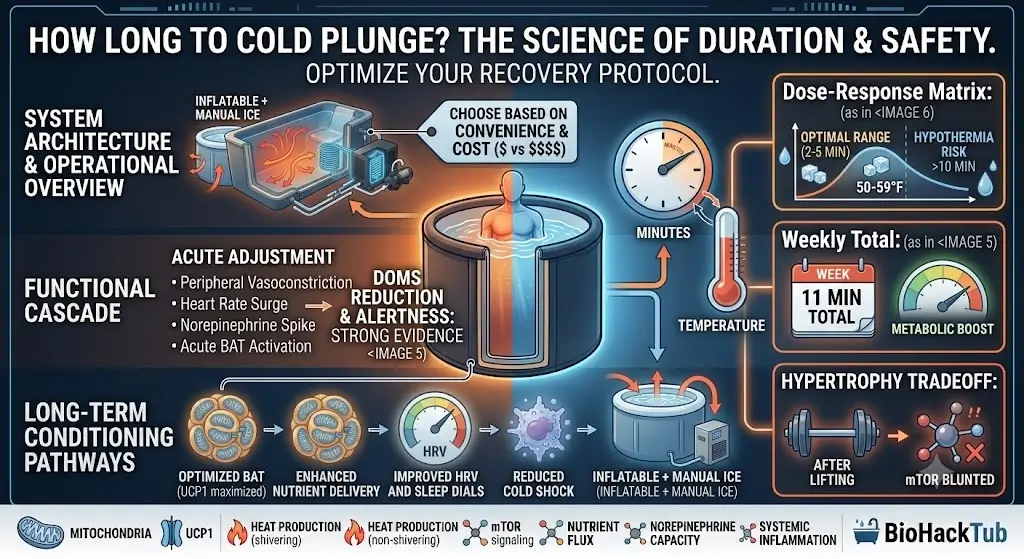
- Optimal Time Window: 2 to 5 minutes in water between 50°F and 59°F captures the peak physiological and recovery stimulus for most individuals. Beginners should start with 1 to 2 minutes.
- Dose-Response Interaction: Time and temperature are inversely related—colder water requires shorter exposure. Staying past 10 minutes increases the risk of hypothermia and motor loss without adding therapeutic benefits.
- Weekly Threshold (The Soeberg Principle): Research suggests a cumulative threshold of approximately 11 minutes per week (divided across 2–4 sessions) is sufficient to trigger sustained metabolic adaptation and brown adipose tissue activity.
- Hypertrophy Timing: Avoid cold immersion within 4 to 6 hours after resistance training if your primary objective is maximizing muscle growth.
Cold plunging has become a popular recovery practice among athletes, wellness users and home biohacking enthusiasts. One of the most common questions is also one of the hardest to answer responsibly: How long should you stay in cold water?
The problem is that cold-water immersion is not a simple dose such as a vitamin or supplement. A person’s response depends on several variables at the same time.
Water temperature, body size, immersion depth, exposure duration, previous cold exposure and individual cardiovascular response can all change the physiological load. Research therefore does not support a single number that should be treated as the “perfect” cold-plunge duration.
Quick Reference Specification: Cold-Water Immersion Duration & Temperature Matrix
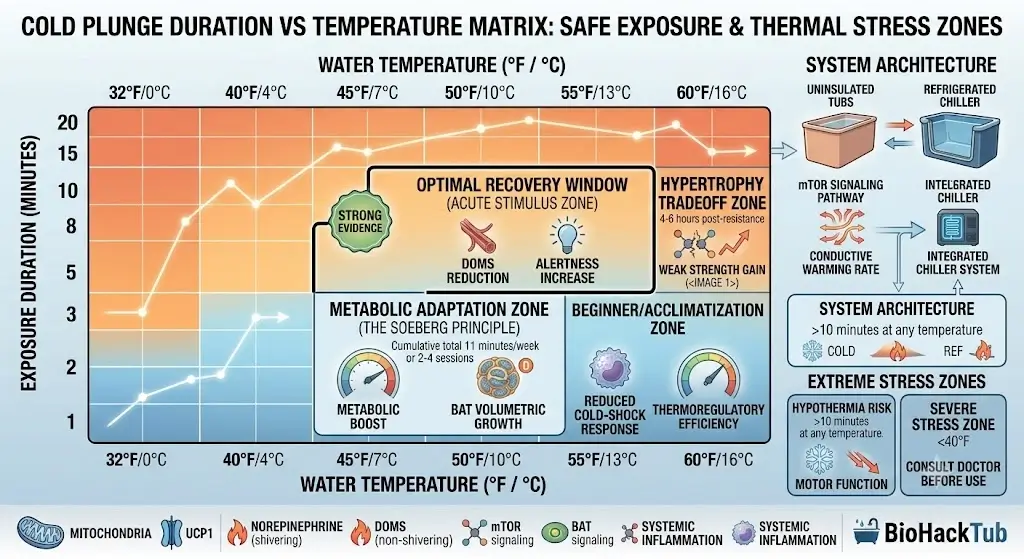
Thermoregulatory heat loss models calculate safe cold-water exposure limits by cross-referencing water temperatures with immersion durations. The reference table below details verified physiological targets, maximum safe time limits, and clinical endpoints across core cold-water temperature tiers:
| Water Temperature | Target Duration Window | Max Recommended Limit | Primary Physiological Stimulus | Safety & Clinical Precaution |
|---|---|---|---|---|
| 55°F – 60°F (12.8°C – 15.6°C) | 3 to 8 minutes | 10 minutes | Mild sympathetic tone; DOMS attenuation | Beginner-friendly; minimal cold-shock panic |
| 50°F – 54°F (10.0°C – 12.2°C) | 2 to 5 minutes | 7 minutes | Norepinephrine release; strong vasoconstriction | Standard athletic recovery target; monitor breath |
| 45°F – 49°F (7.2°C – 9.4°C) | 1 to 3 minutes | 5 minutes | Intense sympathetic activation; BAT stimulation | Experienced users only; rapid extremity numbing |
| 40°F – 44°F (4.4°C – 6.7°C) | 45 to 90 seconds | 3 minutes | Maximum catecholamine spike; acute gasping | High cardiovascular strain; exit path must be clear |
| Below 40°F (< 4.4°C) | 30 to 60 seconds | 2 minutes | Extreme cold-shock defense; non-freezing cold injury | Discouraged for regular wellness protocols |
The Short Answer: There Is No Universal Cold-Plunge Time
Clinical cold-water immersion research identifies no universal immersion time that suits all individuals equally. A useful cold-plunge article should resist the temptation to give every reader the same exposure prescription.
Cold-water immersion creates a physiological response whose intensity depends on multiple factors. A duration that feels manageable for one acclimatized person may produce a substantially stronger response in another.
Research on athletic recovery also uses different combinations of water temperature, immersion duration and exercise protocols, making it difficult to convert the literature into one universal recommendation.
Why Duration Is Only One Variable
Total physiological stress results from water temperature, contact surface area, and subcutaneous fat insulation rather than time alone. When people ask how long to cold plunge, they usually focus on the clock. But the body does not respond to the clock alone.
The thermal stress of cold-water immersion depends on the interaction between several variables:
- Water temperature.
- Time spent immersed.
- How much of the body is underwater (surface area contact).
- Individual body composition (subcutaneous fat vs. lean mass).
- Previous cold exposure.
- Movement during immersion (breaking thermal boundary layer).
- Environmental temperature.
- Individual cardiovascular response.
This means that two people can spend the same amount of time in water and experience very different physiological stress. For example, sitting fully submerged up to the neck in a deep inflatable barrel causes faster heat debt than sitting half-submerged in a shallow bath. If you are comparing compact setups for your home, our round-up of the best portable cold plunge on Amazon breaks down how different tub depths affect your physical immersion surface area.
Water Temperature Changes the Meaning of Duration
Colder water temperatures accelerate core conductive heat loss to compress safe immersion windows significantly. Temperature and duration are closely connected. Colder water generally creates a stronger thermal stimulus. As exposure continues, the body continues losing heat to the surrounding water.
Therefore, the same duration does not represent the same physiological dose at different temperatures.
| Variable | Why it matters |
|---|---|
| Water temperature | Changes the rate at which the body loses heat and the intensity of the cold stimulus. |
| Exposure duration | Longer immersion generally allows more cumulative heat transfer. |
| Immersion depth | Greater body surface area in contact with water changes heat transfer. |
| Acclimatization | Repeated exposure can reduce some aspects of the initial cold-shock response. |
| Individual physiology | Body size, composition, circulation and health status influence response. |
This thermodynamic reality also influences equipment choices. As evaluated in our hands-on The Pod Company Standard Ice Pod review, uninsulated portable tubs suffer rapid conductive warming, forcing users to constantly balance exposure duration against melting ice levels.
Cold Plunge Duration and Exercise Recovery
Ten to fifteen-minute immersion protocols reduce subjective muscle soreness without accelerating maximum voluntary isometric strength recovery. Cold-water immersion is frequently used after strenuous exercise because research suggests it can reduce perceived muscle soreness and influence short-term recovery outcomes.
However, research does not demonstrate one universally superior duration for every athlete and every type of exercise.
Systematic reviews and meta-analyses examining randomized controlled trials show that acute cold-water immersion has outcome-specific effects. Clinical data demonstrate lower subjective soreness overall, while effects on maximal voluntary strength recovery remain variable.
This is important because “recovery” is not one measurement. A person may feel less sore without demonstrating a measurable improvement in every aspect of muscle function.
Cold Plunge After Strength Training: Why Timing Matters
Immediate post-workout cold immersion blunts muscular protein synthesis signaling pathways essential for long-term hypertrophy. People who lift weights need to consider a second issue: the difference between feeling recovered and adapting to training.
Resistance exercise creates signaling processes involved in muscle adaptation. Cold exposure may alter some of those processes.
That does not mean cold water immersion is automatically bad after strength training. It means that someone whose primary objective is maximizing muscle adaptation should not assume that aggressive cold exposure immediately after every workout is optimal.
The current evidence is nuanced, and the best use case may differ between competitive in-season recovery and long-term strength or hypertrophy phases. For an evidence-based breakdown of these physiological adaptations, review our comprehensive guide on cold plunge benefits.
Is a Longer Cold Plunge Better?
Prolonged cold submersion beyond ten minutes escalates hypothermic risks without producing greater clinical anti-inflammatory gains. Longer exposure increases cumulative heat loss. It can also increase discomfort and physiological stress.
The goal of cold exposure should not be to remain in the water for as long as possible. This is especially important because social-media challenges often turn cold exposure into a test of endurance rather than a controlled recovery intervention.
Controlled physiological studies comparing different durations of cold-water immersion confirm that exposure duration directly alters internal muscle and core rectal temperatures, reinforcing that time is a dose multiplier rather than an isolated metric.
Why the First Moments of Cold Exposure Matter
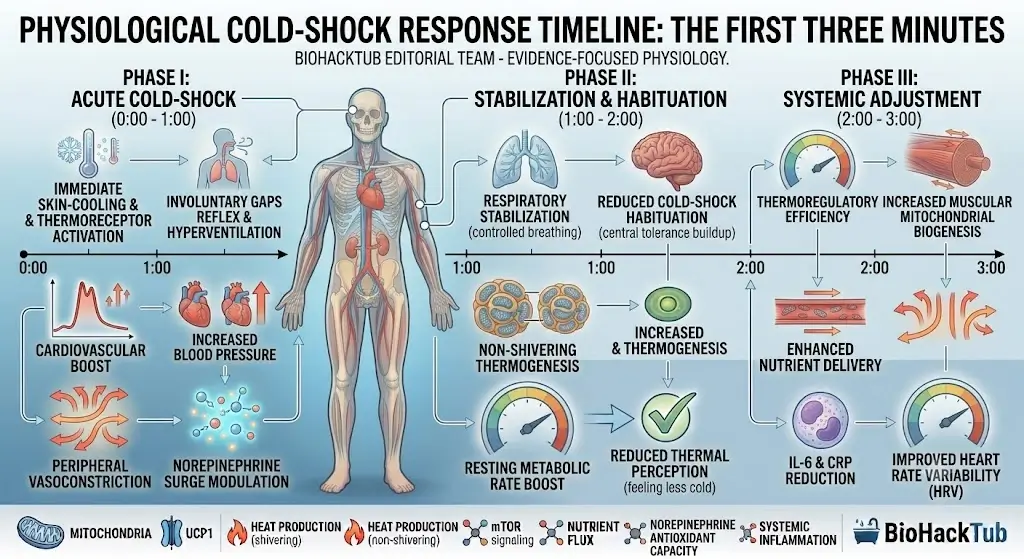
The initial sixty seconds of immersion trigger severe respiratory gasping and sudden tachycardia known as cold shock. Sudden cold immersion can cause rapid changes in breathing, heart rate and blood pressure.
Leading cardiology institutions note that this acute cardiovascular response can place intense stress on the circulatory system, particularly when an individual is not acclimatized.
Research confirms that repeated cold-water immersion can habituate and reduce aspects of the cold-shock response, although the rate of habituation varies between individuals.
This explains an important distinction:
- Cold tolerance can improve with experience.
- Cold exposure still creates physiological stress.
- Feeling comfortable does not prove that a longer exposure is beneficial.
When Should You Stop a Cold Plunge?
Uncontrollable hyperventilation, mental disorientation, and loss of fine motor grip demand immediate water termination. A cold-plunge session should never continue simply because a timer has not finished.
The body’s response is more important than completing an arbitrary duration.
Warning signs that require ending the exposure immediately include:
- Uncontrolled or worsening breathing.
- Dizziness or significant lightheadedness.
- Confusion or unusual difficulty thinking clearly.
- Loss of fine motor coordination.
- Marked muscle weakness or numbness.
- Feeling unable to safely exit the water unassisted.
- Symptoms suggesting significant hypothermic progression.
If someone develops significant cold-related symptoms or altered responsiveness, the appropriate response is to exit the water immediately and begin passive rewarming rather than attempting to “push through.”
Does Acclimatization Change How Long You Can Tolerate Cold?
Consistent cold conditioning dampens subjective sensory shock without altering the physical rate of core temperature loss. Research indicates that repeated cold-water immersion can reduce components of the initial cold-shock response.
However, acclimatization should not be confused with physiological immunity to cold injury. Someone who has become accustomed to the initial shock may simply perceive the exposure as less distressing while their body continues losing thermal mass at the same physical rate.
How Cold-Plunge Duration Depends on Your Goal
Targeted recovery objectives determine whether swimmers utilize two-minute alertness dips or ten-minute anti-inflammatory baths. Match your time in the water to your biological goal:
| Goal | What the evidence suggests | Important limitation |
|---|---|---|
| Reduce perceived soreness | Cold-water immersion may help after strenuous exercise. | Optimal duration is not universal. |
| Feel more alert | Cold exposure produces a strong acute arousal response. | More exposure is not automatically more beneficial. |
| Prepare for another competition | Recovery effects may be useful when repeated performance matters. | Protocol should be individualized. |
| Maximize hypertrophy | Frequent immediate post-training cold exposure deserves caution. | Long-term adaptation is different from short-term soreness. |
| General wellness | Cold exposure can be a controlled environmental stressor. | There is no established requirement to use extreme exposure. |
Common Cold-Plunge Duration Mistakes
Novice cold bathers frequently make critical errors by copying extreme social media stunts and neglecting cardiovascular risks. Avoid these six common duration pitfalls:
1. Copying an athlete’s protocol
Professional athletes operate with specific recovery demands, professional supervision, and structured periodization.
2. Assuming colder means better
A stronger cold stimulus is not automatically a better recovery stimulus.
3. Treating soreness as the only measurement
Feeling less sore is useful information, but it does not describe every aspect of muscular and neural recovery.
4. Increasing exposure because the first session felt easy
Cold response varies from day to day. Fatigue, hydration, exercise load and ambient room conditions all change thermal tolerance.
5. Treating social-media challenges as science
Extreme cold exposure makes compelling video content but does not represent evidence-based recovery.
6. Ignoring cardiovascular risk
Cold shock produces rapid shifts in blood pressure and heart rate. People with pre-existing cardiovascular conditions must seek medical guidance prior to immersion.
What Current Research Actually Shows
Systematic clinical trials prove that cold water immersion alleviates muscle soreness while leaving isometric strength unaffected. The scientific literature on cold-water immersion is more nuanced than typical lifestyle content suggests.
Systematic reviews evaluating randomized controlled trials found that acute cold-water immersion does not produce consistent improvements in maximal voluntary isometric strength, while confirming a moderate benefit in reducing subjective post-exercise soreness.
Earlier physiological research demonstrates that water temperature and immersion duration interact directly to determine changes in deep muscle and core body temperature.
The practical conclusion is that cold-water immersion is an outcome-specific tool: its value depends entirely on what physical adaptation you are trying to influence. For fundamental hardware setups, review our guide on what is a cold plunge.
| Question | Evidence-based answer |
|---|---|
| Is there one perfect duration? | No. |
| Does longer automatically mean better? | No. |
| Can cold immersion reduce soreness? | Evidence suggests it can in some circumstances. |
| Does it restore every aspect of performance? | No consistent universal effect has been established. |
| Does temperature matter? | Yes, substantially. |
| Does individual response matter? | Yes. |
How to Think About Cold-Plunge Duration
Evidence-based protocols determine immersion duration by intended physiological endpoints rather than endurance tolerance limits. Instead of asking: “What is the longest I can stay in?”
That distinction prevents cold plunging from becoming an endurance competition. The objective is to produce a targeted recovery outcome while avoiding unnecessary thermal risk.
Frequently Asked Questions
Direct clinical answers resolve frequent inquiries regarding beginner exposure times, muscle hypertrophy timing, and hypothermia safety limits. Key guidance is detailed below:
How long should you cold plunge?
There is no single scientifically established duration that is optimal for everyone. Water temperature, immersion conditions, acclimatization, health status and the intended goal all influence the response. Most protocols range from 2 to 5 minutes.
Is a longer cold plunge better?
No. Longer exposure increases cumulative heat loss and physiological stress, and research does not establish that extending exposure indefinitely creates proportionally greater benefits.
Does cold-plunge duration affect muscle recovery?
Yes. Duration is one component of the cold-water exposure, and research shows that different durations can produce different changes in body and muscle temperature. However, there is no universal duration that is optimal for every recovery outcome.
Can you stay in a cold plunge too long?
Yes. Prolonged cold exposure can increase heat loss and the risk of cold-related problems. Cold shock and hypothermia are important safety considerations.
Does colder water mean you need less time?
Temperature and duration interact, so colder water creates a stronger cold stimulus. However, there is no universal formula that can safely convert temperature into an individualized exposure time.
Should you cold plunge immediately after lifting weights?
Not necessarily. Cold immersion may reduce soreness, but frequent immediate post-resistance-training exposure may not be ideal when maximizing muscle adaptation is the primary objective.
Does cold-plunge experience make longer exposure safe?
Acclimatization can reduce aspects of the initial cold-shock response, but it does not eliminate heat loss or cold-related risk.
The Bottom Line
Controlled cold-water immersion achieves therapeutic neuromuscular benefits within short, structured exposure windows. There is no universal answer to how long to cold plunge.
The scientific literature shows that cold-water immersion can influence soreness, body temperature, cardiovascular responses and perceived recovery, but the results depend on the specific protocol and outcome being measured.
The strongest takeaway is simple: duration should not be treated as an endurance target. Colder water, longer exposure and greater discomfort do not automatically translate into greater benefits.
For anyone considering cold-water immersion, safety, individual health status and the purpose of the exposure matter more than copying an arbitrary timer from social media.
Continue Your Cold Plunge Research
If you are comparing cold-water protocols, the next useful question is how water temperature changes the physiological stimulus. See our comprehensive Cold Plunge Fundamentals & Temperature Guide for a deeper explanation of temperature thresholds, recovery goals and the equipment required for home setups.
