
Sauna Electrical Requirements: 120V vs 240V, Amps, Circuits & Wiring
Sauna electrical requirements vary substantially by sauna type, heater output, cabin size, and manufacturer. A compact infrared sauna may use a dedicated 120V circuit, while a traditional electric sauna heater commonly requires a dedicated 240V circuit with substantially higher amperage.
The most important buying rule is simple: do not choose the circuit from the sauna’s size alone. Start with the exact manufacturer’s electrical specification—voltage, maximum current or heater kW, phase, connection type and installation requirements—then have the installation evaluated against the electrical code applicable where the sauna will be installed.
Quick answer:
Many compact 1–2 person infrared saunas are designed around 120V household power, while traditional electric sauna heaters and larger sauna systems commonly use 240V. There are important exceptions, so the product’s installation manual and nameplate are the source of truth. Current manufacturer documentation shows examples ranging from 120V/15A infrared systems to 240V/30A or higher traditional-heater configurations.
Safety note:
This article is for product-selection and planning information. Electrical installation, circuit modifications, hardwiring, breaker selection and code compliance should be handled by a qualified electrician and according to the manufacturer’s installation manual and applicable local requirements.
120V vs 240V Sauna Electrical Requirements
| Sauna configuration | Common electrical pattern | Typical buyer consideration |
|---|---|---|
| Compact infrared | 120V, often 15–20A | Can be simpler to accommodate when the manufacturer specifies a suitable dedicated circuit. |
| Larger infrared | 120V or 240V depending on model | Never assume that two- or three-person capacity determines voltage by itself. |
| Traditional electric sauna | Usually 240V with dedicated circuit | Heater kW and manufacturer requirements drive the electrical design. |
| Hybrid sauna | May require more than one circuit | Infrared heating and traditional heating can have separate electrical requirements. |
| Wood-burning sauna | No electrical heater circuit | Electrical planning still applies to lights or accessories, while the stove requires separate installation considerations. |
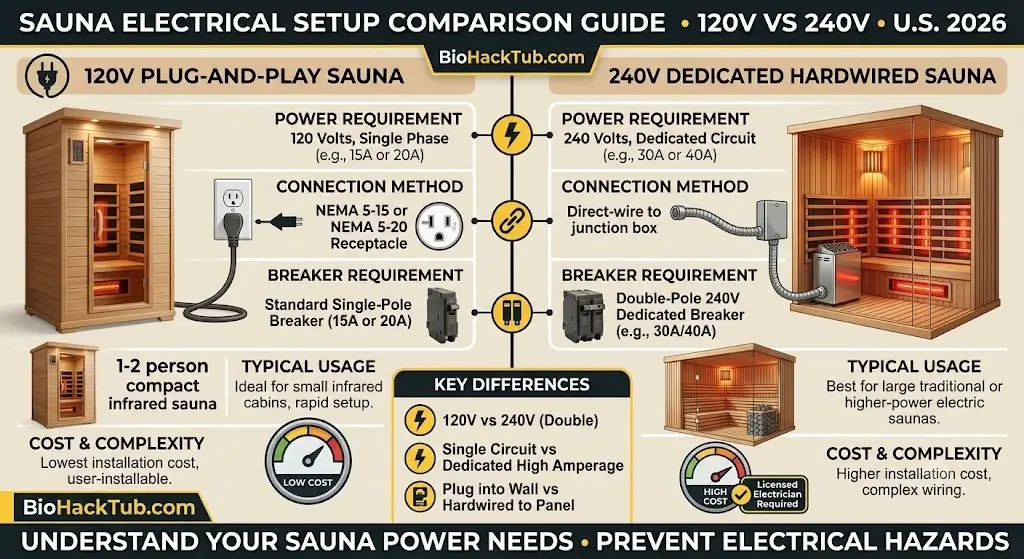
These are broad categories, not universal specifications. Manufacturer documentation demonstrates substantial variation even within the infrared category. For example, Clearlight lists different models at 120V/15A, 120V/20A, 120V/30A and 240V/15–20A depending on configuration and upgrades.
Why Sauna Electrical Requirements Matter Before Buying
Electrical compatibility is one of the easiest sauna specifications to overlook because product listings often emphasize cabin dimensions, heater type, wood species and features before showing the power requirements.
That can create an expensive mismatch.
A sauna may physically fit in a room while the home’s existing electrical infrastructure does not support the manufacturer’s specified circuit.
The electrical requirement can affect:
- Where the sauna can be installed
- Whether a dedicated circuit is available
- Whether an electrician is needed
- Whether the electrical panel has sufficient capacity
- Whether a new circuit or subpanel is required
- Installation cost
- Whether the selected outlet matches the sauna plug
- Whether local inspection or permitting requirements apply
Treat electrical compatibility as a buying filter, not an afterthought. A sauna that looks inexpensive on Amazon can require additional electrical work if its published power requirement does not match the installation location.
Why Many Infrared Saunas Use 120V
Infrared saunas generally operate at lower electrical power than many traditional sauna heaters because their heating system is designed around infrared heating elements rather than heating a large volume of air and sauna stones to traditional sauna temperatures.
Many compact infrared cabins are therefore designed for 120V operation.
Current manufacturer documentation provides several examples. Clearlight lists its Premier 1 and Premier 2 at 120V/15A, while its Premier 3 is listed at 120V/20A. Some configurations with additional heating or red-light equipment require higher electrical capacity.
Tylö’s Kiruna infrared installation manual likewise specifies 120V AC, a 20A service, a dedicated circuit and a NEMA 5-20R receptacle for that particular model.
“Infrared sauna” does not automatically mean “standard 15A outlet.” Some models require 20A, 30A or 240V service. Always use the exact model’s specification.
Why Traditional Sauna Heaters Often Use 240V
Traditional electric sauna heaters can require substantially more power than compact infrared cabins.
Residential traditional heaters commonly fall into the several-kilowatt range. Because electrical power is related to voltage and current, moving from 120V to 240V allows a given power level to be delivered with approximately half the current under comparable conditions.
For example, a purely mathematical comparison:
3,000W ÷ 240V = 12.5A
That does not mean a 3,000W sauna should automatically be connected to either circuit. The calculation simply illustrates why higher-power residential heating equipment often uses 240V.
The actual circuit, breaker, conductors and connection method must follow the heater manufacturer’s specifications and applicable electrical requirements.
Voltage, Amps, Watts and kW Explained
Four electrical terms appear repeatedly on sauna specification sheets:
| Term | Meaning | Why sauna buyers care |
|---|---|---|
| Volts (V) | Electrical potential | Must match the equipment’s required supply. |
| Amps (A) | Electrical current | Used to determine circuit and conductor requirements. |
| Watts (W) | Power | Shows the electrical power consumed by the equipment. |
| Kilowatts (kW) | 1,000 watts | Commonly used to describe sauna heater output. |
The basic electrical relationship is:
Power ≈ Voltage × Current
W ≈ V × A
Real equipment specifications can be more complicated because power factor, controls, multiple components and system configuration may affect actual electrical behavior. For purchasing purposes, use the manufacturer’s stated maximum current or circuit requirement rather than trying to reverse-engineer the entire electrical system from a wattage estimate.
What Does a Dedicated Sauna Circuit Mean?
A dedicated circuit is an electrical circuit intended to serve the specified equipment rather than sharing its capacity with unrelated loads.
This distinction matters because a sauna heater can represent a substantial electrical load.
If a manufacturer specifies a dedicated circuit, plugging the sauna into an outlet that happens to be physically close to the electrical panel does not make it dedicated.
The circuit configuration should be verified by a qualified electrician.
Manufacturer documentation frequently specifies dedicated circuits. Tylö’s infrared sauna manual, for example, specifies a 120V dedicated circuit for its referenced model.
Breaker Sizing: Why the Manufacturer Specification Wins
One of the most common mistakes in sauna research is selecting a breaker based only on the outlet voltage.
A 120V circuit is not automatically a 15A circuit, and a 240V circuit is not automatically a 30A circuit.
The correct electrical configuration depends on the equipment specification and applicable code.
Do not “upgrade” a breaker to stop nuisance trips.
A larger breaker is not a substitute for correctly sized conductors and equipment. If a sauna repeatedly trips its breaker, the cause needs to be diagnosed rather than bypassed with an oversized protective device.
Some manufacturers provide very specific requirements. Heavenly Heat, for example, lists separate 120V/15A and 120V/20A configurations for different sauna models and specifies 240V/20A or 240V/30A dedicated circuits for certain larger models.
Continuous Loads and Sauna Heating
Sauna heaters can operate for extended periods, so electrical planning should account for the fact that heating equipment may represent a sustained load rather than a short-duration appliance load.
The exact treatment of a sauna load depends on the equipment, installation and applicable code provisions. This is another reason a generic online amp chart should not replace the manufacturer’s installation instructions or an electrician’s evaluation.
For U.S. installations, the current edition of the National Electrical Code as adopted and amended by the applicable jurisdiction is an important reference point. Local requirements can differ.
Use the manufacturer’s installation manual as the equipment-specific source, then have the electrician determine the compliant circuit and installation configuration for the property.
Sauna Outlet and Plug Types
The plug shape is another specification that buyers should check before ordering.
Common configurations include:
- NEMA 5-15
- NEMA 5-20
- NEMA 6-series configurations for certain 240V equipment
- Locking receptacle configurations on some equipment
- Hardwired junction-box connections for some traditional heaters
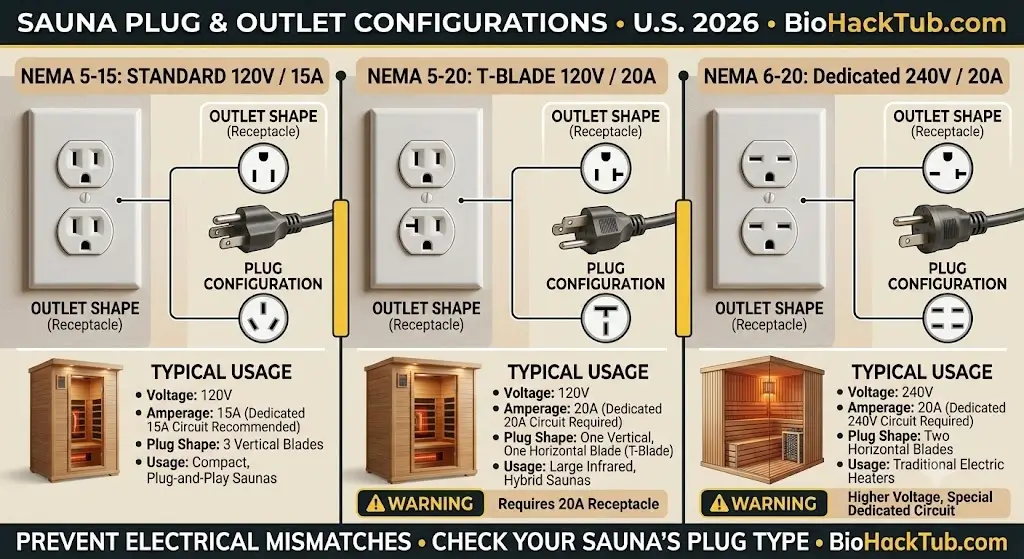
Do not assume that a sauna described as “plug and play” can use any standard household outlet.
For example, Tylö’s referenced Kiruna infrared installation manual specifies a NEMA 5-20R receptacle for its 20A 120V configuration.
Plug-In vs Hardwired Sauna Systems
Plug-in infrared sauna
A plug-in system can simplify installation when the manufacturer’s design specifically permits it and the required dedicated circuit and receptacle are already available.
Hardwired traditional heater
Many traditional electric sauna heaters are connected directly through an electrical junction or control system rather than using a normal household plug.
That is one reason traditional sauna installation should be planned with the electrician before purchasing the heater.
Hybrid sauna
A hybrid system can be more complicated because infrared panels and a traditional heater may have different electrical requirements.
Heavenly Heat provides an example in which its combination sauna uses a dedicated 120V/20A circuit for the infrared system and a separate 240V/30A circuit for the traditional heater.
Does Your Electrical Panel Have Enough Capacity?
Having a 240V service in a house does not automatically mean there is unlimited capacity for a sauna.
The electrician needs to consider the property’s existing electrical service and loads.
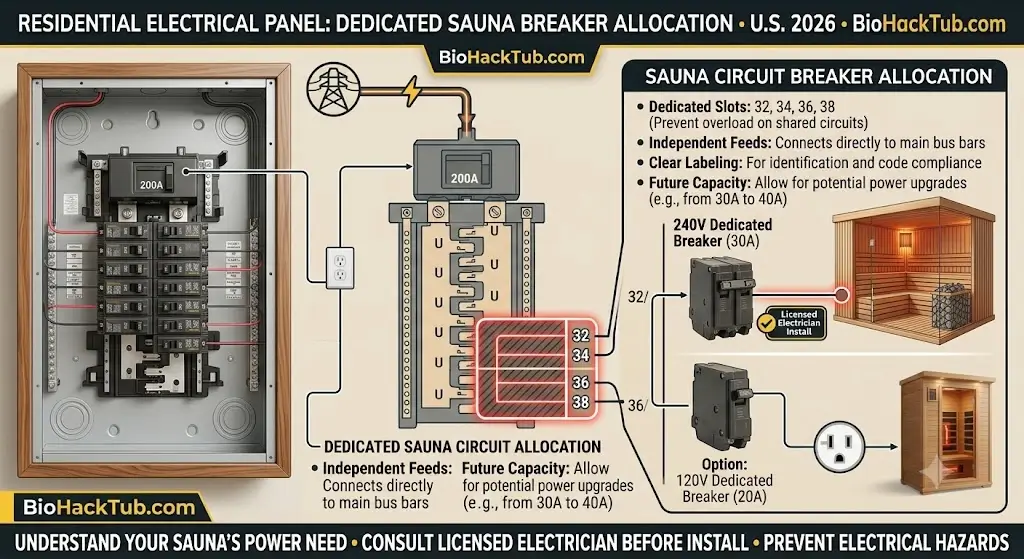
Relevant questions include:
- What is the home’s service capacity?
- Is there available breaker space?
- What other high-load equipment operates in the home?
- Where will the sauna circuit originate?
- How long is the circuit run?
- Will a subpanel be necessary?
- Are there local requirements affecting the installation?
This is particularly important when a home already has electric heating, an EV charger, electric range, dryer, heat pump or other high-load equipment.
The question is not simply “Does my house have 240V?” The better question is “Can my home’s electrical system support the exact sauna configuration under the applicable requirements?”
Why Extension Cords Are Not a Sauna Installation Strategy
A consumer sauna should not be treated like a lamp or small electronic device that can simply be moved farther from the outlet with an extension cord.
If the manufacturer specifies a dedicated receptacle or hardwired installation, that requirement should be followed.
Tylö explicitly warns against using extension cords or undersized/inappropriately rated wiring for its referenced infrared sauna installation.
Do not use an extension cord to solve an electrical mismatch.
If the sauna cannot reach its required outlet with the supplied connection, the correct solution is to have the electrical installation evaluated—not to improvise the power connection.
GFCI and Sauna Electrical Requirements
GFCI protection can be relevant to sauna installations depending on the equipment, location and applicable code.
Requirements can vary based on whether the sauna is indoors, outdoors, near water, and how the equipment is classified and installed.
Do not assume that every sauna has the same GFCI configuration.
The manufacturer’s installation manual and local electrical requirements should be checked before installation.
Outdoor Sauna Electrical Requirements
Outdoor sauna installations introduce additional environmental considerations.
The electrical design must account for the outdoor location, weather exposure, equipment ratings, wiring method, grounding and local requirements.
An indoor sauna specification should not automatically be transferred to an outdoor installation.
Manufacturer specifications demonstrate this difference. Clearlight lists its Outdoor 2 at 240V/15A and Outdoor 5 at 240V/20A, illustrating that outdoor models can have specific electrical configurations rather than simply copying the requirements of smaller indoor units.
Infrared Sauna Electrical Requirements: Real Manufacturer Examples
The following examples demonstrate why buyers should research the exact model rather than relying on a generic “infrared sauna = 120V” rule.
| Example | Published requirement | What it demonstrates |
|---|---|---|
| Clearlight Premier 1 | 120V / 15A | Some compact infrared systems can use relatively modest electrical service. |
| Clearlight Premier 3 | 120V / 20A | Larger cabin configurations can require more current even while remaining at 120V. |
| Clearlight Sanctuary 3 | 240V / 15A | Some infrared cabins move to 240V. |
| Clearlight Sanctuary 5 | 240V / 20A | Large infrared cabins can have substantially different electrical requirements. |
| Tylö Kiruna 3 infrared | 120V / 20A | A specific model may require a dedicated 20A circuit and matching receptacle. |
Sources: manufacturer-published electrical requirements from Clearlight and Tylö.
Traditional Sauna Heater Electrical Requirements
Traditional electric sauna heaters generally require substantially more electrical power than compact infrared cabins.
A useful planning table is:
| Heater class | General planning range | Important qualification |
|---|---|---|
| Small traditional heater | Often 240V | Exact amperage depends on heater model and output. |
| Mid-size residential heater | Often several kW at 240V | Dedicated circuit commonly required. |
| Larger residential heater | Higher-kW 240V systems | May require larger conductors, breaker and potentially additional electrical planning. |
Do not use this table to select a breaker. Its purpose is to show the scale of the difference between traditional heaters and small plug-in infrared cabins.
How Much Electricity Does a Sauna Use?
Electrical consumption depends primarily on power draw and operating time.
A simple energy estimate is:
For example, a hypothetical 1.5 kW sauna operating continuously for one hour would consume approximately:
Actual consumption can be lower or vary over time because thermostatic systems may cycle heating elements rather than drawing their maximum rated power continuously.
For purchasing decisions, the manufacturer’s rated power is the appropriate starting point; real household consumption depends on the heating cycle, ambient temperature, session duration and control strategy.
How to Estimate Sauna Electricity Cost
Once the estimated energy use is known, multiply it by the electricity rate.
For example, if a hypothetical sauna used 2 kWh and the electricity rate were $0.20/kWh:
This is an example calculation, not a national U.S. electricity price. Electricity rates vary significantly by utility and state.
What to Check on an Amazon Sauna Listing
For BioHackTub’s Amazon-only product strategy, electrical specifications should be treated as a mandatory screening criterion.
Before considering a sauna for a commercial roundup, check whether the Amazon listing or manufacturer’s documentation clearly identifies:
- Voltage
- Maximum amperage
- Rated power or heater wattage
- Plug type
- Dedicated-circuit requirement
- Whether the product is plug-in or hardwired
- Number of power cords
- Whether accessories add electrical load
- Indoor or outdoor rating
- Installation instructions
If an Amazon listing says only “120V” but does not clearly disclose the required amperage, plug configuration or installation requirements, the product should receive a lower confidence score for electrical transparency.
Sauna Electrical Pre-Purchase Checklist
Before ordering any home sauna, answer these questions:
- What exact model am I buying?
- What voltage does that model require?
- What is its maximum current requirement?
- What is the rated heater power?
- Does it require a dedicated circuit?
- What receptacle or connection does it require?
- Is it plug-in or hardwired?
- Does the model have multiple power cords?
- Will additional lighting or red-light equipment change the electrical requirement?
- Is the installation indoors or outdoors?
- Does the home’s electrical panel have appropriate capacity?
- Has the planned installation been reviewed by a qualified electrician?
Best buying sequence:
Model → electrical specification → installation location → electrical capacity → professional verification → purchase.
Do not reverse that sequence by buying the sauna first and investigating electrical compatibility after delivery.
Electrical Red Flags in Sauna Product Listings
Be cautious when an Amazon listing contains any of the following:
- “Plug and play” without a stated circuit requirement
- Voltage listed but amperage omitted
- Multiple electrical accessories with no combined load information
- Conflicting voltage specifications in different sections
- Different electrical specifications between the product title and manual
- No installation manual
- No model-specific electrical documentation
- Claims that a 240V sauna can simply use a standard household outlet
- Advice to use an extension cord to reach the sauna
A particularly important warning is contradictory electrical information. If the Amazon listing says 120V but the manufacturer’s manual says 240V, stop the purchase decision until the discrepancy is resolved.
The Most Important Difference: 120V Does Not Mean “Low Power”
One of the most common misconceptions in sauna shopping is that 120V automatically means a sauna has a small electrical load.
Voltage and power are different specifications.
A 120V appliance can still require substantial current.
For example, a hypothetical 1,800W load at 120V would mathematically correspond to:
That is already the full nominal current of a 15A circuit before considering how the equipment is classified and installed.
This is why the exact manufacturer’s maximum-current specification matters more than simply seeing “120V” on a product page.
Why 240V Can Be More Practical for High-Power Sauna Heaters
The advantage of higher voltage for high-power heating is straightforward electrical math.
For the same theoretical power:
4,800W ÷ 240V = 20A
The 240V configuration delivers the same theoretical power at approximately half the current.
This is one reason traditional residential sauna heaters commonly use 240V systems.
It does not, however, tell you which breaker or conductor size to install. Those decisions remain model- and installation-specific.
Sauna Electrical Requirements FAQ
Do infrared saunas need 240V?
Not necessarily. Many compact infrared saunas use 120V, while other infrared models use 240V. Clearlight’s published specifications show examples across both voltage classes.
Can an infrared sauna use a normal household outlet?
Some are specifically designed for a standard household receptacle, but others require a dedicated 20A circuit or a different configuration. Check the exact model’s electrical specification.
Do traditional electric saunas need 240V?
Many residential traditional electric sauna heaters use 240V because their heating power is substantially higher than that of many compact infrared systems. Exact requirements vary by heater.
Does a sauna need a dedicated circuit?
Many manufacturers specify a dedicated circuit for their sauna or heater. The exact requirement should come from the model-specific installation documentation.
Can I use an extension cord with a sauna?
You should not use an extension cord as a workaround for a sauna that requires a dedicated or specially configured circuit. Tylö’s installation manual specifically warns against extension cords and undersized or improperly rated wiring for its referenced infrared model.
How many amps does a home sauna use?
There is no universal number. Compact infrared models may be specified around 15–20A at 120V, while larger infrared and traditional systems can require 240V and substantially different amperage.
What outlet does a 120V infrared sauna use?
The answer depends on the model. NEMA 5-15 and NEMA 5-20 configurations are examples used by some manufacturers. Tylö’s referenced 20A infrared model specifies a NEMA 5-20R receptacle.
Can a sauna share a circuit with other appliances?
If the manufacturer specifies a dedicated circuit, it should not be treated as a shared circuit. Verify the installation requirements with a qualified electrician.
Do sauna heaters need GFCI protection?
The applicable requirement depends on the equipment and installation location. Follow the manufacturer’s instructions and local electrical requirements rather than assuming one GFCI configuration applies to every sauna.
Can I install a 240V sauna myself?
Electrical work involving new circuits, breaker panels, hardwiring or other modifications should be handled by a qualified electrician and performed according to applicable code and the manufacturer’s installation requirements.
How much electricity does an infrared sauna use?
A simple estimate is power in kilowatts multiplied by operating hours. Actual consumption can vary because heating systems may cycle on and off during operation.
Should I buy a sauna before checking electrical requirements?
No. Electrical compatibility should be verified before purchase, especially for 240V or higher-amperage systems.
Bottom Line: Check the Electrical Specification Before You Buy
The safest way to approach sauna electrical requirements is to ignore generic assumptions and start with the exact product documentation.
A compact infrared sauna may work with a dedicated 120V circuit, while a larger infrared cabin or traditional electric heater may require 240V service. Manufacturer specifications show that even products in the same general category can have very different requirements.
For an Amazon purchase, the minimum electrical information worth confirming is:
- Voltage
- Maximum amperage
- Power rating
- Dedicated-circuit requirement
- Plug or hardwire configuration
- Receptacle type
- Installation manual
- Indoor/outdoor electrical requirements
