
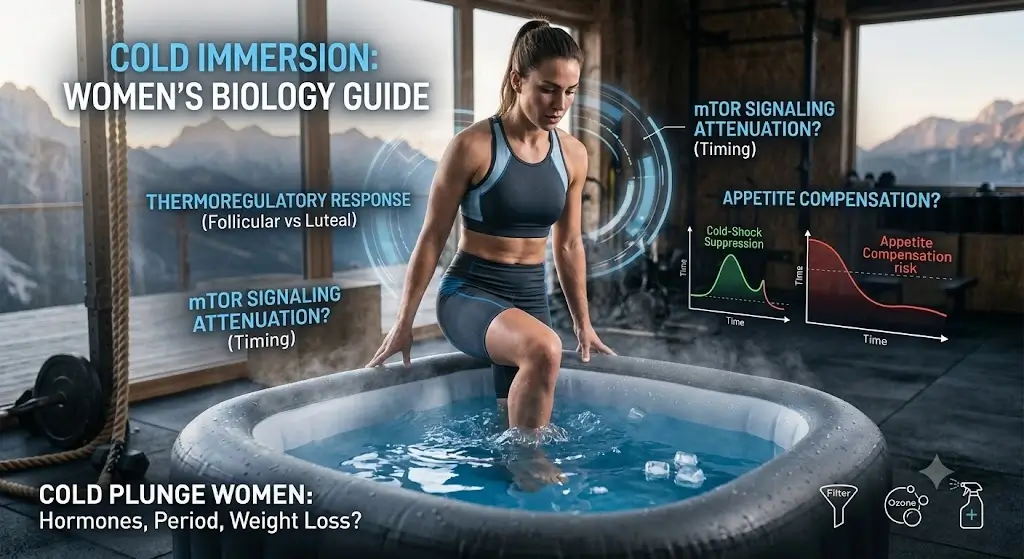
Female Exercise Physiology
Thermoregulation Protocols • 2026
Cold Plunge for Women: Benefits, Safety, Temperature & What to Know
Key Clinical Takeaways: Cold Plunge Protocols for Women
- Physiological Specificity: Women possess higher subcutaneous body fat percentages but lower overall muscle mass and higher surface-area-to-mass ratios, accelerating peripheral heat loss while protecting deep visceral core temperature.
- Recommended Parameters: Beginners achieve optimal neuromuscular recovery at 52°F to 60°F (11°C–15.5°C) for 1 to 3 minutes; temperatures below 45°F elevate autonomic shock without delivering additional recovery gain.
- Menstrual Cycle Interactions: Basal body temperatures shift by approximately 0.5°F to 0.9°F between the follicular and luteal phases, making cold immersion feel subjectively more intense during late luteal progesterone elevations.
- Safety Contraindications: Deliberate cold-water immersion is strictly contraindicated during pregnancy due to uterine vasoconstriction and blood pressure surges; clinical consultation is mandatory.
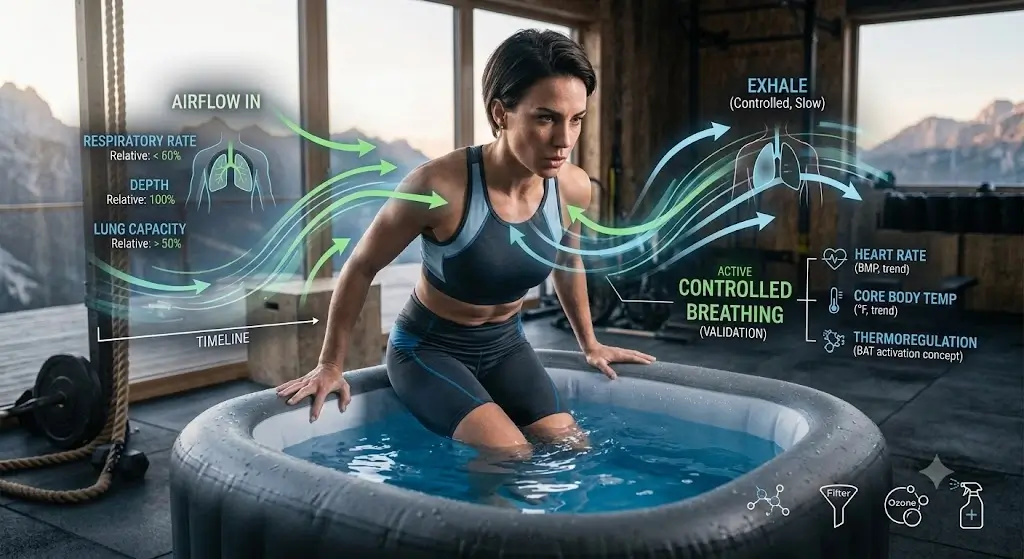
Women can use cold-water immersion, but there is no single “women’s cold plunge” temperature or protocol that applies to everyone. The most useful approach is to treat cold plunging as a controlled exposure that can complement exercise and recovery—not as a required health practice or a shortcut for weight loss.
Cold plunging has moved from niche athletic recovery into mainstream home wellness. Search interest around cold plunge for women raises a more specific question: does cold-water immersion affect women differently, and should women use a different temperature or duration?
The answer is partly straightforward and partly more nuanced.
Cold water triggers well-established physiological responses regardless of sex, including rapid changes in breathing, peripheral blood-vessel constriction and increased heat production.
At the same time, body size, body composition, acclimatization, menstrual-cycle symptoms, pregnancy status, cardiovascular health, training goals and individual cold tolerance can all affect how a person experiences cold immersion.
That means a good protocol should be individualized rather than based on a gender-specific magic number.
Quick Reference Specification: Female Thermoregulatory & Cold Immersion Matrix
Thermoregulatory physiology research indicates that female body composition and cyclical hormonal shifts directly alter cooling kinetics and cold tolerance. The reference table below details verified physiological parameters, evidence-based dosing targets, and safety contraindications across core biological contexts:
| Physiological Context | Target Temperature Window | Exposure Duration | Thermoregulatory Mechanism | Clinical Safety Guidelines |
|---|---|---|---|---|
| Follicular Phase (Days 1–14) | 52°F – 58°F (11.1°C – 14.4°C) | 2 to 4 minutes | Lower baseline body temp; standard cold-shock tolerance | Optimal recovery window for intense training bouts |
| Luteal Phase (Days 15–28) | 55°F – 60°F (12.8°C – 15.6°C) | 1 to 3 minutes | Elevated progesterone increases set-point temp (+0.5°F–0.9°F) | Perceived cold stress increases; reduce thermal strain |
| Active Menstruation | 54°F – 60°F (12.2°C – 15.6°C) | 1 to 2 minutes | Peripheral vasoconstriction; sympathetic arousal | Optional protocol; skip if uterine cramping escalates |
| Post-Resistance Training | Delay 4–6 hours post-lifting | 2 to 3 minutes | Immediate cooling blunts ribosomal p70S6K/mTOR pathways | Separate from lifting to preserve muscle hypertrophy |
| Pregnancy / Postpartum | Contraindicated | Zero immersion | Severe uterine vasoconstriction & maternal blood pressure spikes | Avoid deliberate cold immersion without obstetric clearance |
Is Cold Plunging Good for Women?
Clinical recovery studies demonstrate that female athletes derive comparable delayed-onset muscle soreness reductions from cold immersion as male counterparts. Cold-water immersion can be used by women as a recovery or cold-adaptation practice. The fundamental response to cold is not unique to men.
What is different is that individual responses vary considerably.
A smaller person may cool faster than a larger person under the same conditions. Body composition, the amount of exposed surface area, water temperature, immersion depth and prior acclimatization can all influence heat loss.
This is why copying another person’s exact cold-plunge protocol is not necessarily a good idea.
Women do not need a completely separate cold-plunge system. They do need to account for individual tolerance, training goals, symptoms, health status and circumstances such as pregnancy.
How Cold Water Affects the Female Body
Subcutaneous adipose distribution and higher surface-area-to-mass ratios govern convective heat loss rates across the female frame. Cold-water immersion creates a rapid environmental stressor.
When skin is exposed to cold water, heat is transferred away from the body much more efficiently than it would be in cold air.
The body responds by attempting to preserve core temperature.
| Response | What happens | Why it matters |
|---|---|---|
| Cold shock | Breathing and cardiovascular responses can change rapidly when entering cold water. | The first moments require the greatest attention to controlled breathing and safe positioning. |
| Vasoconstriction | Blood vessels near the skin constrict. | Helps reduce heat loss from the body’s surface. |
| Thermogenesis | The body increases heat production. | Raises metabolic demand during cold exposure. |
| Shivering | Muscle activity produces additional heat. | Indicates increasing thermal stress. |
These responses are normal physiological reactions, not evidence that the body is being “detoxed.”
A cold plunge should therefore be approached as a controlled stressor rather than as a magical wellness treatment.
Potential Benefits of Cold Plunging for Women
Evidence-based wellness trials confirm reduced post-exercise soreness, temporary catecholamine surges, and autonomic nervous system conditioning. The strongest practical reason to consider cold-water immersion is usually recovery, particularly after strenuous exercise.
1. Reduced Perception of Muscle Soreness
Cold-water immersion has been studied as a method for reducing perceived muscle soreness after demanding exercise. This does not mean cold exposure repairs every type of tissue injury, but some people report feeling less sore following immersion.
2. A Controlled Cold-Exposure Stimulus
Cold exposure gives the body a defined environmental challenge. Repeated exposure can produce physiological acclimatization, although adaptation depends on the intensity and frequency of exposure.
3. Potential Recovery Support Between Training Sessions
For women training frequently, the practical value of cold immersion may be whether it helps them feel sufficiently recovered to maintain their normal training schedule. That is a more useful metric than claiming that a plunge “flushes toxins” or “melts fat.”
4. Temporary Alertness
Cold exposure can produce a strong sensory stimulus and temporary alertness. However, individual psychological responses differ, and cold exposure should not be presented as a treatment for depression, anxiety or other medical conditions.
5. Thermogenic Response
Cold exposure increases heat production and energy expenditure. This is a legitimate physiological effect, but it should not be confused with proven long-term weight loss.
Best Cold Plunge Temperature for Women
Moderate water temperatures between fifty and sixty degrees Fahrenheit provide sufficient neuroendocrine stimulus without triggering autonomic shock. There is no scientifically established temperature that is universally “best for women.”
A more useful starting point is to choose a temperature that creates a manageable cold stimulus without turning the session into an endurance contest.
| Water temperature | General interpretation | Practical approach |
|---|---|---|
| 55–60°F | Cool cold exposure | Reasonable range for someone beginning to learn how their body responds. |
| 50–55°F | Moderately cold | Provides a stronger stimulus while remaining manageable for many experienced users. |
| 45–50°F | Cold | Requires more attention to duration and individual tolerance. |
| Below 45°F | Very cold | Greater thermal stress; colder is not automatically better. |
These ranges are not prescriptions. A person’s response depends on the entire exposure—not just the thermometer reading.
Do not use lower water temperature as a measure of toughness. More intense cold exposure creates more physiological stress, not necessarily more benefit.
How Long Should Women Cold Plunge?
Conservative immersion sessions lasting one to three minutes effectively capture therapeutic benefits while avoiding peripheral hypothermia. Duration should be considered together with temperature.
A short exposure in very cold water can create a stronger thermal challenge than a longer exposure in moderately cool water.
For a beginner, a short session is generally more sensible than immediately attempting prolonged immersion.
| Experience | Example approach | Priority |
|---|---|---|
| Beginner | Start with a short exposure in moderately cold water. | Breathing control and safe exit. |
| Intermediate | Gradually adjust temperature or duration. | Consistency without excessive stress. |
| Experienced | Use a repeatable protocol appropriate to the goal. | Avoid unnecessary extremes. |
There is no requirement to remain in cold water until severe shivering occurs. Longer is not automatically better. For an exhaustive clinical analysis of time parameters, consult our guide on how long to cold plunge.
Cold Plunge for Women: Beginner Protocol
Gradual stepwise water entry combined with conscious nasal breathing establishes autonomic control and mitigates hyperventilation gasping. The first few sessions should focus on learning your response rather than chasing an aggressive temperature.
- Measure the water temperature before entering.
- Keep the plunge in a location where you can exit easily.
- Enter slowly enough to maintain control.
- Focus on steady breathing instead of deliberately hyperventilating.
- Keep your head and face out of the water.
- Use a short initial exposure.
- Exit before you become excessively cold or impaired.
- Warm yourself naturally afterward.
The objective of a beginner session is not to prove how long you can tolerate cold. The objective is to learn how your body responds while maintaining complete control of the situation.
Cold Plunge for Women’s Exercise Recovery
Post-workout immersion accelerates systemic clearance of metabolic fatigue markers following high-volume running and endurance training. Cold-water immersion is particularly relevant to women who participate in running, cycling, team sports, endurance training or high-volume exercise.
After strenuous exercise, muscle soreness can become a limiting factor.
Cold-water immersion may reduce the perception of soreness for some people.
However, the best timing depends on the training objective. If the primary objective is rapid recovery between demanding events, cold immersion may have a different role than if the primary objective is maximizing muscle growth from resistance training.
Cold Plunge and Strength Training
Immediate post-lift cold exposure attenuates anabolic signaling cascades and blunts long-term muscular hypertrophy gains. This is an important consideration for women who lift weights.
Resistance training creates signals that help the body adapt to the training stimulus. Frequent immediate cold-water immersion after resistance exercise has been investigated because cooling may alter some of the signaling and inflammatory processes involved in adaptation.
Research suggests that habitual immediate post-exercise cold immersion may attenuate some aspects of training adaptation under certain conditions. If your goal is preserving or building lean muscle mass, check our detailed timing guide: Cold Plunge Before or After Workout? Recovery, Strength & Timing Explained.
If maximizing strength or muscle adaptation is the priority, it may make sense not to automatically use an intense cold plunge immediately after every resistance-training session.
Can Women Cold Plunge During Their Period?
Menstruation presents no physiological contraindication to cold water therapy provided individual comfort levels remain manageable. Menstruation by itself does not create a universal rule that women must avoid cold-water immersion.
However, comfort and individual symptoms matter.
Some people experience significant cramps, fatigue, headaches, dizziness or changes in exercise tolerance during menstruation. If cold exposure makes those symptoms worse, there is little reason to force a session.
A cold plunge is an optional recovery practice. Missing a session does not undermine fitness progress.
Cold Plunge and the Menstrual Cycle
Luteal phase progesterone surges elevate baseline core temperature and increase subjective perception of cold discomfort. Hormonal fluctuations across the menstrual cycle can influence thermoregulation and perceived temperature. This is one reason women may notice that the same cold-water temperature feels different at different times.
However, the available evidence does not justify a universal protocol such as:
- “Use this temperature during the follicular phase.”
- “Avoid all cold exposure during the luteal phase.”
- “Cold plunging balances female hormones.”
Those statements go beyond what current evidence can confidently establish. A better approach is to monitor personal tolerance and adjust the exposure when symptoms or recovery needs change.
Cold Plunge During Pregnancy
Severe maternal vasoconstriction and rapid blood pressure elevations create substantial clinical risks during pregnancy. Pregnancy requires a different level of caution.
A cold plunge should not be treated as a routine wellness intervention during pregnancy without appropriate medical guidance.
Pregnancy changes cardiovascular physiology, thermoregulation and other systems, and safety data for deliberate cold-water immersion during pregnancy are limited compared with general adult populations.
The same cautious approach applies to people with medical conditions that could make sudden cold exposure hazardous.
Cold Plunge for Women’s Weight Loss
Thermogenic brown fat activation produces negligible net caloric burn that cannot replace sustained dietary caloric deficits. Cold exposure can increase energy expenditure because the body must produce heat. Cold exposure can also activate brown adipose tissue.
But neither fact establishes cold plunging as a reliable standalone method for losing body fat. For a deeper breakdown of thermogenesis versus sustainable fat loss, read our complete analysis on Cold Plunge Weight Loss: Does an Ice Bath Help You Lose Fat?.
| Statement | Evidence interpretation |
|---|---|
| Cold exposure increases thermogenesis. | Supported. |
| Cold exposure can increase energy expenditure. | Supported. |
| Cold exposure activates brown fat. | Supported. |
| Cold plunges reliably produce major long-term fat loss. | Not established. |
| Cold plunging can replace exercise for weight loss. | No. |
For body-composition goals, nutrition, physical activity, resistance training and sustainable recovery habits remain substantially more important.
Cold Plunge, Stress and Sleep
Pre-bedtime cold plunges can disrupt sleep architecture if late-evening catecholamine spikes prevent core circadian cooling. Cold exposure is sometimes promoted as a solution for sleep or stress. The physiological response to cold is real, but individual reactions vary.
Some people find a structured recovery routine relaxing after the initial cold stimulus, while others find cold exposure stimulating or uncomfortable.
Therefore, there is no reason to assume that a cold plunge automatically improves sleep for every woman. If sleep is the objective, personal response should determine whether the practice belongs earlier or later in the day.
Does Cold Plunging Affect Female Hormones?
Peer-reviewed endocrinology literature refutes commercial assertions that cold-water baths balance circulating estrogen and progesterone. This is one of the most overused claims in women’s wellness content.
Cold exposure clearly activates the sympathetic nervous system and produces acute physiological changes. That does not mean a cold plunge has been demonstrated to “balance hormones,” “reset estrogen” or normalize the menstrual cycle.
Cold plunging creates measurable acute physiological responses, but evidence is insufficient to claim that routine cold-water immersion universally balances female hormones or regulates the menstrual cycle.
Cold Plunge vs Sauna for Women
Sauna hyperthermia triggers whole-body peripheral vasodilation whereas cold plunging induces intense cutaneous vasoconstriction. Women interested in home recovery equipment often compare cold plunges with saunas. They should not be treated as interchangeable technologies.
| Feature | Cold plunge | Sauna |
|---|---|---|
| Primary stimulus | Cold exposure | Heat exposure |
| Thermoregulatory direction | Body works to conserve and produce heat | Body works to dissipate heat |
| Typical use case | Recovery, cold adaptation | Heat exposure, relaxation, recovery |
| Immediate cardiovascular response | Cold shock and vasoconstriction | Heat-related cardiovascular strain and vasodilation |
| Weight-loss role | Not established as a standalone fat-loss tool | Not established as a standalone fat-loss tool |
The better choice depends on what you want the equipment to accomplish.
Cold Plunge Safety for Women
Uncontrolled hyperventilation gasping and rapid cardiovascular spikes demand strict water-exit protocols and adult supervision. Cold-water immersion is not risk-free. The initial entry can produce a rapid cold-shock response involving breathing, heart rate and blood pressure. This is why the first priority should always be control and safe exit—not achieving the lowest possible water temperature.
Keep Your Head Above Water
A cold plunge does not require underwater exposure. Keeping the head and face out of the water reduces unnecessary risk while still providing substantial cold exposure to the body.
Avoid Breath-Holding Challenges
Do not combine deliberate hyperventilation or prolonged breath holding with cold-water immersion. A sudden loss of consciousness in water can turn a wellness practice into an emergency.
Do Not Chase Extreme Temperatures
Very cold water is not automatically more beneficial. Increasing intensity also increases physiological stress.
Know When to Stop
Exit if you become confused, unusually weak, dizzy, excessively numb or otherwise unable to safely control the situation.
People with cardiovascular disease, significant blood-pressure problems, circulation disorders or other conditions that could make sudden cold exposure hazardous should obtain appropriate medical advice before beginning cold-water immersion.
Choosing a Cold Plunge for Home Use
Home installation planning requires verifying internal tub ergonomics, active chiller capacities, and electrical safety ratings. For women setting up a cold plunge at home, the most important specifications are not simply the lowest advertised temperature. Look at the entire system.
| Specification | Why it matters |
|---|---|
| Internal dimensions | Determines whether the tub accommodates your body comfortably. |
| Water capacity | Affects cooling time, sanitation and water consumption. |
| Insulation | Reduces heat gain from the surrounding environment. |
| Chiller capacity | Determines how effectively the system can maintain target water temperature. |
| Filtration | Helps remove suspended particles from recirculated water. |
| Sanitation | Important for maintaining water quality between changes. |
| Electrical requirements | Important when installing a powered chiller indoors or outdoors. |
| Drainage | Makes maintenance substantially easier. |
| Cover | Reduces debris entry and heat transfer when the plunge is not being used. |
For an outdoor installation, also consider freezing weather, direct sunlight, rain exposure and the location of the electrical connection.
Portable vs Hard-Shell Cold Plunge for Women
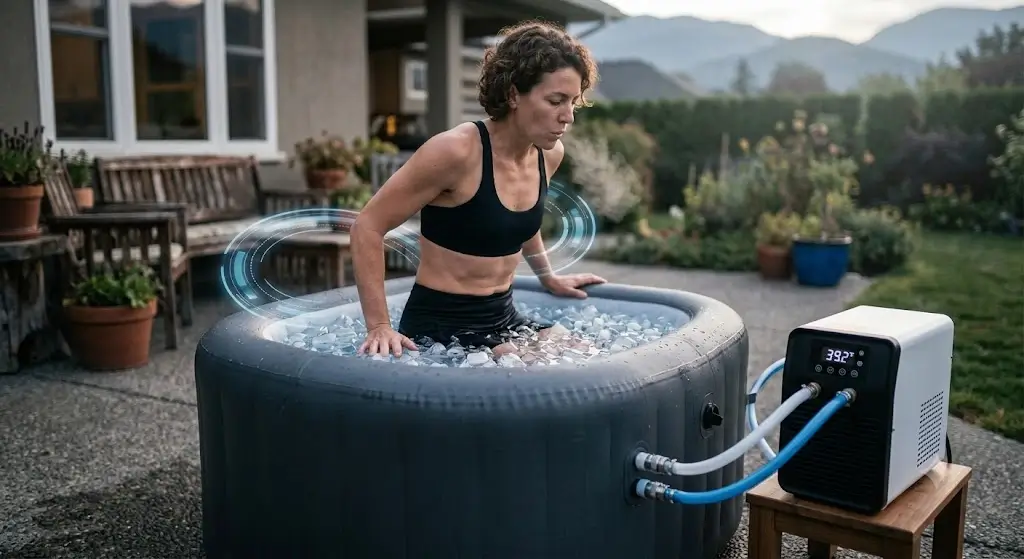
Lightweight inflatable barrels offer compact step-in heights while rigid hard-shell tubs deliver permanent insulated refrigeration loops. A portable tub can be attractive for renters, small homes or people who want to test cold-water immersion before investing in a permanent system. If you are exploring budget-friendly portable options, check out our tested picks for the best inflatable ice bath tubs under $150.
| Type | Best suited for | Main trade-off |
|---|---|---|
| Inflatable | Beginners, renters, lower initial cost | Less rigid and often requires separate cooling equipment. |
| Drop-stitch | Portable setups requiring more structural support | Still needs careful setup and maintenance. |
| Hard-shell | Dedicated home recovery spaces | Higher cost and less portability. |
| Integrated chiller tub | Users wanting automated temperature control | Higher purchase price and electrical requirements. |
Frequently Asked Questions
Clinical sports medicine answers clarify common questions regarding menstrual phases, pregnancy contraindications, and beginner water temperatures. Key answers are detailed below:
Is cold plunging good for women?
Women can use cold-water immersion, and the core physiological response to cold is not fundamentally sex-specific. Potential uses include exercise recovery and cold adaptation, but cold plunging should not be treated as a cure-all.
What temperature should women use for a cold plunge?
There is no universal female-specific temperature. Beginners can start with moderately cold water and gradually adjust based on individual tolerance rather than immediately using extremely cold water.
How long should a woman stay in a cold plunge?
There is no universal duration. Beginners should use shorter exposures and prioritize controlled breathing and a safe exit. Duration should always be considered alongside water temperature.
Can women cold plunge during their period?
Menstruation itself does not establish a universal prohibition against cold-water immersion. Individual symptoms, comfort and medical circumstances should determine whether a session makes sense.
Can cold plunging affect the menstrual cycle?
There is not enough evidence to claim that routine cold plunging universally regulates or disrupts the menstrual cycle. Individual experiences may vary.
Can women cold plunge while pregnant?
Pregnancy requires additional caution because cardiovascular and thermoregulatory physiology changes. Women who are pregnant should discuss deliberate cold-water immersion with their healthcare professional before using a cold plunge.
Can cold plunging help women lose weight?
Cold exposure increases thermogenesis and energy expenditure, but it is not established as a reliable standalone method for meaningful long-term body-fat loss.
Should women cold plunge after strength training?
Cold immersion may reduce perceived soreness, but frequent immediate use after resistance training may interfere with some training adaptations. If muscle growth is the primary goal, timing deserves consideration.
Is 50°F too cold for a beginner?
It can be a substantial cold stimulus for someone who is not acclimatized. Beginners do not need to start at an aggressive temperature, and a warmer starting point can make it easier to learn breathing and tolerance.
Is cold plunging better than sauna for women?
Neither is universally better. They create opposite thermal stresses and can serve different purposes. The appropriate choice depends on the individual’s goals, tolerance and health circumstances.
Bottom Line: Cold Plunge for Women
Personalized thermal dosing based on individual cooling rates and training goals outperforms rigid gender-specific wellness prescriptions. Cold plunging can be a legitimate recovery and cold-exposure practice for women.
The strongest case is not that cold water “balances hormones,” “melts fat” or produces universal health benefits.
The stronger case is much simpler:
Women do not need to chase extreme temperatures or copy a male athlete’s protocol. A sensible approach is to begin conservatively, learn your individual response, match the protocol to your training goal and treat the plunge as an optional component of a broader recovery routine.
For women who are pregnant, have cardiovascular concerns or have another condition that could make sudden cold exposure problematic, medical guidance should come before experimentation.
Continue Your Cold Plunge Research
If you are choosing a home system, the next question is usually temperature. See our Cold Plunge Fundamentals & Temperature Guide to understand how water temperature changes the intensity of cold-water immersion and how beginners can choose a sensible starting point.
Editorial Standards
BioHackTub enforces strict physiological evidence standards to dismantle commercial wellness myths regarding female endocrine function. We separate established physiological mechanisms from stronger claims about long-term health outcomes. We do not treat temporary metabolic changes, subjective recovery or wellness anecdotes as proof of disease treatment or guaranteed body-composition changes.
This article is educational and does not provide individualized medical advice, diagnosis or treatment.
