
What Is a Sauna? How It Works, Types, Temperature, Benefits & Safety
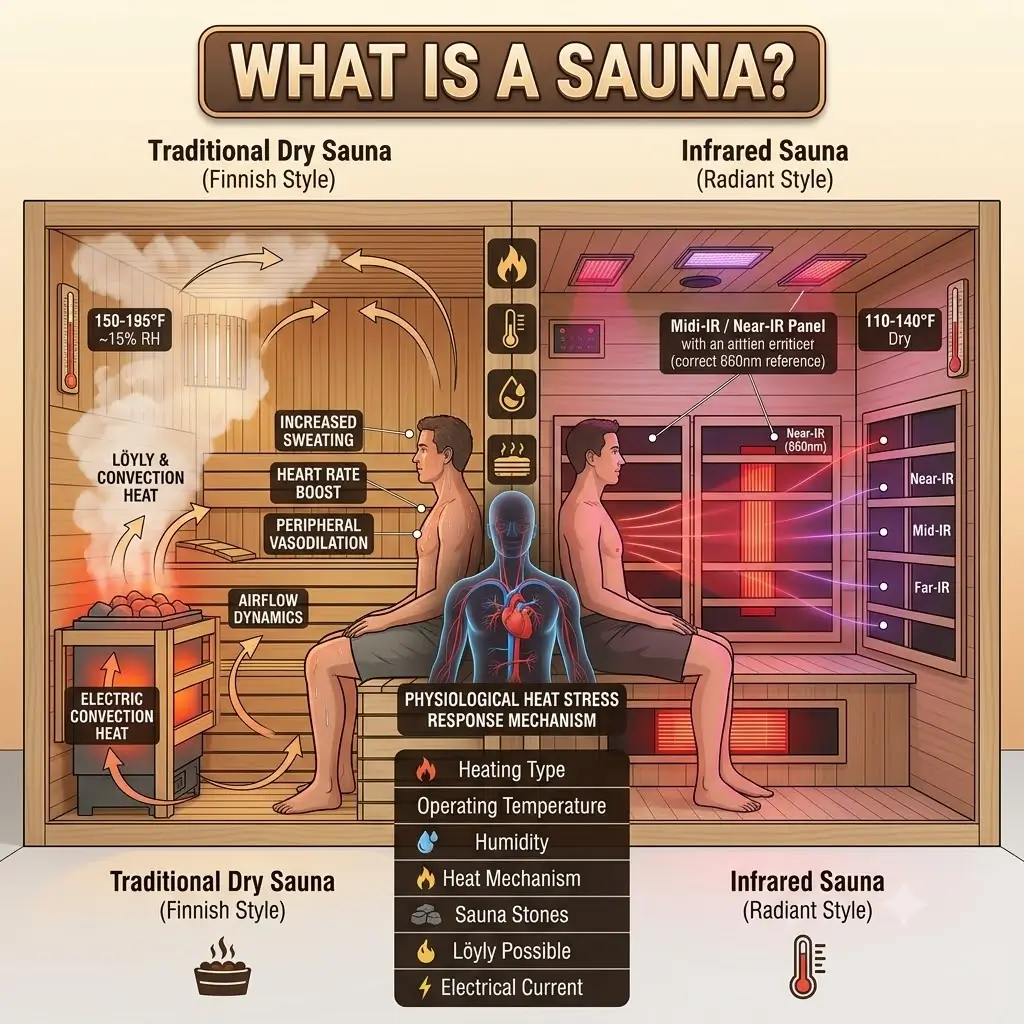
A sauna is a heated room or enclosure designed to expose the body to elevated temperatures. Traditional saunas primarily create heat by warming the surrounding air and surfaces, while infrared saunas use infrared emitters to provide radiant heat at lower ambient temperatures.
The word “sauna” covers several different designs, so temperature alone does not define the technology. Heater type, heat-transfer mechanism, humidity, cabin construction, ventilation and electrical requirements all affect how a sauna operates.
Quick Reference Specification: Sauna Thermal Classification & Engineering Metrics
Thermal enclosure engineering classifies saunas by thermodynamic transfer mode, operational temperature ranges, and relative humidity limits. The benchmark matrix below synthesizes core thermodynamic mechanisms, electrical power demands, and physiological stress profiles across primary heat formats:
| Sauna Classification | Thermodynamic Heat Transfer | Operating Temperature | Relative Humidity (RH) | Typical Electrical Demand |
|---|---|---|---|---|
| Traditional Finnish Dry Sauna | Ambient convection & rock conduction | 150°F – 195°F (65°C – 90°C) | 10% – 20% (Spikes via löyly) | 240V / 30A–50A (4.5–9.0 kW) |
| Far-Infrared Radiant Cabin | Direct radiant electromagnetic waves (FIR) | 110°F – 140°F (43°C – 60°C) | Ambient room RH (< 15%) | 120V / 15A–20A (1.5–2.4 kW) |
| Full-Spectrum Infrared Cabin | Multi-wavelength radiant bands (NIR/MIR/FIR) | 115°F – 150°F (46°C – 65°C) | Ambient room RH (< 15%) | 120V/20A or 240V/15A (2.0–3.5 kW) |
| Commercial / Home Steam Room | Latent heat transfer via boiled steam vapor | 100°F – 120°F (38°C – 49°C) | 100% Saturation (Vapor phase) | 240V / 30A–40A Dedicated Generator |
Technical Snapshot: What Defines a Sauna?
- Core Definition: A controlled thermal enclosure engineering hyperthermic exposure through ambient convective/conductive heat transfer (traditional) or direct radiant electromagnetic emission (infrared).
- Operating Temperatures: Traditional dry cabins stabilize at 150°F to 195°F (~10–20% RH); Infrared saunas run at 110°F to 140°F (dry); Steam rooms operate at 100°F to 120°F (near 100% RH).
- Primary Physiological Biomarkers: Transient elevation in core body temperature, cutaneous peripheral vasodilation, elevated heart rate (mimicking light-to-moderate cardiovascular stress), and active homeostatic fluid transpiration.
- Detox & Weight Loss Reality: Induces rapid post-session fluid and electrolyte reduction; does not directly cause immediate adipose lipolysis. Primary systemic detox remains regulated by the liver and kidneys.
Short answer:
A sauna is a controlled heat environment used for bathing, relaxation and heat exposure. A traditional Finnish-style sauna typically uses a heater and sauna stones to create a very hot, relatively dry cabin. An infrared sauna uses radiant infrared emitters and usually operates at a lower air temperature. Both create physiological heat stress, but they are not identical experiences.
What Is a Sauna?
A sauna functions as a purpose-built thermal chamber designed to induce controlled hyperthermia and active physiological transpiration. It intentionally elevates environmental conditions above normal room temperature so that the body is exposed to sustained thermal stress.
Traditional sauna bathing has deep roots in Finland and other Nordic countries, where saunas have historically been used for bathing, relaxation and social activities.
Modern residential saunas range from small prefabricated cabins featured in our best home infrared saunas guide to custom-built outdoor cabins.
The defining feature is controlled heat exposure. The specific method used to create that heat determines the type of sauna.
How Does a Sauna Work?
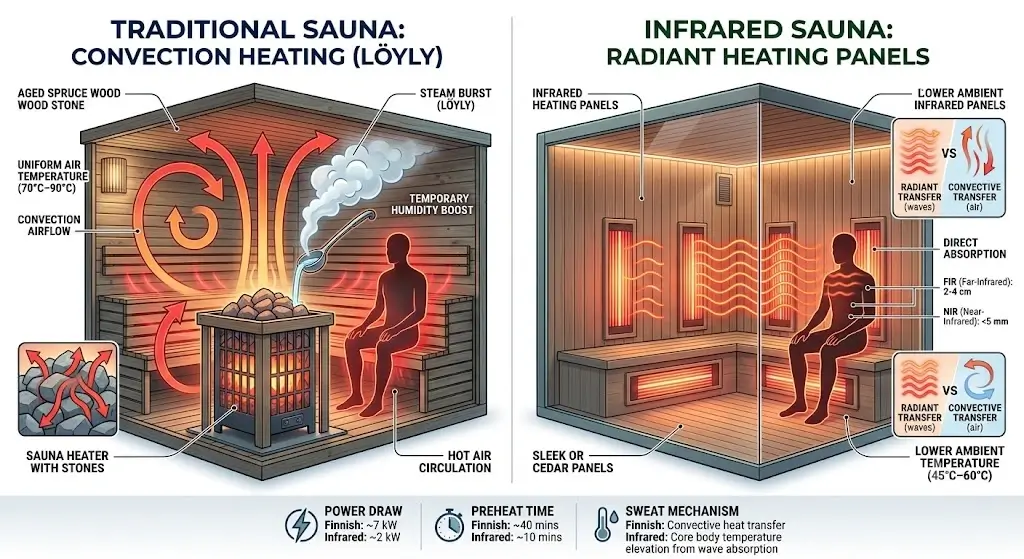
Heater elements transfer thermal energy into human tissue through convective air circulation or direct infrared electromagnetic radiation. A sauna works by moving heat from a central heating system to the surrounding environment and ultimately to the user’s body.
In a conventional sauna, the heater raises the temperature of the air, stones, walls and benches. The body then gains heat through a combination of convection, radiation and contact with warm surfaces.
An infrared sauna works differently. Infrared emitters produce radiant energy that travels through the cabin and is absorbed directly by surfaces, including the body.
Once the body absorbs enough heat to raise its temperature, thermoregulation begins.
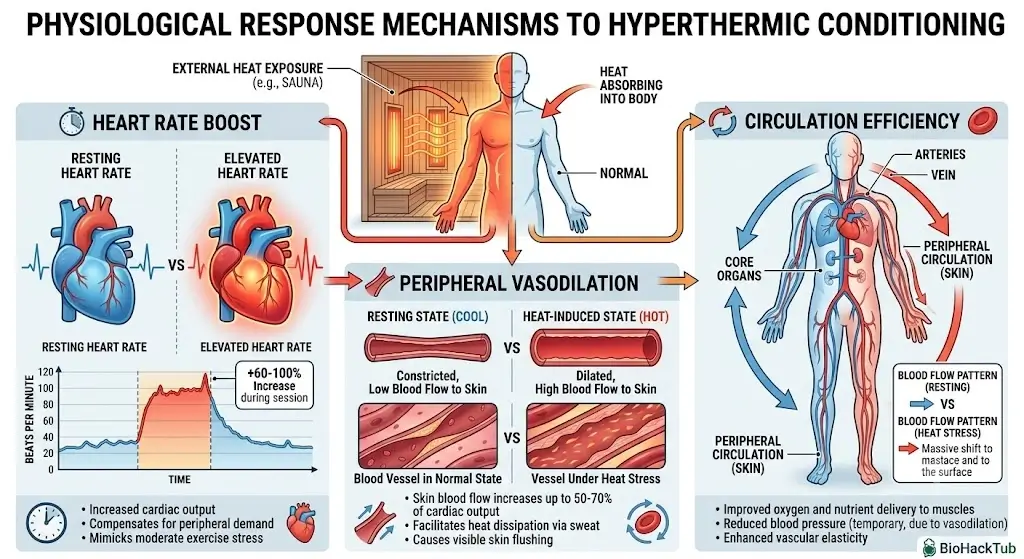
Blood flow to the skin increases, sweating becomes more active and the cardiovascular system adjusts to help move heat toward the skin.
What Happens to Your Body in a Sauna?
Acute hyperthermic exposure triggers profound cutaneous vasodilation, elevated heart rates, and active eccrine sweat excretion. The human body continuously attempts to keep its internal temperature within a narrow physiological range.
When exposed to a hot sauna, heat enters the body faster than it would under normal indoor conditions.
The body responds through several physiological mechanisms:
- Skin blood flow increases. Blood vessels near the skin dilate, allowing more blood to reach the body’s surface.
- Sweating increases. Sweat evaporating from the skin helps dissipate heat.
- Heart rate rises. The cardiovascular system works harder to circulate blood while supporting heat transfer.
- Core temperature increases. The magnitude depends on temperature, duration, humidity, radiant exposure and individual factors.
- Fluid is lost. Sweating removes water and electrolytes from the body.
Important distinction:
These are normal physiological responses to heat. They do not automatically prove that a sauna will produce a specific long-term health outcome for every person. Review our full breakdown on infrared sauna benefits to see what clinical trials actually support.
How Hot Is a Sauna?
Operating cabin temperatures span from one hundred and ten degrees Fahrenheit in radiant booths to nearly two hundred degrees in dry stone saunas. There is no single universal sauna temperature.
Traditional dry saunas are generally much hotter than infrared cabins because they heat the surrounding air to a high temperature.
| Heat environment | Typical temperature range | Humidity characteristics |
|---|---|---|
| Traditional dry sauna | Approximately 150–195°F | Generally low; temporary humidity increase possible from water on stones |
| Infrared sauna | Often approximately 110–140°F | Generally low |
| Steam room | Typically 100–120°F | Very high humidity (near 100%) |
These ranges are useful for understanding the categories, not universal specifications. Individual products can operate outside these ranges.
Why Is a Sauna So Hot?
Sustained high ambient temperatures overcome basal heat dissipation to activate therapeutic heat-shock protein pathways. The purpose of sauna heat is not simply to make the room uncomfortable.
The high temperature creates a controlled thermal challenge.
When environmental heat exceeds the body’s ability to dissipate heat through normal mechanisms, skin temperature rises and the body increases its thermoregulatory response.
Traditional sauna temperatures are particularly high because the experience is based largely on heating the surrounding environment.
Infrared systems can operate at lower air temperatures because radiant energy contributes directly to the thermal load.
What Is a Traditional Sauna?
Traditional Finnish saunas utilize electric or wood-burning rock heaters to warm ambient air through natural convection. A traditional sauna is the classic sauna format most closely associated with Nordic bathing rituals.
A conventional electric sauna typically contains:
- An electric sauna heater.
- Sauna stones.
- Wooden benches.
- Insulated walls and ceiling.
- Ventilation openings.
- A sauna control system.
The heater raises the temperature of the cabin. Water can be poured over the heated stones to produce a short-lived burst of steam and increase humidity.
This practice is called löyly in Finnish sauna culture.
What Is an Infrared Sauna?
Infrared saunas emit specific radiant electromagnetic light wavelengths to directly heat body tissue at lower ambient temperatures. Rather than relying primarily on hot air, the emitters generate infrared radiation that travels toward the body and other surfaces.
Because the cabin does not need to reach the same ambient temperature as a conventional sauna, infrared systems generally operate at lower air temperatures.
This can make infrared saunas attractive to people who dislike extremely hot air.
It also creates a different experience from a traditional sauna rather than simply a cooler version of the same technology.
What Are the Main Types of Saunas?
Sauna technologies categorize into electric rock cabins, wood-fired stoves, radiant infrared enclosures, and wet steam rooms. The operational differences across primary categories are structured below:
| Type | How it produces heat | Typical characteristic |
|---|---|---|
| Electric traditional sauna | Electric sauna heater | High-temperature cabin |
| Wood-burning sauna | Wood-fired stove | Traditional experience; requires combustion and chimney planning |
| Infrared sauna | Infrared emitters | Lower ambient temperature; radiant heating |
| Full-spectrum infrared | Multiple infrared emitter types | Designed to cover different infrared wavelength ranges |
| Outdoor sauna | Electric or wood-burning heater | Designed for exterior installation |
| Portable sauna | Usually compact electric heating system | Small footprint and easier storage |
Dry Sauna vs Infrared Sauna
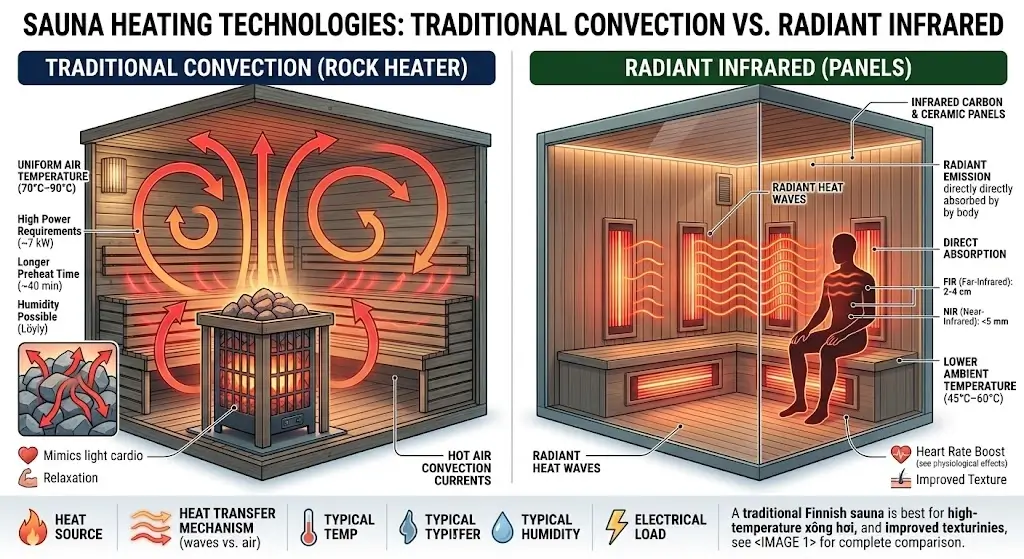
Convective dry cabins heat ambient air with hot rocks while infrared cabins utilize radiant carbon or ceramic panels. The most important difference between these two popular residential categories is how heat is delivered.
| Feature | Dry/Traditional Sauna | Infrared Sauna |
|---|---|---|
| Primary heating method | Heats air and cabin surfaces | Radiant infrared heating |
| Typical ambient temperature | Higher | Lower |
| Sauna stones | Common | Usually absent |
| Water on stones | Possible on appropriate heaters | Generally not applicable |
| Electrical demand | Often higher | Often lower |
| Classic sauna experience | Yes | No; different heat experience |
| Research base | More extensive | Smaller |
Sauna vs Steam Room: What Is the Difference?
Steam rooms maintain one hundred percent humidity at lower temperatures while dry saunas sustain low moisture levels at higher heat. A sauna and a steam room both expose the body to heat, but their environmental conditions are very different.
A traditional sauna uses high air temperature with relatively low humidity.
A steam room uses a steam generator to produce a highly humid environment. Because evaporation from the skin is reduced when humidity is very high, the perceived heat can be substantial even though the air temperature is lower than in a dry sauna.
| Feature | Sauna | Steam Room |
|---|---|---|
| Air temperature | High | Lower |
| Humidity | Generally low | Very high |
| Heating system | Sauna heater or infrared emitters | Steam generator |
| Typical materials | Wood is common | Water-resistant surfaces are required |
A steam room is therefore not simply a “wet sauna.”
What Is Sauna Humidity and Löyly?
Water vaporizing over heated stones creates a transient wave of humid steam known traditionally as löyly. Humidity refers to the amount of water vapor in the air. Traditional saunas are generally described as dry because their relative humidity is much lower than that of a steam room.
However, dry does not mean zero humidity.
When water contacts hot sauna stones, some of the water vaporizes and temporarily increases humidity. Löyly is the Finnish term associated with this wave of hot steam.
The resulting steam briefly increases perceived heat and changes how the environment feels on the skin, distinguishing Finnish sauna bathing from infrared cabins.
What Are the Potential Benefits of Sauna Use?
Regular hyperthermic bathing supports cardiovascular conditioning, reduces muscle stiffness, and promotes autonomic relaxation. Research on sauna bathing has examined several areas of human health and physiology. The strongest general conclusion is that sauna exposure produces a measurable cardiovascular and heat-stress response.
1. Relaxation
Many people find sauna bathing relaxing because it provides a quiet, warm environment and can be incorporated into a broader recovery routine.
2. Increased sweating
Sweating is one of the body’s main mechanisms for releasing heat and maintaining thermal equilibrium.
3. Cardiovascular response
Heat exposure increases skin blood flow and elevated heart rate as the cardiovascular system works to dissipate thermal load.
4. Temporary muscle relaxation
Warm environments can feel soothing to muscles and joints, helping relieve perceived stiffness after athletic training.
5. Stress reduction
For many users, structured sauna sessions offer dedicated screen-free time that supports mental relaxation and subjective stress reduction.
What Does Sauna Research Actually Show?
Long-term observational studies associate frequent sauna bathing with improved cardiovascular markers and reduced all-cause mortality. Sauna research needs to be interpreted carefully because different studies use different sauna temperatures, session durations, populations and outcome measurements.
Traditional Finnish sauna bathing has a particularly substantial research literature.
Some large observational studies have reported associations between more frequent sauna use and lower rates of certain cardiovascular and mortality events.
However, people who use saunas frequently may differ from infrequent users in other ways, including exercise habits, socioeconomic factors, lifestyle and health status.
Evidence rule:
A study showing that frequent sauna users have better health outcomes does not automatically prove that the sauna itself caused those outcomes. Observational associations and randomized clinical trials answer different scientific questions.
Common Myths: Detox and Weight Loss
Post-session scale weight drops represent transient fluid losses rather than genuine adipose tissue reduction. Many marketing claims confuse fluid shifts with metabolic adaptations:
Does Sauna Detox Your Body?
The body already has highly specialized systems for processing and eliminating waste, particularly the liver and kidneys. Sauna sweating primarily regulates body temperature, not full-body medical detoxification.
Does Sauna Help With Weight Loss?
A sauna can cause the scale to move temporarily due to fluid loss through sweating. After rehydration, that weight is restored. Sauna use is not a direct substitute for caloric expenditure or dietary fat reduction.
| Effect | Interpretation |
|---|---|
| Heavy sweating | Thermoregulatory heat defense |
| Lower scale weight immediately after session | Temporary water and electrolyte loss |
| Weight restored after hydration | Normal fluid replacement |
| Sustained body fat loss | Requires long-term caloric balance and physical activity |
How to Use a Sauna: Beginner Guidelines
Beginners should limit initial thermal sessions to ten or fifteen minutes to assess cardiovascular tolerance safely. Follow the step-by-step acclimation procedure below:
- Start conservatively. Choose a moderate temperature and limit your initial sessions to 10–15 minutes.
- Hydrate appropriately. Drink water before entering and avoid starting a session while dehydrated.
- Pay attention to symptoms. Exit immediately if you experience dizziness, lightheadedness, or nausea.
- Cool down gradually. Allow your heart rate and body temperature to return to baseline before showering or cold plunging.
- Replace fluids. Rehydrate with water and electrolytes following heavy sweat sessions.
When Should You Avoid Sauna Use?
Unstable cardiovascular disease, active febrile infections, and alcohol consumption represent strict contraindications to sauna bathing. Heat exposure is not appropriate in every situation.
Use extra caution and consult a physician when:
- You are significantly dehydrated or fatigued.
- You have an active fever or acute infection.
- You are under the influence of alcohol or sedatives.
- You have unstable cardiovascular conditions or severe blood-pressure dysregulation.
- You are pregnant or taking medications that impair sweating or thermoregulation.
Planning a Home Sauna Installation
Residential installation requires evaluating dedicated electrical circuits, subfloor moisture protection, and room ventilation pathways. Key infrastructure items to evaluate include:
- Flooring Suitability: Ensure the subfloor is level and protected from moisture. Review our guide on placing saunas on hardwood or carpet floors.
- Electrical Infrastructure: Confirm voltage and breaker requirements. Consult our sauna electrical requirements (120V vs 240V) guide.
- Operating Costs: Estimate utility expenses using our breakdown on sauna electricity running costs.
- Ventilation & Clearances: Ensure proper air intake and exhaust to maintain air quality and prevent heat trapping.

Frequently Asked Questions
Authoritative technical answers clarify common inquiries regarding operating temperatures, fat loss, and electrical requirements. Key answers are outlined below:
What exactly is a sauna?
A sauna is a heated room or enclosure designed for controlled exposure to elevated temperatures. Traditional saunas heat the surrounding environment, while infrared saunas use radiant infrared energy.
How hot does a sauna get?
Traditional dry saunas commonly operate around 150–195°F, although actual settings vary. Infrared saunas generally operate at lower ambient temperatures, often around 110–140°F.
Is a sauna the same as a steam room?
No. A traditional sauna generally uses high temperature and relatively low humidity. A steam room uses very high humidity and lower air temperature.
What is the difference between dry and wet sauna?
A traditional sauna is generally a relatively dry heat environment. Water can be added to sauna stones to temporarily increase humidity. A steam room continuously generates high humidity and is technically a different environment.
Does sauna make you sweat?
Yes. Sweating is a major thermoregulatory response to sauna heat.
Does sweating in a sauna burn fat?
Not directly. Sweating mainly causes temporary fluid loss. Meaningful fat loss depends on long-term energy balance.
Is infrared sauna better than traditional sauna?
Neither is universally better. Traditional sauna is the stronger choice for high-temperature sauna bathing, while infrared can be attractive for people who prefer lower ambient temperatures and radiant heat.
Can a sauna help you relax?
Many people find sauna bathing relaxing. The warm environment, quiet setting and routine can contribute to subjective relaxation.
Can I put a sauna in my house?
Yes, many saunas are designed for residential use. The installation must account for available space, flooring, ventilation, electrical requirements, heat clearance and the manufacturer’s specifications.
Does a sauna require a special electrical circuit?
Some do and some do not. Electrical requirements depend on the specific heater or sauna. Always use the manufacturer’s stated voltage, amperage and circuit requirements.
What is the best temperature for a sauna?
There is no universal best temperature. The appropriate setting depends on sauna type, individual tolerance, session duration and the manufacturer’s operating range.
Can you use a sauna every day?
Some people use saunas frequently, but daily use is not required for everyone. Total heat exposure, hydration, tolerance and health status matter more than simply maximizing frequency.
Final Answer: What Is a Sauna?
A sauna represents an engineered thermal exposure environment that stimulates beneficial vascular adaptations and homeostatic sweating. Traditional saunas create that environment primarily by heating air and surrounding surfaces with an electric or wood-burning heater. Infrared saunas use radiant infrared emitters and generally operate at lower ambient temperatures.
The resulting heat causes normal thermoregulatory responses such as increased sweating, skin blood flow and cardiovascular activity.
Sauna bathing has a substantial research history, particularly for traditional Finnish-style sauna use. The evidence supports clear physiological effects and has produced interesting associations with several health outcomes, but marketing claims should not be confused with established medical treatments.
Bottom line:
A sauna is best understood as a controlled heat-exposure system. Traditional dry saunas deliver the classic high-temperature experience; infrared saunas deliver radiant heat at lower ambient temperatures. The right choice depends on your preferred heat experience, home installation constraints and how consistently you can use the system.
Research & Technical Notes
Published medical literature and clinical reviews document cardiovascular, metabolic, and electrical installation baselines:
Heat physiology: Sauna exposure increases thermal load and activates thermoregulatory mechanisms including sweating and increased skin blood flow.
Traditional sauna research: Finnish-style sauna bathing has been studied extensively in observational and physiological research, particularly in relation to cardiovascular outcomes.
Infrared sauna research: Infrared sauna studies exist but are generally smaller and more heterogeneous than the traditional Finnish-sauna literature.
Weight change: Short-term reductions in body weight after sauna exposure are primarily associated with fluid loss and should not be interpreted as equivalent to body-fat loss.
Electrical safety: Residential sauna installations should follow the equipment manufacturer’s electrical specifications and applicable U.S. electrical and building requirements.
Editorial note: This article is educational and does not provide individualized medical advice. Heat tolerance varies substantially between people. Follow the sauna manufacturer’s instructions. People with medical conditions, pregnancy, cardiovascular concerns, blood-pressure concerns or medications that may affect heat tolerance should seek individualized professional guidance before using a sauna.
