

Infrared Sauna Benefits: What Research Actually Supports
Infrared saunas have become a popular home wellness product because they produce substantial heat and sweating without requiring the extremely hot air temperatures associated with many traditional saunas.
The more important question is whether those differences translate into meaningful health benefits. Research has investigated infrared sauna use in areas including cardiovascular function, blood pressure, heart failure, pain, relaxation, exercise recovery and quality of life. Some findings are promising, but the evidence is not equally strong for every claim.
Bottom line:
Infrared sauna exposure has legitimate physiological effects: it raises body temperature, increases sweating, changes skin blood flow and generally raises heart rate. Clinical research also suggests potential benefits for selected cardiovascular and pain-related outcomes. However, many studies are small, protocols vary, and larger controlled trials are needed before infrared sauna can be described as a proven treatment for specific diseases. Mayo Clinic similarly notes that evidence for several proposed health benefits remains preliminary.
Infrared Sauna Benefits at a Glance
| Potential benefit | What the research suggests | Evidence status |
|---|---|---|
| Heat exposure | Raises body temperature and produces sweating. | Well established |
| Cardiovascular response | Heart rate and peripheral circulation increase during heat exposure. | Well established |
| Blood pressure | Some studies report favorable changes. | Promising but limited |
| Heart failure | Selected studies report improvements in some short-term cardiac measures. | Promising; not definitive |
| Pain | Infrared therapies have shown potential for some musculoskeletal pain conditions. | Condition-specific |
| Relaxation | Heat exposure can support subjective relaxation. | Reasonable practical benefit |
| Exercise recovery | Possible benefits have been investigated, but results are mixed. | Uncertain |
| Fat loss | Post-session weight changes primarily reflect fluid loss. | Not a proven fat-loss method |
| Detox | Sweating occurs, but broad detox claims are poorly established. | Overstated by marketing |

1. What Is an Infrared Sauna?
An infrared sauna uses infrared radiation to produce heat rather than relying primarily on hot air to warm the body.
In a conventional sauna, the heater raises the temperature of the surrounding air and surfaces. The body then absorbs heat from that environment.
An infrared sauna uses infrared emitters to deliver radiant energy directly toward the body. Because the surrounding air does not need to become as hot, infrared saunas generally operate at lower ambient temperatures than traditional saunas.
Mayo Clinic describes this difference as one reason infrared saunas may appeal to people who find conventional sauna temperatures difficult to tolerate.
Infrared sauna cabins generally feel less aggressively hot than many traditional Finnish saunas.
Infrared emitters transfer energy toward the body rather than relying only on hot air.
The body responds to the thermal load by activating thermoregulation and sweating.
Heart rate and peripheral blood flow can increase as the body attempts to dissipate heat.
2. How Does Infrared Sauna Heat Affect the Body?
The central biological stimulus is still heat.
When body temperature rises, the cardiovascular system helps move heat from the body’s core toward the skin. Skin blood vessels dilate and sweating increases.
This produces a measurable cardiovascular workload without requiring physical movement.
That does not mean infrared sauna is equivalent to exercise. Exercise places mechanical and metabolic demands on muscles while also challenging cardiovascular capacity. Sauna exposure creates a passive heat stress.
Important distinction:
The fact that infrared sauna produces some physiological responses similar to exercise does not mean sitting in an infrared sauna provides all of the health adaptations produced by exercise.
3. Infrared Sauna and Cardiovascular Health
Cardiovascular effects are among the most researched potential benefits of infrared sauna use.
A systematic review of repeated dry sauna bathing included 40 clinical studies involving 3,855 participants. Twenty-five of those studies used infrared sauna interventions. The review found potential improvements across several health measures but also noted that many studies were small and that only 13 were randomized controlled trials.
This makes cardiovascular health an interesting area, but it also explains why strong claims should be avoided.
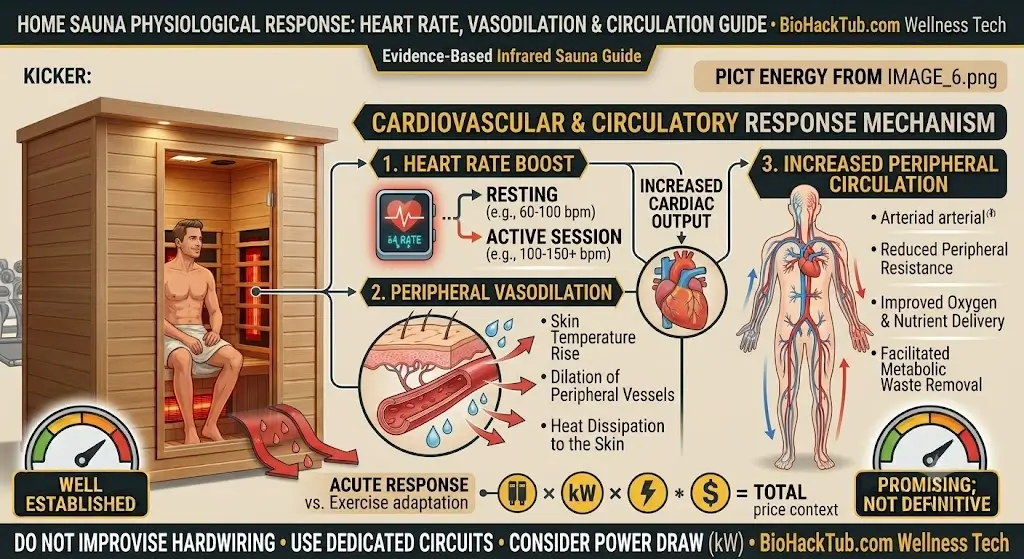
Infrared heat can increase peripheral blood flow and heart rate. Over repeated sessions, researchers have investigated whether these acute responses translate into changes in vascular function or cardiovascular performance.
Why Heat May Affect Circulation
Heat causes peripheral vasodilation. As blood vessels near the skin expand, blood can move toward the surface where heat can be released.
The cardiovascular system compensates for this redistribution by increasing cardiac output and heart rate.
This is one reason infrared sauna exposure can feel physically demanding even though the user is sitting still.
4. Infrared Sauna and Blood Pressure
Blood pressure is another frequently studied outcome.
Heat-induced vasodilation can temporarily reduce vascular resistance. Researchers have therefore investigated whether repeated infrared sauna sessions could contribute to longer-term blood-pressure changes.
The evidence is promising but not definitive.
Earlier far-infrared sauna research reported preliminary support for effects on systolic hypertension, while also emphasizing limitations such as small sample sizes and short study durations.
This means an infrared sauna should not be marketed as a replacement for blood-pressure medication or medical care.
5. Infrared Sauna and Heart Failure Research
Heart failure is one of the more unusual areas of infrared sauna research because some clinical trials have specifically examined infrared heat therapy in people with heart failure.
A systematic review and meta-analysis identified nine studies and found that the included infrared sauna studies were associated with short-term improvements in several cardiac measures, including B-type natriuretic peptide, cardiothoracic ratio and left-ventricular ejection fraction in selected protocols. However, the strength of evidence ranged from moderate to insufficient, and the authors called for additional research on long-term effects.
These findings are scientifically interesting but should not be interpreted as proof that home infrared sauna use treats heart failure.
Important:
People with cardiovascular disease should not assume that because infrared sauna has been studied in clinical populations, every sauna protocol is appropriate for them. Medical supervision and individualized advice may be necessary.
6. Infrared Sauna and Relaxation
Relaxation is one of the most practical reasons to use an infrared sauna.
The combination of warmth, sweating, reduced external stimulation and a predictable routine can make sauna sessions subjectively relaxing.
Unlike claims about disease prevention, this benefit does not require assuming that sauna heat cures a particular condition.
For home users, a sauna can function as a structured recovery or relaxation period, provided the heat exposure is comfortable and safe.
7. Infrared Sauna and Pain
Infrared radiation has been investigated as a complementary approach for several musculoskeletal and chronic-pain conditions.
A systematic review examining infrared radiation for musculoskeletal conditions found reductions in pain measures in several studied conditions, including osteoarthritis and fibromyalgia. However, the authors also found that infrared treatment did not consistently improve muscle recovery after athletic injuries.
This is an important distinction because “infrared therapy” is a broader category than “infrared sauna.” A study using a specific infrared medical device should not automatically be interpreted as evidence for every consumer sauna.
Information Gain:
When evaluating infrared sauna research, check whether the study actually used an infrared sauna cabin, a far-infrared device, a photobiomodulation device or another form of infrared therapy. These technologies are related but are not interchangeable.
8. Infrared Sauna and Exercise Recovery
Heat exposure is commonly included in recovery routines because increased circulation and relaxation may influence how a person feels after exercise.
However, the evidence does not justify saying that infrared sauna dramatically accelerates muscle repair.
The systematic review of dry sauna bathing found some evidence relevant to exercise performance and recovery, but the research base remains heterogeneous.
For athletes, the fundamentals remain more important: adequate sleep, appropriate training load, sufficient nutrition and hydration.
9. Does Infrared Sauna Help With Weight Loss?
Infrared sauna marketing frequently connects sweating with weight loss.
The immediate scale change after a hot sauna session primarily reflects fluid loss.
Sweating more does not mean that the body has lost the same amount of stored fat.
| What happens | What it means |
|---|---|
| Body temperature rises | The body increases heat-dissipation mechanisms. |
| You sweat | Water and electrolytes are lost. |
| Scale weight falls temporarily | Mostly a fluid effect. |
| You rehydrate | Much of the temporary weight change returns. |
There is not enough evidence to present infrared sauna as a meaningful standalone fat-loss intervention.
10. Does Infrared Sauna Detox the Body?
“Detox” is one of the most common terms used in sauna marketing and one of the easiest to overstate.
Sweating is primarily a mechanism for controlling body temperature.
Sweat contains water, sodium and other substances, but that does not mean that increasing sweat production broadly cleanses the body.
The liver and kidneys perform major roles in processing and eliminating many substances from the body.
Evidence-based conclusion:
Infrared sauna can make you sweat. That is established. Claims that infrared sauna provides a broad “detox” treatment for unspecified toxins are not established to the same standard.
11. Infrared Sauna and Skin
Heat increases blood flow to the skin and causes sweating, so it is reasonable for users to notice temporary changes in skin warmth and moisture.
However, this should not automatically be translated into claims that infrared sauna reverses aging, clears every skin condition or removes toxins through the skin.
The systematic review of dry sauna bathing reported potential effects on skin moisture-barrier properties, but evidence remains insufficient to make broad dermatological claims.
12. Infrared Sauna and Sleep
Many sauna users report that heat exposure helps them relax before bed.
That makes physiological sense because a quiet, warm relaxation period can become part of a consistent evening routine.
However, evidence specifically proving that infrared sauna improves sleep quality across the general population remains limited.
If sauna helps an individual relax without causing overheating or dehydration, it may be useful as part of a broader sleep routine.
13. Infrared Sauna vs Traditional Sauna
Infrared and traditional saunas both expose the body to heat, but the heat-transfer mechanisms differ.
| Feature | Infrared sauna | Traditional sauna |
|---|---|---|
| Primary heating mechanism | Infrared radiant energy | Heated air and surfaces |
| Typical ambient temperature | Lower | Higher |
| Sweating | Yes | Yes |
| Cardiovascular response | Yes | Yes |
| Health evidence | Promising but less extensive | More extensive observational evidence |
| Universal health winner? | No | No |

A systematic review that included both Finnish and infrared sauna studies concluded that there was not enough evidence to distinguish specific health advantages between repeated Finnish-style and repeated infrared sauna bathing.
14. Why Lower Temperature Does Not Mean No Heat Stress
A common misconception is that a lower-temperature infrared sauna is physiologically insignificant.
The relevant variable is not simply the number displayed on the cabin thermometer.
The body responds to the total thermal load, including radiant heat, ambient temperature, exposure duration, humidity and the body’s ability to dissipate heat.
An infrared sauna can therefore produce substantial sweating and cardiovascular responses despite having a lower air temperature than a traditional sauna.
15. What About Near-, Mid- and Far-Infrared?
Infrared radiation spans a broad region of the electromagnetic spectrum.
Infrared is commonly divided into near-, mid- and far-infrared bands according to wavelength.
Consumer sauna manufacturers frequently emphasize particular wavelength ranges, but the presence of a specific infrared band alone does not prove that a sauna provides superior health outcomes.
The clinical evidence for infrared sauna bathing is more important than a marketing label claiming that one wavelength category is automatically better.
16. What the Research Does NOT Prove
| Marketing claim | Evidence-based interpretation |
|---|---|
| “Infrared sauna melts fat.” | Not established as a meaningful fat-loss method. |
| “Infrared sauna detoxes your body.” | Broad detox claims are not well established. |
| “Infrared sauna replaces exercise.” | No. |
| “Infrared sauna prevents disease.” | Not established. |
| “More sweating means more health benefits.” | Not demonstrated. |
| “Far-infrared is automatically superior.” | Not established. |
| “Every infrared sauna provides the same results.” | Different devices and protocols vary substantially. |
17. How Strong Is the Infrared Sauna Evidence?
The evidence is best understood as a hierarchy.
Level 1: Established physiological response
Infrared sauna exposure produces heat stress, sweating, increased skin blood flow and cardiovascular responses.
Level 2: Clinical signals
Studies have reported potential benefits involving cardiovascular function, blood pressure, pain and quality-of-life measures.
Level 3: Long-term health claims
Claims about disease prevention, longevity or broad systemic health benefits require substantially stronger evidence than short-term physiological studies.
This distinction matters because the consumer sauna industry often uses evidence from one level to imply certainty at another.
18. Why Infrared Sauna Studies Need Better Research
The 2018 systematic review identified 40 clinical studies but found that most were small and only a minority were randomized controlled trials. Study protocols also differed substantially in temperature, session length, frequency and duration.
Some infrared studies also came from specific clinical settings and therefore may not perfectly represent healthy consumers using a home sauna.
A larger study with standardized sauna equipment, objective outcomes and long-term follow-up would provide much stronger evidence.
What a strong future study would ideally measure:
- Large and diverse participant population
- Randomized comparison groups
- Standardized infrared sauna exposure
- Long-term follow-up
- Objective cardiovascular measurements
- Adverse-event monitoring
- Comparison with traditional sauna or another control condition
19. Infrared Sauna Safety
Infrared sauna exposure is not automatically risk-free simply because the cabin operates at a lower air temperature.
Heat can contribute to dehydration, light-headedness and low blood pressure in susceptible people.
The systematic review of dry sauna bathing reported mostly mild adverse symptoms in the included clinical studies, although heat intolerance and low blood pressure were among the reported problems.
People with cardiovascular conditions, problems regulating blood pressure, dehydration, acute illness or other medical concerns should seek individualized medical advice before using significant heat exposure.
Leave the sauna if you feel unwell.
Dizziness, faintness, confusion, unusual weakness, chest discomfort or significant breathing difficulty are not signs that a session is “working.” Stop the session and seek appropriate medical help when necessary.
20. Infrared Sauna and Hydration
Sweating means losing fluid and electrolytes.
Hydration is therefore a practical consideration for anyone using an infrared sauna.
- Begin a session normally hydrated.
- Replace fluids after substantial sweating.
- Do not use dehydration as a weight-loss strategy.
- Do not assume that extreme sweating equals a more effective session.
The goal is controlled heat exposure rather than maximizing fluid loss.
21. Who May Prefer an Infrared Sauna?
Infrared saunas may appeal particularly to people who dislike the very high ambient temperatures of traditional saunas.
The lower air temperature can make the experience more tolerable while still producing significant warmth and sweating.
That does not mean infrared is medically superior. It means the format may be more comfortable for certain users.
22. How to Evaluate an Infrared Sauna Claim
When evaluating a product page or wellness article, ask five questions:
- Was the study actually performed using an infrared sauna?
- Was the outcome measured objectively?
- Was the study randomized?
- How many participants were included?
- Was the outcome short-term or clinically meaningful over the long term?
These questions prevent a common SEO and wellness-content mistake: taking a preliminary physiological observation and turning it into a definitive health claim.
23. Frequently Asked Questions
What are the main infrared sauna benefits?
The most established effects are heat exposure, sweating, increased skin blood flow and increased heart rate. Research also suggests possible cardiovascular, blood-pressure and pain-related benefits, but evidence quality varies by outcome.
Is infrared sauna good for your heart?
Infrared sauna produces cardiovascular responses and has been investigated in people with cardiovascular conditions. Some studies report favorable short-term outcomes, but infrared sauna should not be considered a replacement for cardiovascular treatment.
Can infrared sauna lower blood pressure?
Some studies suggest it may influence blood pressure, but the evidence remains insufficient to establish infrared sauna as a standalone treatment for hypertension.
Does infrared sauna burn fat?
A sauna can reduce scale weight temporarily through sweating and fluid loss. That should not be interpreted as meaningful body-fat loss.
Does infrared sauna detox the body?
Infrared sauna increases sweating, but broad claims about detoxification are not established strongly enough to describe sauna as a medical detox treatment.
Does infrared sauna help with pain?
Infrared therapies have shown potential for some musculoskeletal pain conditions, but evidence varies by condition and treatment type. Infrared therapy should not automatically be equated with every consumer infrared sauna.
Is infrared sauna better than traditional sauna?
There is no strong evidence establishing one type as universally superior. Infrared saunas operate at lower ambient temperatures, while traditional saunas have a larger and longer research history.
Can infrared sauna replace exercise?
No. Sauna produces passive heat stress, while exercise produces mechanical, metabolic and cardiovascular adaptations that heat exposure does not fully reproduce.
24. Final Verdict: Are Infrared Sauna Benefits Real?
Yes—but the strongest claims are also the simplest ones.
Infrared sauna is a legitimate form of passive heat exposure. It can raise body temperature, increase sweating, increase skin blood flow and elevate heart rate. Those effects are well established.
Clinical research also provides promising signals for cardiovascular function, blood pressure, selected heart-failure measures and some pain-related outcomes. But the research base is still limited by small studies, different protocols and insufficient long-term randomized evidence.
The most responsible conclusion is therefore not that infrared sauna is a miracle therapy. It is that infrared sauna is a potentially useful heat-based wellness modality whose benefits are plausible and partially supported, while several popular claims remain ahead of the evidence.
BioHackTub takeaway:
Choose an infrared sauna primarily because you want a tolerable, repeatable form of passive heat exposure. The strongest case is for the physiological effects of heat and the practical benefits of relaxation. Cardiovascular, pain and other health benefits are promising areas of research, but they should be described as potential benefits rather than guaranteed outcomes.
Research Sources
Mayo Clinic — Infrared Sauna Health Benefits: Mayo Clinic explains the difference between infrared and conventional saunas and notes that more precise research is needed to establish many proposed health benefits.
Clinical Effects of Regular Dry Sauna Bathing — Systematic Review: A systematic review of 40 clinical studies involving 3,855 participants, including 25 infrared-sauna studies.
Infrared Sauna and Heart Failure — Systematic Review and Meta-Analysis: Review of nine studies examining sauna exposure in heart-failure populations, with evidence ranging from moderate to insufficient depending on the outcome.
Infrared Radiation and Musculoskeletal Conditions — Systematic Review: Review examining infrared therapy across osteoarthritis, fibromyalgia and other musculoskeletal conditions.
